
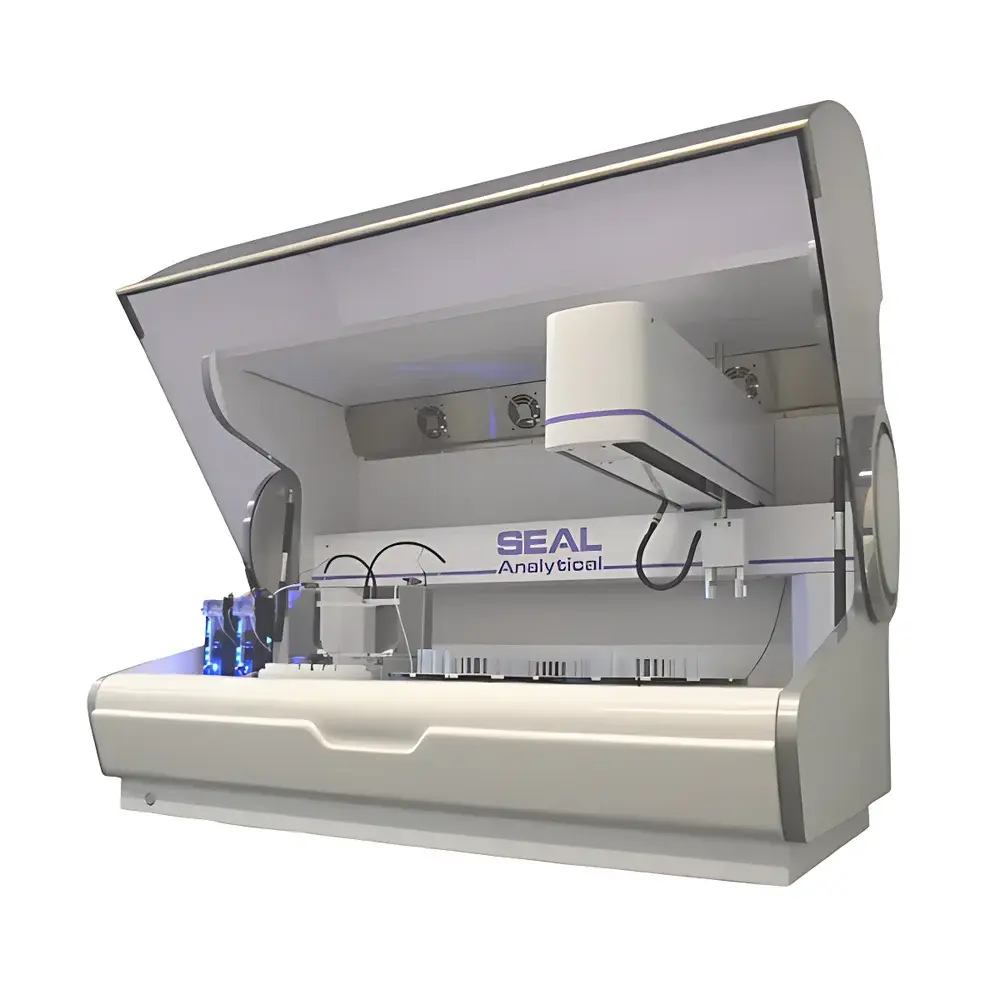
SEAL AQ700 Automated Discrete Analyzer
| Brand | SEAL |
|---|---|
| Model | AQ700 |
| Instrument Type | Discrete Analyzer |
| Wavelength Range | 350–880 nm |
| Sample Capacity | 1 rack (up to 120 positions, configurable per tray) |
| Reagent Positions | 1 rack (up to 60 positions) |
| Cuvette Pathlength | 10 mm |
| Light Source | Tungsten-halogen lamp |
| Detection Principle | Photometric Absorption Spectrophotometry |
| Automation Architecture | 4-axis robotic arm with 4 independent sample trays |
| Operational Mode | Unattended batch processing with integrated reagent cooling and temperature-controlled reaction zones |
Overview
The SEAL AQ700 Automated Discrete Analyzer is an engineered solution for high-precision, regulatory-compliant wet-chemistry analysis in environmental, agricultural, and water quality laboratories. Unlike continuous-flow or flow injection systems, the AQ700 implements true discrete analysis—each sample and reagent is handled individually in dedicated cuvettes, eliminating cross-contamination and enabling rigorous method traceability. Its photometric detection system operates across a broad visible spectrum (350–880 nm), supporting standardized colorimetric and enzymatic assays without optical recalibration between methods. The instrument employs a four-axis robotic arm architecture synchronized with four independently addressable sample trays, allowing flexible scheduling of heterogeneous sample batches—including mixed matrices (e.g., surface water, digested soil extracts, wastewater effluents) within a single run. All liquid handling steps—including aspiration, dispensing, mixing, incubation, and absorbance measurement—are fully automated and programmable via method-specific protocols compliant with ISO 15304, ASTM D129, EPA 365.4, and Standard Methods 4500 series.
Key Features
- Four independent robotic arms with coordinated motion control for simultaneous aspiration, reagent addition, and cuvette positioning—enabling sub-5-second cycle time per measurement under standard conditions.
- Modular tray system accommodating up to 120 sample positions and 60 reagent positions; trays support ANSI/SLAS-compliant microplates and custom vial racks.
- Temperature-stabilized reaction zone (±0.2 °C) for kinetic and endpoint assays requiring precise thermal control (e.g., enzymatic phosphatase assays, phenol red alkalinity titrations).
- Integrated halogen light source with stabilized output and real-time intensity monitoring; paired with a high-resolution CCD spectrophotometer delivering absorbance linearity from 0.005 to 2.5 AU (R² > 0.9999).
- Self-diagnostic fluidics module with pressure sensing, bubble detection, and automatic priming—reducing manual intervention and supporting GLP audit readiness.
- Onboard barcode scanning for sample tube identification and full chain-of-custody logging within the LIMS-integrated software environment.
Sample Compatibility & Compliance
The AQ700 accepts liquid samples in standard 12–16 mm diameter glass or polypropylene tubes (1–5 mL volume), as well as pre-diluted extracts from solid matrices (e.g., EPA Method 3050B soil digests, TCLP leachates). It supports direct analysis of turbid or particulate-laden samples through optional centrifugation integration or on-line filtration modules. All validated methods align with international regulatory frameworks: US EPA approved methods for nutrients (e.g., 353.2, 354.1), ISO 11923 for ammonia, ISO 6777 for nitrate/nitrite, and EN ISO 15681-1 for orthophosphate. Instrument design conforms to IEC 61000-6-3 (EMC) and IEC 61010-1 (safety); firmware includes 21 CFR Part 11-compliant electronic signatures, audit trail, and role-based access control.
Software & Data Management
AQ700 operation is managed through SEAL’s proprietary AQSoft™ platform—a Windows-based application built on .NET Framework with SQL Server backend. The software provides drag-and-drop method builder, real-time run monitoring with dynamic error flagging, and automatic calibration curve generation using NIST-traceable standards. Raw absorbance data, calculated concentrations, QC flags (e.g., drift correction, outlier rejection per Grubbs’ test), and instrument logs are stored in a structured relational database. Export formats include CSV, PDF analytical reports, and ASTM E1384-compliant XML for seamless LIMS or ELN integration. Audit trails record all user actions, parameter changes, and result modifications with timestamp, operator ID, and reason-for-change fields—fully satisfying GLP and GMP documentation requirements.
Applications
The AQ700 delivers validated performance across environmental and process control applications: nutrient profiling in freshwater and marine ecosystems (NH₄⁺, NO₃⁻+NO₂⁻, PO₄³⁻, SiO₂, SO₄²⁻); regulatory compliance testing for wastewater discharge permits (COD, alkalinity, chloride, cyanide, phenols); soil fertility assessment (extractable P, K, NO₃⁻); and drinking water safety screening (free chlorine, total hardness, fluoride). Its discrete architecture ensures method fidelity for complex multi-step chemistries—including diazotization, indophenol blue, and molybdenum blue reactions—where timing, temperature, and stoichiometric precision directly impact accuracy and reproducibility.
FAQ
What distinguishes discrete analysis from flow injection or segmented flow techniques?
Discrete analysis processes each sample-reagent combination in an isolated cuvette, eliminating memory effects and enabling strict adherence to classical wet-chemistry protocols—critical for accreditation bodies requiring method equivalence to manual reference procedures.
Can the AQ700 be integrated into an existing laboratory automation infrastructure?
Yes—it supports RS-232, Ethernet TCP/IP, and OPC UA communication protocols; API-driven control allows orchestration via third-party middleware (e.g., STARLIMS, LabVantage) or robotic sample handlers.
Is method validation support available for regulatory submissions?
SEAL provides IQ/OQ documentation templates, certified reference material test reports, and collaborative validation assistance aligned with ISO/IEC 17025 requirements.
How is carryover managed during high-concentration sample analysis?
The system performs triple-rinse cycles with deionized water and air-dry steps between samples; optional high-efficiency wash stations reduce carryover to <0.005% for analytes such as phosphate and ammonium.
Does the instrument support kinetic assay modes?
Yes—programmable incubation timing (1 s to 24 h), adjustable measurement intervals (0.1 s to 60 s), and real-time slope calculation enable enzyme kinetics, oxidation-reduction rate studies, and pH-dependent reaction monitoring.





