
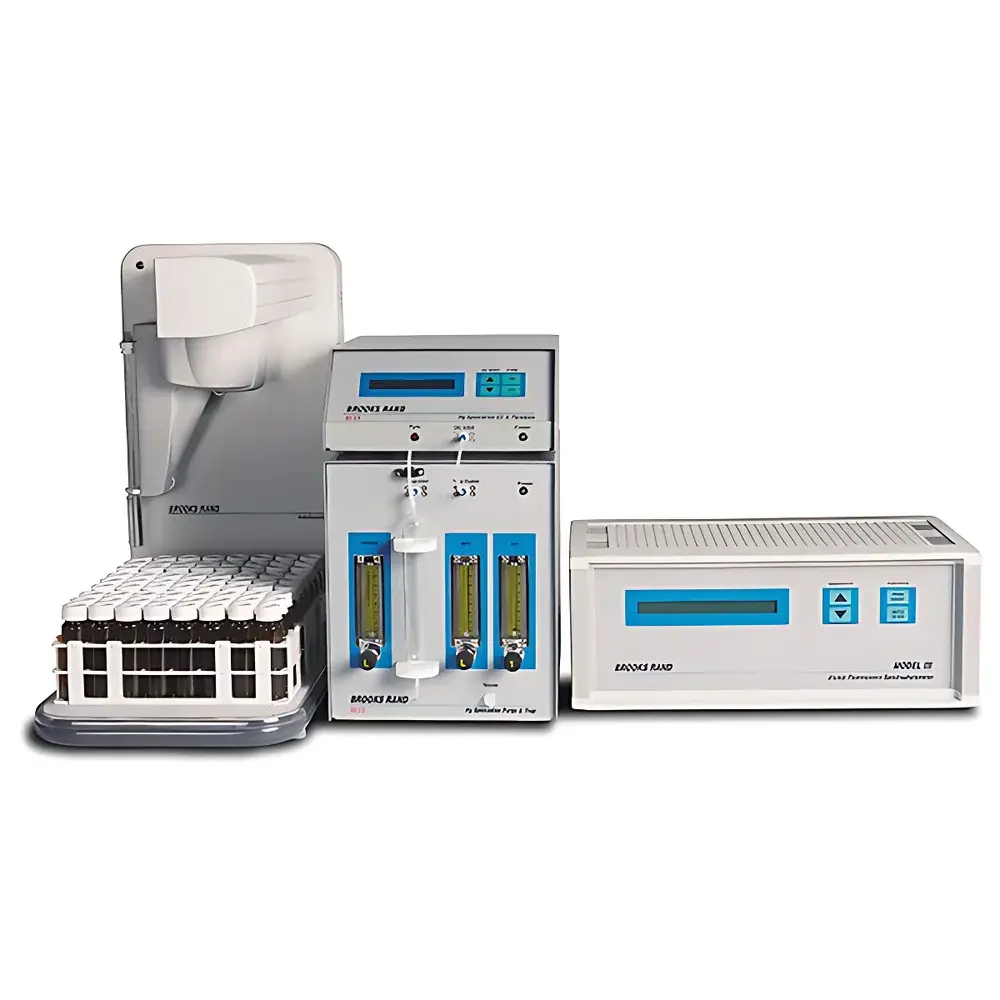
Brookfield MERX Automated Alkylmercury Analysis System
| Brand | Brooks Rand Labs |
|---|---|
| Origin | Imported |
| Instrument Type | Benchtop Laboratory Analyzer |
| Measurement Principle | Cold Vapor Atomic Fluorescence Spectrometry (CVAFS) |
| Detection Limit | Methylmercury: 0.002 ng/L |
| Ethylmercury | 0.002 ng/L |
| Repeatability | RSD ≤ 3% at 25 pg |
| Linear Range | Methylmercury and Ethylmercury: 0.0125–50 ng/L |
| Quantification Range | 0–50 ng/L |
| Sample Throughput | Up to 72 positions via integrated autosampler |
Overview
The Brookfield MERX Automated Alkylmercury Analysis System is a fully integrated, benchtop analytical platform engineered for the selective, sensitive, and regulatory-compliant quantification of methylmercury (MeHg) and ethylmercury (EtHg) in environmental and biological matrices. It employs a validated multi-step workflow based on purge-and-trap preconcentration, gas chromatographic separation, high-temperature thermal cracking (>900 °C), and detection via cold vapor atomic fluorescence spectrometry (CVAFS). This measurement principle delivers exceptional selectivity for organomercury species by eliminating interferences from inorganic mercury and matrix-derived volatile compounds. The system is purpose-built for laboratories requiring routine, high-throughput analysis under strict quality assurance frameworks—particularly those operating under national and international regulatory mandates including China’s HJ 977–2018 (water), HJ 1269–2022 (soil and sediment), GB/T 5750.6–2023 (drinking water), and U.S. EPA Method 1630.
Key Features
- Modular architecture enabling seamless integration of purge-and-trap, GC separation, thermal cracking, and CVAFS detection—optimized for method robustness and serviceability.
- Dual-channel Tenax® trap system with alternating capture cycles, ensuring uninterrupted sample processing and minimizing downtime between analyses.
- Precision electronic mass flow control for carrier and purge gases, maintaining consistent flow rates across variable matrix loads and ambient conditions.
- Ballistic infrared heating module delivering rapid, uniform thermal desorption and quantitative transfer of alkylmercury species to the GC column.
- Pre-configured, method-validated GC temperature programs—including ramped oven profiles and optimized injection parameters—to ensure baseline resolution of MeHg and EtHg peaks without co-elution artifacts.
- High-sensitivity CVAFS detector with low-noise photomultiplier tube (PMT) and calibrated mercury vapor cell, supporting sub-pg absolute detection capability.
- Intuitive 7-inch capacitive touchscreen interface with real-time signal visualization, parameter logging, and audit-ready configuration history.
Sample Compatibility & Compliance
The MERX system accommodates aqueous samples (e.g., surface water, wastewater, drinking water), solid-phase environmental specimens (soil, sediment, sludge), and biological tissues (fish muscle, liver, plankton) following standardized extraction protocols (e.g., acidic leaching, distillation, or solvent-based derivatization). All operational parameters and data handling workflows are aligned with Good Laboratory Practice (GLP) and ISO/IEC 17025 requirements. The system supports full traceability per FDA 21 CFR Part 11 through electronic signatures, user access controls, and immutable audit trails for instrument settings, calibration records, and raw spectral data. It has undergone formal method validation per HJ 977–2018, HJ 1269–2022, GB/T 5750.6–2023, and EPA 1630—demonstrating compliance with recovery criteria (85–115%), precision limits (RSD ≤ 3%), and linearity (r² ≥ 0.999) across the 0.0125–50 ng/L range.
Software & Data Management
Instrument control, data acquisition, and reporting are managed via MERX Control Suite—a Windows-based application designed for regulated environments. The software features automated calibration curve generation (linear and quadratic), internal standard correction (e.g., isotopically labeled Me¹⁹⁹Hg), peak integration with retention time locking, and customizable report templates compliant with CNAS and CMA accreditation formats. All raw chromatograms, fluorescence decay curves, and metadata are stored in vendor-neutral .csv and .xml formats. Audit trail functionality logs every user action—including method edits, calibration updates, and result overrides—with timestamps and operator IDs. Data export supports LIMS integration via ASTM E1384-compliant interfaces.
Applications
- Regulatory monitoring of alkylmercury in municipal drinking water supplies and source waters per GB/T 5750.6–2023 and EPA 1630.
- Compliance testing of wastewater effluents and industrial discharges under national water quality standards.
- Ecotoxicological assessment of MeHg bioaccumulation in fish tissue, bivalves, and aquatic food webs.
- Site characterization and risk assessment of contaminated sediments and floodplain soils per HJ 1269–2022.
- Method development and reference material certification in national metrology institutes and accredited environmental testing labs.
FAQ
What regulatory methods is the MERX system validated for?
The MERX system is formally validated for HJ 977–2018 (water), HJ 1269–2022 (soil/sediment), GB/T 5750.6–2023 (drinking water), and U.S. EPA Method 1630.
Does the system support unattended operation?
Yes—the integrated 72-position autosampler, dual-trap architecture, and automated GC/CVAFS sequence enable overnight and weekend batch analysis with minimal manual intervention.
How is carryover minimized during high-concentration sample analysis?
The system incorporates dedicated bake-out cycles for Tenax traps and GC liner, programmable post-run column purging, and real-time blank monitoring to detect and flag potential carryover events.
Is method transfer possible between MERX instruments?
All GC methods, calibration files, and instrument configurations are exportable and reproducible across MERX units, facilitating harmonized multi-lab studies and networked environmental monitoring programs.
What maintenance intervals are recommended for routine operation?
Standard maintenance includes quarterly PM checks (trap integrity, GC inlet cleanliness, lamp alignment), annual PM (detector PMT calibration, IR heater calibration), and replacement of consumables (Tenax traps, GC columns, quartz cells) per usage logs or performance verification results.





