
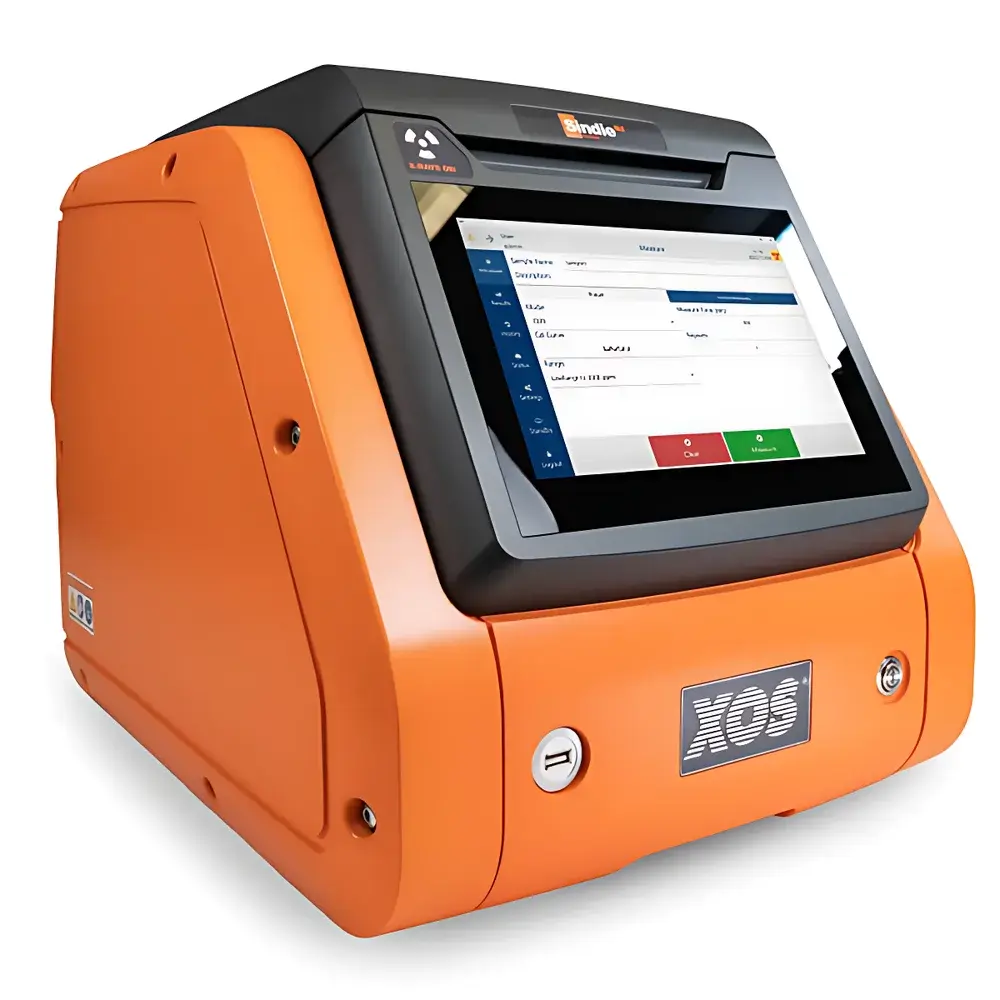
XOS Sindie R3 Benchtop Monochromatic Wavelength-Dispersive X-Ray Fluorescence (MWD-XRF) Sulfur Analyzer
| Brand | XOS |
|---|---|
| Origin | Imported |
| Manufacturer Type | Authorized Distributor |
| Instrument Type | Benchtop |
| Excitation Source | 75 W Low-Power X-ray Tube |
| Analyte Element | Sulfur (S) |
| Detection Principle | Monochromatic Wavelength-Dispersive XRF |
| Compliance | ASTM D7039, ASTM D2622, NB/SH/T 0842, ISO 20884, GB/T 11140 |
| LOD | 0.18 mg/kg @ 300 s |
| Quantification Range | 0.18 mg/kg – 10 wt% (dual-range mode) |
| Sample Volume | ≤10 mL |
| Sample Cell | Accucell™ with Mylar® film |
| Measurement Time | 10–999 s (user-defined) |
| Data Storage | >50,000 test records |
| Display | 10-inch capacitive color touchscreen |
| Moving Parts | None in analyzer core |
| Calibration | Multi-curve storage, infrequent recalibration required |
Overview
The XOS Sindie R3 is a benchtop monochromatic wavelength-dispersive X-ray fluorescence (MWD-XRF) sulfur analyzer engineered for high-precision, interference-free quantification of total sulfur in liquid hydrocarbon fuels and lubricants. Unlike conventional energy-dispersive (ED-XRF) or polychromatic WDXRF systems, the Sindie R3 employs a dual curved-crystal optical architecture to generate and isolate a single, highly intense monochromatic excitation beam—specifically tuned to the K-absorption edge of sulfur (λ ≈ 0.537 nm). This selective excitation minimizes Bremsstrahlung background and matrix-induced spectral overlap, resulting in exceptional signal-to-noise ratios and sub-part-per-trillion (ppt) effective detection limits. The instrument operates on the fundamental principle of secondary X-ray emission: the monochromatic primary beam ejects K-shell electrons from sulfur atoms in the sample; subsequent electron relaxation emits characteristic S Kα fluorescence (0.5373 nm), which is collected, filtered, and measured by a high-resolution gas-proportional detector. No combustion, no carrier gases, no acid digestion, and no sample derivatization are required—ensuring full sample integrity and eliminating operational hazards associated with high-temperature or oxidative methods.
Key Features
- Monochromatic excitation using dual hyperbolic curved crystals for ultra-low background and superior spectral selectivity
- Detection limit of 0.18 mg/kg (ppb) sulfur at 300-second measurement time—validated per ASTM D7039 precision requirements
- Two-tier quantification range: 0.18 mg/kg – 3,000 mg/kg (ppb–ppm) and 3,000 mg/kg – 10 wt% (ppm–wt%), enabling seamless analysis from ultra-low-sulfur diesel (ULSD) to high-sulfur residuals
- Zero-maintenance optical path: no moving parts within the analyzer core; no goniometer, no slits, no mechanical choppers
- Integrated 10-inch industrial-grade capacitive touchscreen interface with intuitive workflow navigation and real-time diagnostics
- Onboard data management: secure local storage of >50,000 test records including spectra, calibration logs, operator ID, timestamp, and environmental metadata
- Accucell™ sample cup compatibility with standardized 4-mil Mylar® film—enabling rapid, contamination-free loading and disposal
- Plug-and-play operation: requires only standard 100–240 VAC power; no compressed air, helium, or external cooling
- Advanced self-diagnostic engine with granular error logging, component health monitoring, and guided troubleshooting protocols
Sample Compatibility & Compliance
The Sindie R3 is validated for direct analysis of transparent to mildly turbid liquid petroleum products without dilution or pretreatment. Compatible matrices include gasoline (including ethanol-blended E10/E15), diesel fuel (EN 590, ASTM D975), jet fuel (Jet A-1, JP-8), kerosene, naphtha, biodiesel (B100), biodiesel blends (B5–B20), crude oil (stabilized), vacuum gas oil, lubricating base oils, and residual fuels. All measurements comply with internationally recognized regulatory and quality control standards: ASTM D7039-15a(2020), ASTM D2622-21, NB/SH/T 0842-2017, ISO 20884:2019, and GB/T 11140-2008. The system supports GLP/GMP-aligned audit trails—including electronic signatures, user access levels, and immutable method versioning—making it suitable for laboratories operating under FDA 21 CFR Part 11, ISO/IEC 17025, or API RP 957 compliance frameworks.
Software & Data Management
The embedded firmware provides full method development, calibration curve generation (linear, quadratic, or multi-point non-linear), and automated QC checks (e.g., drift correction via reference standards, blank subtraction, peak shape validation). Raw spectral data (channel intensity vs. pulse height) is stored alongside processed results. Optional XOS Connect software enables remote instrument monitoring, centralized database synchronization, CSV/PDF report export (with customizable templates), and integration with LIMS via ASTM E1384-compliant interfaces. All data files include embedded metadata: instrument serial number, firmware revision, calibration certificate ID, ambient temperature/humidity (via internal sensors), and operator authentication token.
Applications
The Sindie R3 serves as a primary or confirmatory sulfur testing platform across refinery process control labs, finished product quality assurance departments, independent testing laboratories (ILAC-accredited), and regulatory enforcement agencies. Typical use cases include: real-time monitoring of hydrotreater effluent streams; batch release testing of ULSD (<10 mg/kg) and marine gasoil (IMO 2020-compliant <0.5 wt%); verification of sulfur removal efficiency in FCC feed pretreatment; certification of biofuel blends for EN 14214 or ASTM D6751 compliance; and forensic analysis of adulterated fuels. Its robustness, speed (<90 s typical for routine ULSD), and minimal consumables make it ideal for high-throughput environments where reliability and traceability are non-negotiable.
FAQ
Does the Sindie R3 require daily calibration or frequent standardization?
No. Due to its monochromatic excitation geometry and stable crystal optics, the instrument maintains long-term calibration stability. Routine verification using certified reference materials (CRMs) is recommended every 24 hours or per ASTM D7039 Section 8.1; full recalibration is typically required only after major maintenance or firmware updates.
Can the Sindie R3 analyze viscous or high-boiling samples such as heavy fuel oil or bitumen?
Yes—provided the sample is homogenized and loaded into the Accucell™ cup with intact Mylar® film. For samples with significant particulate content or volatility, optional pre-filtration or temperature-controlled sample handling modules may be deployed.
Is the instrument compatible with automated sample introduction?
Yes. An optional XYZ robotic autosampler (XOS AutoLoad R3) supports unattended analysis of up to 48 samples, with integrated barcode reading and cup-level sensing.
What safety certifications does the Sindie R3 hold?
It complies with IEC 61010-1 (Safety Requirements for Electrical Equipment for Measurement, Control, and Laboratory Use) and carries CE marking for EMC and radiation safety (EN 62471, Class 1 LED-equivalent hazard level).
How is data integrity ensured during power interruption or system crash?
All measurements are written to non-volatile flash memory in atomic transactions. In the event of unexpected shutdown, the system resumes from the last completed measurement and preserves all prior records without corruption.
Related Products





