
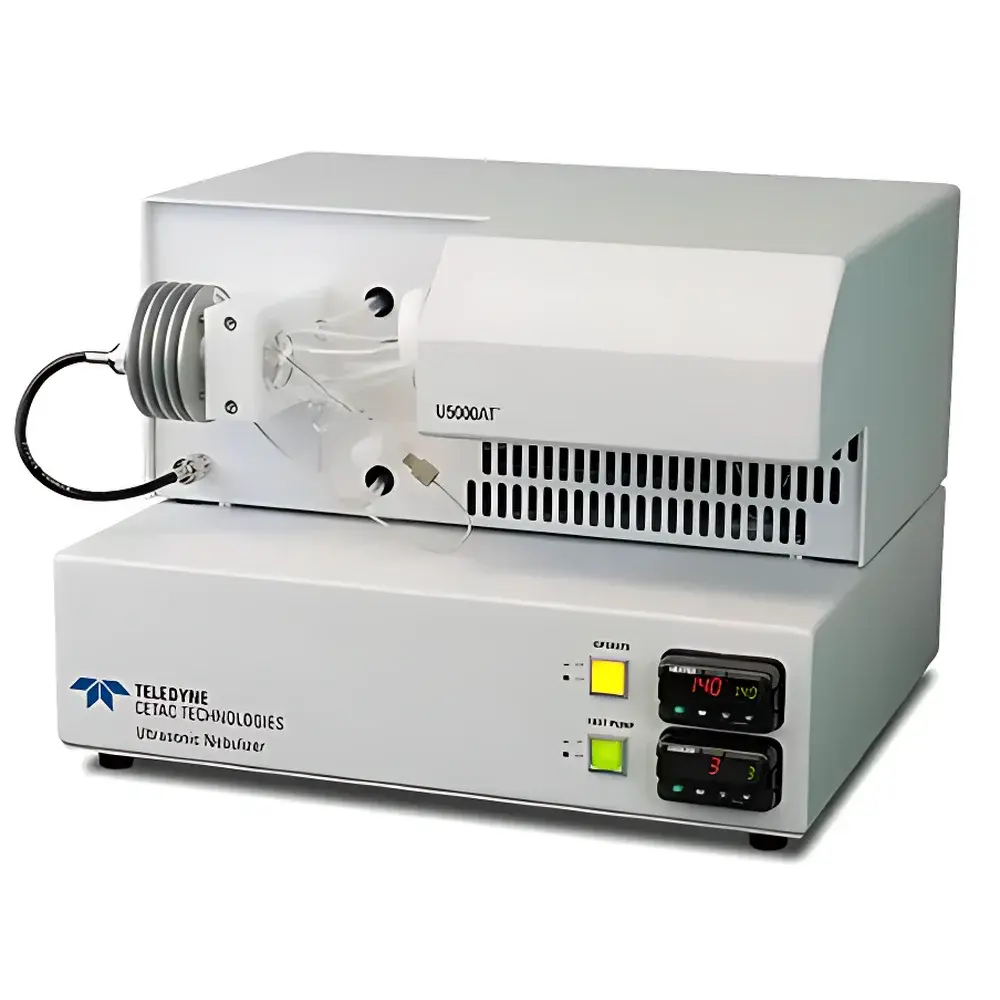
Teledyne CETAC U5000AT+ Ultrasonic Nebulization System
| Brand | CETAC |
|---|---|
| Origin | Imported |
| Manufacturer Type | Authorized Distributor |
| Model | U5000AT+ |
| Instrument Type | Multifunctional Autosampler for ICP-OES and ICP-MS |
| Nebulization Principle | High-Efficiency Ultrasonic Nebulization (USN) |
| Detection Limit Improvement | 5–25× vs. Conventional Pneumatic Nebulizers |
| Compatibility | Integrated with Teledyne CETAC Apex Q, Apex HF, and standard ICP/OES/MS sample introduction systems |
| Energy Control | Closed-loop automatic RF power tuning for real-time droplet size stabilization |
Overview
The Teledyne CETAC U5000AT+ Ultrasonic Nebulization System is a high-performance, modular sample introduction solution engineered specifically for inductively coupled plasma optical emission spectrometry (ICP-OES) and mass spectrometry (ICP-MS). Unlike conventional pneumatic nebulizers—whose aerosol generation relies on gas shear forces—the U5000AT+ employs high-frequency ultrasonic transduction (1.7 MHz) to atomize liquid samples into a fine, monodisperse aerosol with median droplet diameters typically 80% vs. <5% for standard concentric nebulizers), reduces oxide-based polyatomic interferences, lowers background signal intensity, and enhances elemental sensitivity across the entire mass range. As a result, detection limits for trace and ultra-trace elements—including As, Se, Cd, Pb, and rare earth elements—are improved by a factor of 5 to 25 relative to conventional nebulization, enabling routine analysis of sub-pg/mL concentrations without cryogenic desolvation or microflow systems.
Key Features
- Modular architecture designed for seamless integration with Teledyne CETAC Apex Q and Apex HF desolvation modules, as well as third-party ICP interfaces compliant with ISO 17025-compliant sample introduction standards.
- Real-time closed-loop ultrasonic energy regulation: an embedded feedback circuit continuously monitors acoustic impedance at the nebulizer surface and dynamically adjusts RF drive power to maintain optimal cavitation conditions across varying sample matrices (e.g., 0–20% v/v organic solvents, 0.1–5% HNO₃, saline solutions up to 0.9% NaCl).
- Integrated peristaltic autosampler interface supporting multistep protocols—including standard calibration, QC check, blank wash, and multi-acid digestion matrix handling—fully programmable via CETAC’s ASX-560 control firmware.
- Corrosion-resistant titanium alloy nebulizer chamber and fused-silica capillary delivery system rated for continuous operation with aggressive acids (HF not recommended) and compatible with USP / elemental impurities testing workflows.
- No moving parts in the aerosol generation zone; maintenance intervals exceed 12 months under GLP-compliant daily use, minimizing downtime and operator intervention.
Sample Compatibility & Compliance
The U5000AT+ accommodates aqueous, diluted acid-digested, and low-organic-content samples (≤10% methanol, ethanol, or isopropanol). It is validated for use with EPA Methods 200.8 and 6020B, ASTM D5191–22 (trace metals in gasoline), and ISO 14851 (aquatic biodegradability testing requiring metal spike recovery). All firmware and hardware configurations comply with FDA 21 CFR Part 11 requirements for electronic records and signatures when deployed with CETAC’s ASX-560 software suite. System-level validation documentation—including IQ/OQ/PQ templates, uncertainty budgets per EURACHEM/CITAC Guide, and interference checklists for ClO⁺, ArO⁺, and doubly charged rare earth ions—is provided with each shipment.
Software & Data Management
Control and synchronization are managed through the CETAC ASX-560 Autosampler Software, which supports bidirectional communication with Thermo Fisher iCAP, Agilent 7900/8900, PerkinElmer NexION, and Shimadzu ICPE-9800 platforms. The software enables method-driven sequence definition with audit-trail logging (including timestamped parameter changes, nebulizer energy output history, and per-sample transport efficiency estimates). Raw nebulization performance metrics—including acoustic power consumption, temperature drift compensation values, and pulse duty cycle—are exportable in CSV format for trending analysis and laboratory quality assurance reporting.
Applications
- Routine environmental monitoring of drinking water, wastewater, and soil leachates per EPA regulatory limits.
- Pharmaceutical elemental impurities screening in APIs and excipients aligned with ICH Q3D and USP /.
- Geochemical exploration requiring rapid multi-element analysis of rock digests with minimal dilution.
- Nuclear fuel cycle materials analysis where low-background CeO⁺/Ce⁺ ratios and high Ba⁺/BaO⁺ selectivity are critical.
- Academic and contract research laboratories performing method development for challenging matrices such as biological fluids, high-salinity brines, and nanoparticle suspensions.
FAQ
Is the U5000AT+ compatible with non-CETAC desolvation systems?
Yes—mechanical and electrical interface specifications (including ¼”-28 UNF mounting, 0–10 V analog control input, and RS-232 command set) conform to ASTM E2532-19 for universal ICP sample introduction interoperability.
What is the typical aerosol output stability over an 8-hour analytical run?
Under constant temperature (22 ± 1°C) and humidity (45 ± 5% RH) conditions, RSD of signal intensity remains ≤2.1% for internal standard (Y or In) over 480 minutes, as verified per ISO/IEC 17025:2017 Clause 7.7.2.
Does the system require external cooling or compressed gas?
No—operation is self-contained; only 110/230 V AC power and deionized water coolant (flow rate: 1.2 L/min) are required. No argon or nitrogen supply is needed for nebulization.
Can the U5000AT+ be used for hydride-generating elements (e.g., As, Sb, Bi)?
Yes—when coupled with CETAC’s HGX-200 hydride generation module, the system achieves sub-pg absolute detection limits for hydride-forming elements without compromising ICP-MS plasma stability.





