
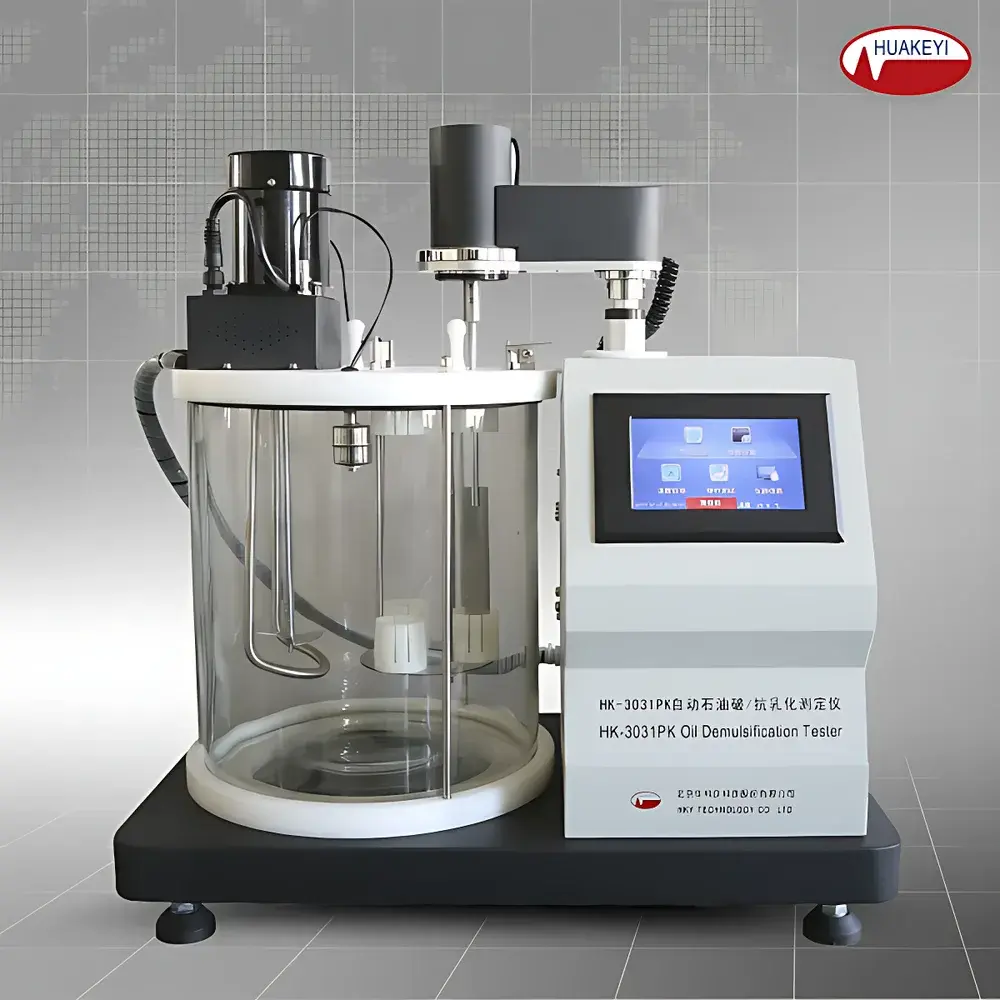
Huake Instrument HK-3031PK Automatic Petroleum Demulsibility Tester
| Brand | Huake Instrument |
|---|---|
| Origin | Beijing, China |
| Manufacturer Type | Authorized Distributor |
| Origin Category | Domestic (China-made) |
| Model | HK-3031PK |
| Pricing | Upon Request |
Overview
The Huake Instrument HK-3031PK Automatic Petroleum Demulsibility Tester is a precision-engineered laboratory instrument designed to quantitatively assess the water separation behavior of petroleum-based oils and synthetic lubricants under standardized thermal and mechanical agitation conditions. It operates in strict accordance with two key national standards of the People’s Republic of China: GB/T 7305–2003 “Determination of Water Separability of Petroleum and Synthetic Fluids” and GB/T 7605–2008 “Determination of Demulsibility of In-Service Turbine Oils”. The test principle follows the classical demulsibility protocol—where a defined volume of oil and distilled water is mixed at a specified temperature and rotational speed, then allowed to separate; the time required for the formation of a distinct 3 mL interfacial emulsion layer (or the time to reach a specified separation threshold) is recorded as the demulsibility value. This measurement is critical for evaluating the long-term stability of turbine oils, hydraulic fluids, and gear oils in power generation, petrochemical processing, and marine propulsion systems where water ingress poses risks to equipment reliability and corrosion control.
Key Features
- High-resolution 800 × 480 color LCD touchscreen interface with dual-language (English/Chinese) menu navigation for intuitive operation and real-time status monitoring.
- Full automation of the entire test sequence—including sample loading confirmation, temperature ramping, timed agitation at 1500 ± 15 rpm, phase separation observation, and endpoint detection—eliminating manual timing errors and operator dependency.
- PID-based digital temperature control system with high-sensitivity Pt100 RTD sensors, delivering stable thermal regulation within ±0.5 °C across the full operating range (ambient to 100 °C).
- Triple independent test stations enable concurrent analysis of up to three samples under identical or individually configured conditions—enhancing throughput for QC laboratories and routine maintenance testing.
- Integrated optical liquid-level sensing with automatic dry-run protection and audible/visual alarm activation—ensuring safe operation during unattended runs and preventing heater damage.
- Dual communication interfaces: standard RJ45 Ethernet port for networked data logging and remote firmware updates; USB 2.0 port for direct export of test reports (CSV/Excel-compatible) and configuration backup.
- Precise real-time clock module synchronized to millisecond resolution, supporting GLP-compliant audit trails when paired with external LIMS integration.
Sample Compatibility & Compliance
The HK-3031PK is validated for use with mineral-based turbine oils, synthetic ester and polyol ester lubricants, hydraulic fluids (ISO HM/HV), and industrial gear oils meeting ASTM D975, D2880, and D4378 specifications. Its design accommodates standard 100 mL calibrated glass graduated cylinders (supplied), conforming to the dimensional and material requirements outlined in GB/T 7305–2003 Annex A. While primarily aligned with Chinese national standards, its operational parameters are functionally equivalent to ASTM D1401 (“Standard Test Method for Water Separability of Petroleum Oils”) and ISO 6614 (“Petroleum products — Determination of demulsibility”). The instrument supports compliance workflows for ISO/IEC 17025-accredited laboratories, with configurable user access levels, electronic signature support, and optional audit-log generation for FDA 21 CFR Part 11 readiness when deployed in regulated GMP environments.
Software & Data Management
The embedded firmware provides on-device test method storage, customizable parameter templates (temperature setpoint, agitation duration, pass/fail criteria), and timestamped result archiving. All test records include metadata such as operator ID, sample ID, ambient conditions, calibration verification status, and sensor drift logs. Data export via USB yields structured CSV files containing raw time-series separation readings, final demulsibility values (in minutes), and system diagnostic flags. Optional PC-based software (available upon request) enables trend analysis, SPC charting, report generation per ISO 17025 clause 7.8.2, and secure database synchronization with enterprise LIMS platforms via TCP/IP.
Applications
- Routine quality control of new and in-service turbine oils in power plants and combined-cycle facilities.
- Formulation development and additive performance screening for demulsifier packages in lubricant R&D labs.
- Condition monitoring of hydraulic systems in offshore drilling rigs and refinery process units.
- Third-party certification testing for commercial lubricant suppliers seeking API, OEM, or DIN approvals.
- Academic research on interfacial rheology and surfactant-mediated oil-water destabilization mechanisms.
FAQ
What standards does the HK-3031PK comply with?
It is fully compliant with GB/T 7305–2003 and GB/T 7605–2008; its methodology is technically aligned with ASTM D1401 and ISO 6614.
Can the instrument operate at temperatures above 82 °C?
Yes—the maximum setpoint is 100 °C; optional heat-resistant shielding is recommended for prolonged operation above 85 °C to ensure operator safety and enclosure integrity.
Is multi-user access control supported?
The device supports role-based login (administrator/operator/auditor) with password protection and configurable permission tiers for method editing, data deletion, and system configuration.
How is calibration verified?
Built-in self-test routines validate temperature sensor linearity and timer accuracy prior to each test cycle; NIST-traceable reference thermometers and stopwatch calibrators are recommended for periodic external verification.
Does it meet cybersecurity requirements for lab network integration?
Firmware v2.3+ includes TLS 1.2 encryption for HTTP/S communications, MAC address filtering, and disabled default credentials—supporting alignment with IEC 62443-3-3 for industrial control system security.
Related Products






