
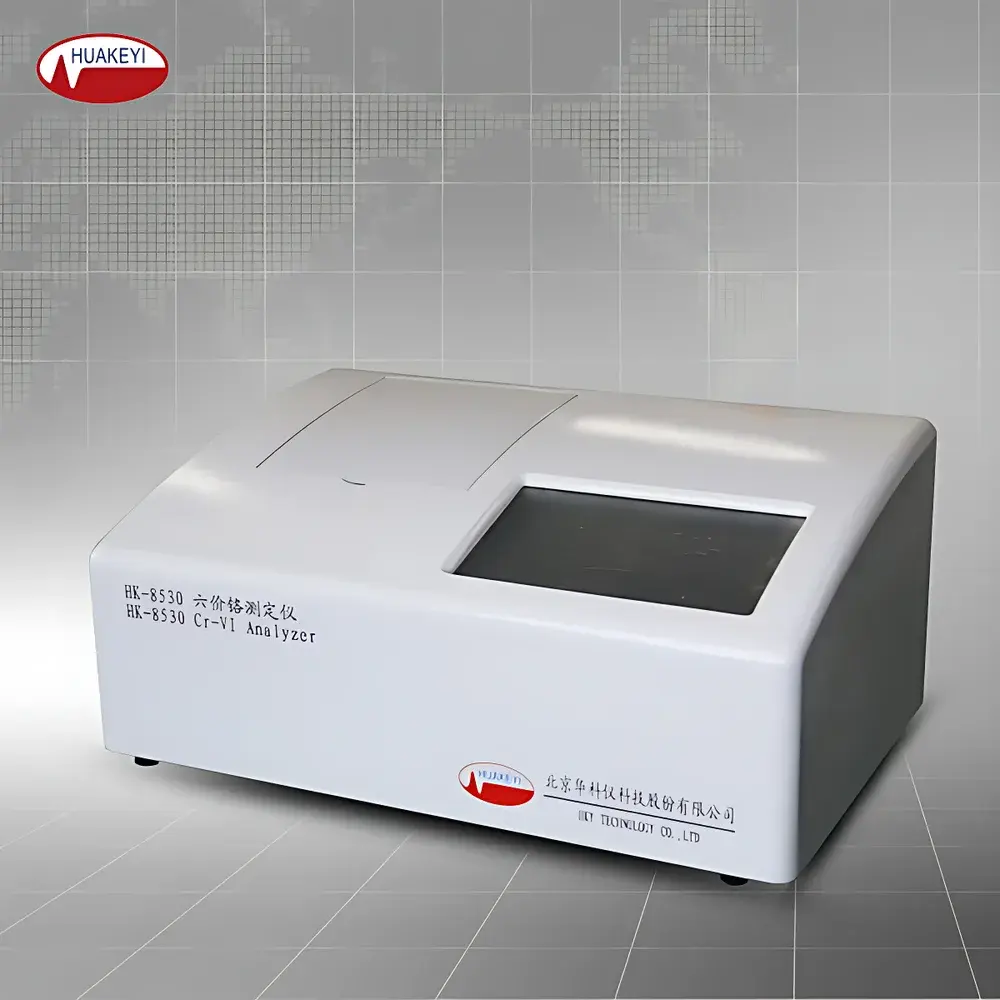
Huakeyi HK-8530 Hexavalent Chromium Analyzer
| Brand | Huakeyi |
|---|---|
| Origin | Beijing, China |
| Manufacturer Type | Authorized Distributor |
| Country of Origin | China |
| Model | HK-8530 |
| Instrument Type | Benchtop Laboratory Analyzer |
| Detection Principle | Spectrophotometry (Diphenylcarbazide Method) |
| Target Analyte | Hexavalent Chromium (Cr(VI)) |
| Analysis Time | 20 min |
| Accuracy | ±5% of reading |
| Resolution | 0.001 mg/L |
| Detection Range | 0–50 mg/L (extendable to 60 mg/L via dilution) |
| LOD | 0.001 mg/L |
| Display | 7-inch TFT LCD touchscreen (Chinese/English switchable) |
| Temperature Control | Integrated thermostatic system |
| Light Source | Imported monochromatic LED (540 nm) |
| Calibration Options | Single-point, two-point, or multi-point |
| Data Storage | ≥100,000 records (measurements, calibrations, system logs) |
| Interface | USB port for data export |
| Power Supply | AC 100–240 V, 50–60 Hz |
| Power Consumption | 10 W |
| Dimensions | 390 × 248 × 175 mm |
| Weight | 5 kg |
Overview
The Huakeyi HK-8530 Hexavalent Chromium Analyzer is a benchtop spectrophotometric instrument engineered for precise, routine quantification of hexavalent chromium (Cr(VI)) in aqueous samples. It implements the standardized diphenylcarbazide (DPC) colorimetric method per GB/T 7467–1987 — the Chinese national standard equivalent to EPA Method 7196A and ISO 11084:1994. In acidic medium, Cr(VI) reacts stoichiometrically with DPC to form a stable, intensely colored violet complex with maximum absorbance at 540 nm. The analyzer measures absorbance using a temperature-stabilized optical path and high-purity monochromatic LED illumination, enabling trace-level detection down to 0.001 mg/L. Designed for regulatory compliance and laboratory reproducibility, the HK-8530 supports quality assurance workflows in drinking water treatment, wastewater discharge monitoring, environmental field laboratories, industrial effluent control, and academic research where Cr(VI) speciation and quantification are mandated under national and regional environmental statutes.
Key Features
- 7-inch capacitive touchscreen interface with bilingual (English/Chinese) language support and intuitive icon-driven navigation.
- Integrated Peltier-based thermostatic system maintains consistent cuvette compartment temperature, minimizing thermal drift and improving inter-day measurement repeatability.
- High-stability monochromatic LED light source centered at 540 nm ensures narrow spectral bandwidth (10,000 h).
- Patented optical alignment architecture with dual-beam referencing eliminates baseline drift and enhances long-term photometric stability.
- Flexible calibration protocols: single-point zero/span, two-point linear, or multi-point non-linear calibration — configurable to match matrix-specific performance requirements.
- Automatic endpoint detection (“Auto-Stabilize”) identifies absorbance equilibrium in real time, reducing operator dependency and standardizing reaction timing across analysts.
- Onboard dilution calculation engine enables automatic concentration correction when sample pre-dilution is applied — critical for compliance with wide-range reporting requirements (e.g., 0–60 mg/L).
- USB 2.0 interface supports direct export of CSV-formatted datasets (including timestamps, calibration IDs, operator tags, and raw absorbance values) for LIMS integration or audit-ready documentation.
Sample Compatibility & Compliance
The HK-8530 is validated for use with clarified, filtered, or centrifuged water matrices including potable water, surface water, groundwater, municipal and industrial wastewater, and process rinse streams. It accommodates standard 10-mm pathlength glass or quartz cuvettes and is compatible with common pretreatment methods such as pH adjustment (to pH 1.5–2.0), filtration (0.45 µm), and masking of interfering ions (e.g., Fe³⁺, Mo⁶⁺) via controlled reagent addition. The instrument’s measurement protocol aligns with key regulatory frameworks: GB/T 7467–1987 (China), EPA Method 7196A (U.S.), ISO 11084:1994 (International), and ASTM D5281–18 (Standard Test Method for Hexavalent Chromium in Water by Colorimetry). While not inherently 21 CFR Part 11 compliant, its audit-trail-capable data logging (with user ID, timestamp, and action type) supports GLP/GMP-aligned documentation practices when deployed within validated laboratory SOPs.
Software & Data Management
Firmware v3.2+ provides embedded data governance features including user-level access control (admin/operator modes), immutable measurement logs with electronic signatures, and full traceability of calibration history (date, standard lot number, concentration, deviation). Stored records include raw absorbance, calculated concentration, dilution factor, temperature at measurement, and operator ID. All data are retained in non-volatile memory with battery-backed real-time clock synchronization. Exported files contain ISO 8601 timestamps and comply with minimum metadata requirements for environmental data submission portals (e.g., China’s National Environmental Monitoring Platform, U.S. NetDMR). No cloud connectivity or remote firmware updates are implemented — ensuring data sovereignty and network isolation per IT security policies common in regulated laboratories.
Applications
- Drinking water utilities verifying Cr(VI) compliance against WHO (0.05 mg/L), EU (0.05 mg/L), and China’s GB 5749–2022 (0.05 mg/L) limits.
- Wastewater treatment plants conducting daily discharge monitoring per local environmental protection bureau mandates.
- Electroplating, leather tanning, and pigment manufacturing facilities performing internal QA/QC on rinse waters and process streams.
- Environmental testing laboratories supporting third-party certification (e.g., CMA, CNAS) and contract analysis under ISO/IEC 17025.
- University and government research labs studying Cr(VI) redox behavior, adsorption kinetics, or remediation efficiency of novel sorbents.
FAQ
What is the certified detection limit for Cr(VI) using the HK-8530?
The instrument achieves a method detection limit (MDL) of 0.001 mg/L under standard operating conditions (n = 7 replicates, signal-to-noise ratio ≥3), verified per EPA Guidance for Determining LOD/MDL.
Can the HK-8530 measure total chromium, or only hexavalent chromium?
The HK-8530 is specifically optimized for Cr(VI) quantification via selective DPC chemistry. Total chromium requires prior oxidation (e.g., KMnO₄ digestion) and is outside the scope of this analyzer’s design and validation.
Is the instrument suitable for field deployment or strictly for lab use?
It is a benchtop unit requiring stable AC power, level placement, and ambient temperature control (15–30°C); not designed for portable or battery-operated operation.
Does the HK-8530 support external printer output or network printing?
No. Data export is limited to USB storage devices; no Ethernet, Wi-Fi, or direct printer interface is provided.
How frequently must the optical system be recalibrated?
Optical alignment is factory-set and does not require user recalibration. Annual verification using NIST-traceable neutral density filters is recommended for ISO/IEC 17025 accreditation maintenance.
Related Products







