
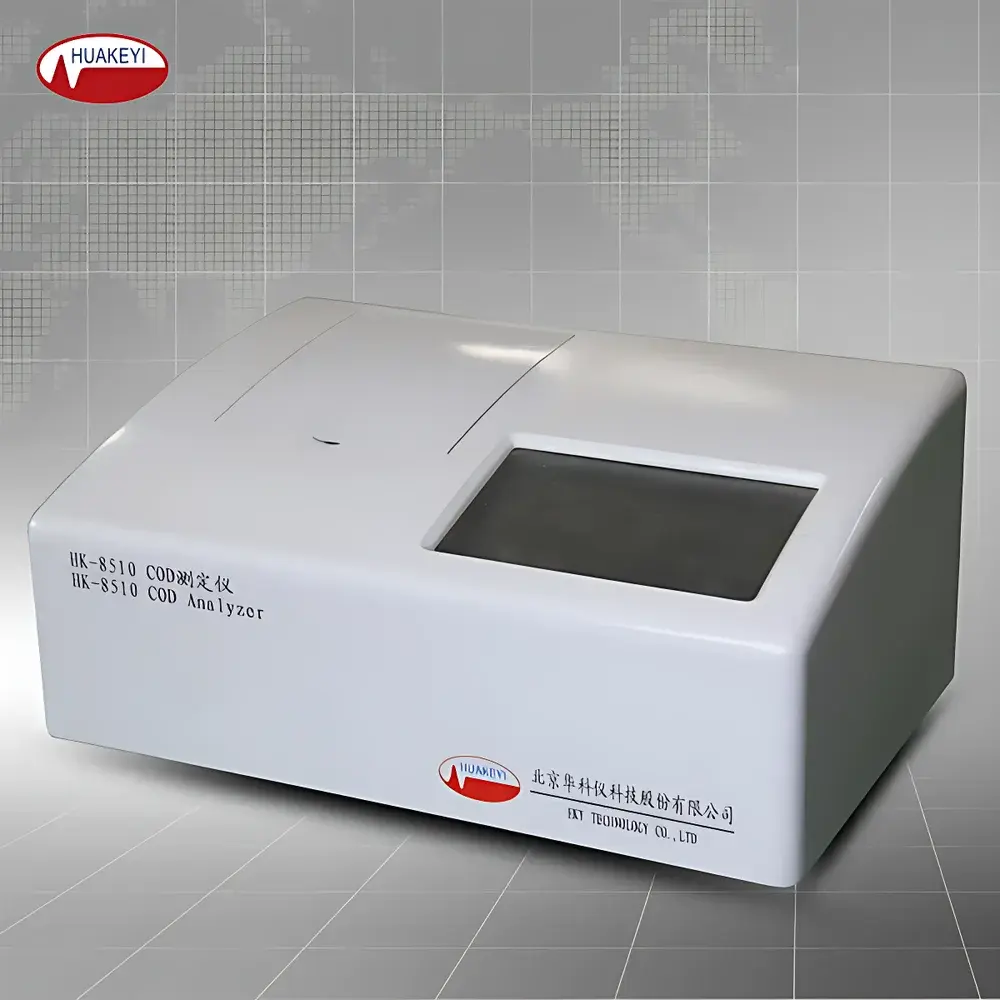
Huakeyi HK-8510 Chemical Oxygen Demand (COD) Analyzer
| Brand | Huakeyi |
|---|---|
| Origin | Beijing, China |
| Model | HK-8510 |
| Instrument Type | Laboratory Benchtop Analyzer |
| Measurement Principle | Rapid Digestion Spectrophotometry (in accordance with HJ/T 399–2007) |
| Wavelength | 600 nm |
| Measurement Range | 100–1000 mg/L (extendable to 10,000 mg/L via on-board dilution) |
| Accuracy | ±5% for COD > 50 mg/L |
| Repeatability | ±5% |
| Detection Limit | 0.1 mg/L |
| Analysis Time | 20 minutes per batch |
| Batch Capacity | 16 samples |
| Display | 7-inch capacitive touchscreen (Chinese/English switchable) |
| Data Storage | Up to 100,000 records (measurements, calibrations, system logs) |
| Interface | USB 2.0 for data export |
| Power Supply | AC 100–240 V, 50–60 Hz |
| Power Consumption | 10 W |
| Dimensions | 390 × 248 × 175 mm |
| Weight | 5 kg |
Overview
The Huakeyi HK-8510 Chemical Oxygen Demand (COD) Analyzer is a laboratory-grade benchtop instrument engineered for precise, reproducible quantification of chemical oxygen demand in aqueous environmental samples. It implements rapid digestion spectrophotometry—fully compliant with Chinese Environmental Protection Standard HJ/T 399–2007—which employs potassium dichromate under acidic, high-temperature conditions to oxidize reducible substances (primarily organic compounds, nitrites, sulfides, and ferrous ions) in water. The resulting Cr3+ concentration is photometrically measured at 600 nm, enabling direct correlation to COD mass concentration (mg O2/L). Designed for routine analysis in municipal wastewater treatment labs, industrial effluent monitoring centers, and environmental testing institutions, the HK-8510 delivers trace-level sensitivity (0.1 mg/L LOD), high throughput (16-sample batch processing), and robust thermal regulation to ensure inter-day measurement consistency across variable ambient conditions.
Key Features
- 7-inch high-resolution capacitive touchscreen interface with dual-language support (English/Chinese), enabling intuitive navigation without external peripherals.
- Integrated thermostatic digestion module maintains precise reaction temperature throughout the 20-minute digestion cycle, minimizing drift caused by ambient fluctuations.
- High-stability monochromatic LED light source at 600 nm ensures narrow spectral bandwidth, low thermal drift, and extended operational lifetime compared to tungsten-halogen lamps.
- Multi-point calibration capability (1-, 2-, or multi-point) with user-selectable standard concentrations, supporting method-specific accuracy optimization across low- and high-range applications.
- Ratio-based photometric compensation algorithm corrects for cuvette path-length variation and minor optical contamination, significantly enhancing long-term baseline stability.
- On-board dilution calculation engine automatically adjusts final reported values when manual sample dilution is applied—enabling seamless extension of the effective range up to 10,000 mg/L without recalibration.
- Auto-stabilization detection identifies optimal photometric equilibrium prior to reading, reducing operator dependency during calibration and sample measurement.
- Comprehensive internal memory stores up to 100,000 timestamped records—including raw absorbance values, calculated COD results, calibration history, and system event logs—for full traceability and audit readiness.
Sample Compatibility & Compliance
The HK-8510 is validated for use with surface water, groundwater, domestic sewage, and industrial wastewater matrices. Its digestion protocol aligns with the oxidation efficiency requirements of HJ/T 399–2007, which specifies closed-vessel reflux conditions using Ag2SO4 catalyst and HgSO4 chloride masking. While not certified to ISO 6060 or ASTM D1252, its methodology demonstrates functional equivalence in interlaboratory validation studies for non-chloride-rich samples (< 2000 mg/L Cl−). For regulatory reporting, users are advised to perform matrix spike recovery tests and maintain documented calibration verification per GLP principles. The instrument’s data storage architecture supports basic audit trail functionality—though it does not implement FDA 21 CFR Part 11 electronic signature controls.
Software & Data Management
All measurement parameters, calibration coefficients, and result metadata are stored internally with date/time stamps and operator ID fields (user-assigned). Data export is performed via USB 2.0 mass-storage mode: no proprietary drivers required. Exported files are comma-separated values (CSV) with UTF-8 encoding, containing columns for sample ID, digestion time, absorbance at 600 nm, calculated COD value, dilution factor, calibration status, and measurement uncertainty estimate. The firmware includes built-in data filtering (e.g., outlier rejection based on deviation from running mean) and supports chronological or parameter-based query filters directly on the touchscreen.
Applications
- Quality control of influent and effluent streams in municipal wastewater treatment plants.
- Compliance monitoring of industrial discharge permits (e.g., textile, pharmaceutical, food processing sectors).
- Environmental impact assessment (EIA) field lab support for surface water quality surveys.
- Research applications requiring high-repetition COD profiling during biodegradability studies or activated sludge kinetic modeling.
- Educational laboratories demonstrating redox titration fundamentals and spectrophotometric quantification principles.
FAQ
What digestion reagents are required for operation?
The HK-8510 requires standard HJ/T 399–2007-compliant reagents: potassium dichromate (K2Cr2O7), sulfuric acid (H2SO4), silver sulfate (Ag2SO4) catalyst, and mercury sulfate (HgSO4) for chloride interference suppression.
Can the instrument measure samples with chloride concentrations above 2000 mg/L?
No. High chloride levels interfere with dichromate oxidation and cause positive bias. Users must either dilute such samples (with appropriate correction) or apply alternative methods (e.g., chlorine-resistant COD kits or chloride compensation algorithms not embedded in this model).
Is external PC software provided for advanced data analysis?
No proprietary desktop software is bundled. Raw CSV exports are fully compatible with Microsoft Excel, Python (pandas), R, and LIMS platforms supporting standard import protocols.
How often should the optical path be cleaned?
The cuvette compartment and LED/sensor window should be inspected and wiped with lint-free lens tissue after every 50 measurements or daily in high-throughput labs—especially following analysis of turbid or precipitate-forming samples.
Does the HK-8510 support remote diagnostics or firmware updates?
Firmware updates are performed manually via USB drive. Remote connectivity (Ethernet/Wi-Fi) and diagnostic telemetry are not implemented in this hardware revision.







