
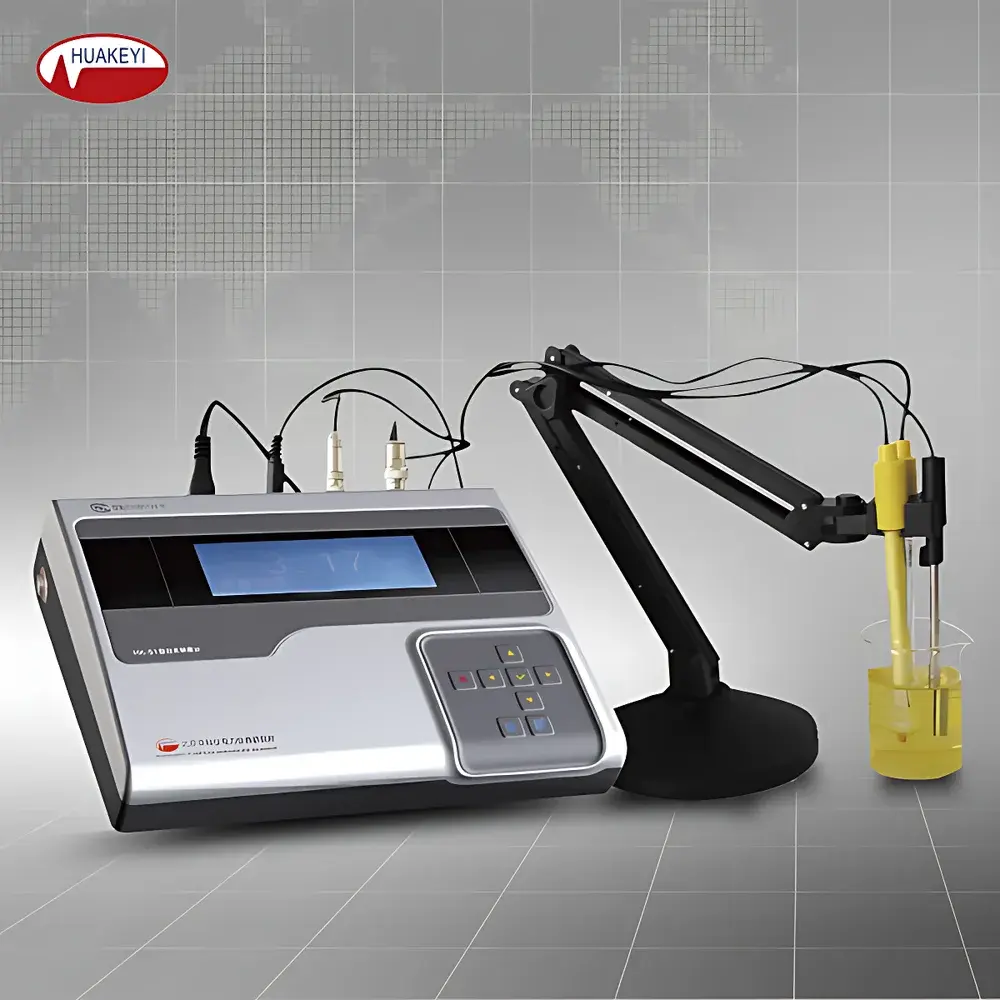
Huake Instrument HK-307 Benchtop Conductivity Meter
| Brand | Huake Instrument |
|---|---|
| Origin | Beijing, China |
| Manufacturer Type | Authorized Distributor |
| Origin Category | Domestic (China) |
| Model | HK-307 |
| Detection Parameters | Single-parameter (Conductivity/TDS/Resistivity/Salinity/Temperature) |
| Form Factor | Benchtop |
| Conductivity Range | (0.00–20.00) µS/cm |
| TDS Range | 0–100 g/L |
| Resistivity Range | 0–100 MΩ·cm |
| Salinity Range | 0–100 ppt |
| Temperature Range | (0.0–99.9) °C |
| Accuracy | ±1.5% FS |
| Minimum Resolution | 0.001 µS/cm |
| Display | 192 × 64 dot-matrix LCD (English/Chinese switchable) |
| Temperature Sensor | Pt1000 |
| Temp. Compensation | Automatic or Manual (0.1–60.0 °C, reference 25 °C, coefficient 0.00–9.99 %/°C) |
| Response Time (T90) | 30 s at 25 °C |
| Operating Ambient | 5–45 °C, ≤90% RH (non-condensing) |
| Power Supply | AC 100–240 V, 50–60 Hz |
| Power Consumption | 3 W |
| Dimensions | 270 × 200 × 65 mm (L×W×H) |
| Weight | 2 kg |
Overview
The Huake Instrument HK-307 Benchtop Conductivity Meter is a precision electrochemical analyzer engineered for reliable, repeatable measurement of solution conductivity, total dissolved solids (TDS), resistivity, salinity, and temperature in laboratory and industrial quality control environments. Based on the fundamental principle of electrical conductance—where current flow between two electrodes immersed in an aqueous sample is inversely proportional to its resistivity—the HK-307 delivers quantitative insight into ionic concentration and solution purity. Its four auto-ranging conductivity scales (spanning from ultra-low 0.001 µS/cm up to 20 mS/cm) enable accurate characterization across diverse sample types—from ultrapure water in power plant condensate loops to high-salinity brines in petrochemical process streams. Designed for compliance-critical workflows, the instrument supports traceable calibration and stable operation under ambient conditions typical of QC labs, research facilities, and pilot-scale production monitoring stations.
Key Features
- 32-bit embedded microcontroller architecture with intelligent auto-stabilization algorithm for rapid, drift-free endpoint detection (T90 ≤ 30 s at 25 °C)
- Auto-ranging conductivity measurement with seamless scale switching based on electrode constant (K = 0.01, 0.1, 1.0, or 10.0 cm⁻¹) and real-time signal analysis
- Dual-mode temperature compensation: automatic (Pt1000 sensor, 0.1–60.0 °C range) or manual, with adjustable linear compensation coefficient (0.00–9.99 %/°C) referenced to 25 °C
- High-resolution 192 × 64 dot-matrix LCD display supporting bilingual interface (English/Chinese), multi-parameter simultaneous readout, and intuitive menu navigation
- Ruggedized benchtop enclosure constructed from enhanced waterproof ABS plastic with full silicone membrane keypad for chemical resistance and tactile feedback
- Integrated data logging capability with internal memory for timestamped measurement records; export via USB or manual query function for audit trail generation
- Low-power design (3 W nominal) compliant with IEC 61000-4 EMC standards; universal AC input (100–240 V, 50–60 Hz) ensures global deployment readiness
Sample Compatibility & Compliance
The HK-307 is validated for use with aqueous electrolyte solutions within a defined operational window: sample temperature 5–60 °C, conductivity 0.001 µS/cm to 20 mS/cm, and salinity up to 100 ppt. It accommodates interchangeable conductivity cells—including K = 0.01 cm⁻¹ flow-through electrodes for ultrapure water applications per ASTM D1125 and ISO 7888—and standard K = 1.0 cm⁻¹ lab cells for general-purpose analysis. All measurements adhere to the theoretical basis of Kohlrausch’s law and conform to international conductivity metrology practices. While not pre-certified to GLP or FDA 21 CFR Part 11, the device supports GxP-aligned workflows through manual calibration logs, user-accessible calibration history, and deterministic response behavior suitable for internal SOP documentation. Its ±1.5% full-scale accuracy meets routine QC requirements aligned with ISO/IEC 17025 method validation guidelines for non-accredited laboratories.
Software & Data Management
The HK-307 operates without external software dependencies—its firmware implements all signal conditioning, temperature compensation, unit conversion (e.g., µS/cm → ppm NaCl equivalent → g/L TDS), and stability evaluation onboard. Calibration data (up to three-point conductivity and single-point temperature verification) is retained in non-volatile memory with time/date stamping. Users may review stored readings directly on the LCD or transfer them manually for inclusion in LIMS or Excel-based reporting templates. For regulated environments requiring electronic record integrity, the instrument’s deterministic output and absence of wireless connectivity simplify validation protocols. Optional PC communication modules (sold separately) support RS-232 or USB-to-serial interfaces for automated data capture in continuous monitoring setups.
Applications
- Power generation: Monitoring condensate purity, boiler feedwater, and demineralizer effluent per ASTM D512 and EPRI guidelines
- Petrochemical refining: Verifying wash water salinity, catalyst rinse solutions, and cooling tower bleed-off conductivity
- Pulp & paper manufacturing: Controlling bleach plant electrolyte strength and process water reuse thresholds
- Academic teaching labs: Demonstrating ionic dissociation, Debye-Hückel theory, and temperature dependence of conductance
- Environmental testing: Screening surface water, wastewater effluents, and groundwater samples per EPA Method 120.1
- Pharmaceutical water systems: Supporting Stage 1 USP conductivity testing for Purified Water and Water for Injection (WFI) when paired with appropriate K = 0.01 cm⁻¹ cells
FAQ
What electrode constants are supported by the HK-307?
The instrument is compatible with standardized conductivity cells having cell constants of K = 0.01, 0.1, 1.0, and 10.0 cm⁻¹. The system automatically adjusts range and calculation coefficients upon electrode selection.
Does the HK-307 meet ISO/IEC 17025 requirements for accredited testing?
While the HK-307 itself is not certified, its measurement repeatability (±1.5% FS), documented calibration traceability, and stable thermal compensation enable laboratories to incorporate it into validated methods under ISO/IEC 17025 clause 6.4.2.
Can the HK-307 perform automatic temperature compensation below 0 °C?
No—the Pt1000 sensor and compensation algorithm are specified for 0.0–99.9 °C; sub-zero measurements fall outside the validated operating range.
Is the display language configurable during operation?
Yes—users may toggle between English and Chinese interface modes via the setup menu without resetting the instrument.
What is the maximum storage capacity for logged measurements?
The internal memory retains up to 500 timestamped entries, accessible via the “Data Query” function on the main menu.




