
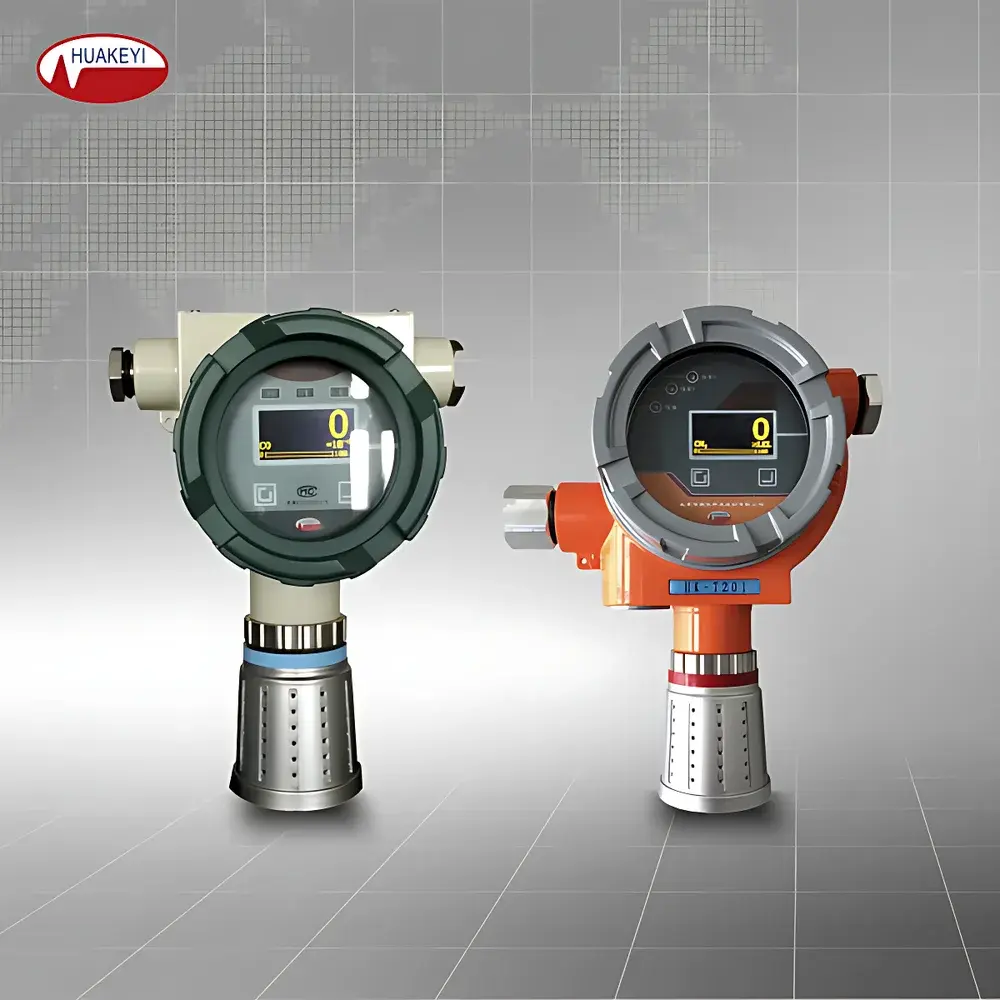
Huakeyi HK-7100A / HK-7101 Fixed-Mount Combustible Gas Detector
| Brand | Huakeyi |
|---|---|
| Origin | Beijing, China |
| Model | HK-7100A / HK-7101 |
| Instrument Type | Fixed Online Gas Detector |
| Detectable Gases | CH₄, CO₂, HC (hydrocarbons), and other combustible/toxic gases |
| Measurement Principle | Infrared (IR) and Catalytic Bead (Pellistor) |
| Response Time (T90) | ≤10 s (catalytic), ≤15 s (IR) |
| Accuracy | ±3% FS (full scale) |
| Measurement Range | CH₄: 0–100% LEL |
| CO₂ | 0–5000 ppm, 0–2%, 0–5%, or 0–100% vol (configurable) |
| Display | Dual-language OLED (Chinese/English) |
| Output Signal | 4–20 mA analog + optional RS485 Modbus RTU |
| Power Supply | DC 18–30 V (bus- or zone-powered) |
| Enclosure Rating | IP66 |
| Operating Temperature | −40 °C to +70 °C |
| Explosion Protection | Ex d II C T6 Gb |
| Compliance | GB 15322.1–2003 |
| Wiring | 3-wire or 4-wire |
| Power Consumption | ≤5 W |
| Atmospheric Pressure Range | 86–106 kPa |
| Transmission Distance | 4–20 mA ≤1000 m (2.5 mm² cable) |
Overview
The Huakeyi HK-7100A / HK-7101 is a fixed-mount, intrinsically robust combustible gas detector engineered for continuous, real-time monitoring of hazardous atmospheric conditions in industrial process environments. Designed for integration into centralized safety systems, it operates using dual, field-selectable detection principles—non-dispersive infrared (NDIR) spectroscopy for hydrocarbons (e.g., CH₄, C₃H₈) and CO₂, and catalytic bead (pellistor) sensing for general LEL-range combustible gases. Its architecture supports automatic sensor recognition and plug-and-play replacement of intelligent, hot-swappable sensor modules—eliminating manual calibration or configuration during maintenance. The device meets the structural and performance requirements of Class I, Division 1 hazardous locations under Ex d II C T6 Gb certification and complies with China’s national standard GB 15322.1–2003 for point-type combustible gas detectors used in industrial settings.
Key Features
- Modular sensor platform supporting five detection technologies—including NDIR, catalytic bead, electrochemical, PID, and semiconductor—with universal host compatibility and full interchangeability across hundreds of gas-specific configurations.
- Intelligent hot-swap sensors that self-identify measurement principle, target gas, range, and calibration status upon insertion—enabling zero-downtime maintenance and field reconfiguration without software tools.
- High-reliability 32-bit embedded microcontroller architecture delivering fast signal processing, low-latency alarm response (T90 ≤10 s for catalytic, ≤15 s for IR), and stable long-term drift compensation.
- OLED display with wide viewing angle, high contrast, and ambient-light adaptability—operable under direct sunlight or low-illumination conditions across −40 °C to +70 °C.
- Dual-language (Chinese/English) menu interface with intuitive navigation via magnetic stylus or optional infrared remote control—designed for glove-compatible operation in PPE-restricted environments.
- Flexible power architecture: supports both centralized bus-powered deployment (via 4–20 mA loop or dedicated controller bus) and independent zone supply—reducing infrastructure complexity in distributed installations.
- Industrial-grade SMT manufacturing ensures compact form factor, enhanced thermal stability, and resistance to mechanical shock and vibration per IEC 60068-2 standards.
Sample Compatibility & Compliance
The HK-7100A / HK-7101 is validated for continuous monitoring of methane (CH₄), carbon dioxide (CO₂), and broad-spectrum hydrocarbons in ambient air. Its NDIR channel provides selective, interference-resistant quantification of CO₂ at multiple ranges (0–5000 ppm, 0–2%, 0–5%, or 0–100% vol), while the catalytic bead module delivers standardized %LEL measurement for gases such as propane, butane, hydrogen, and gasoline vapors. All configurations operate via natural diffusion sampling—requiring no pumps or sample conditioning for typical indoor or sheltered outdoor applications. The unit conforms to GB 15322.1–2003, which aligns with functional safety concepts found in IEC 61508 (SIL 2 capable when integrated into certified safety instrumented systems). It is rated IP66 for dust-tight and high-pressure water jet resistance, and its flameproof enclosure (Ex d II C T6 Gb) permits safe use in Zone 1 and Zone 2 classified areas per IEC 60079-0 and IEC 60079-1.
Software & Data Management
While the HK-7100A / HK-7101 operates as a stand-alone analog transmitter, it integrates seamlessly into higher-level SCADA, DCS, or gas detection management platforms via its 4–20 mA output and optional RS485 Modbus RTU interface. Configuration and diagnostics are performed locally via the OLED interface—no PC software required. Alarm thresholds (Level 1 and Level 2), fault reporting logic, and relay activation modes are fully user-definable on-device. Event logging—including alarm activation timestamps, sensor fault codes, and power-up diagnostics—is retained in non-volatile memory for post-event forensic review. Though not FDA 21 CFR Part 11 compliant out-of-the-box (as it lacks electronic signature or audit trail functionality), its deterministic analog output and traceable calibration records support GLP/GMP-aligned validation protocols when deployed within auditable system architectures.
Applications
- Petrochemical refineries and offshore platforms—monitoring compressor stations, flare stacks, and tank farm perimeters for CH₄ and hydrocarbon leaks.
- Natural gas distribution facilities—including metering skids, regulator stations, and LNG vaporization areas—where CO₂ and CH₄ co-monitoring enhances combustion efficiency and leak localization.
- Chemical storage terminals and liquid bulk handling zones—detecting fugitive emissions from valves, flanges, and loading arms.
- Industrial boiler rooms and CHP plants—ensuring safe operation of gas-fired burners through continuous %LEL surveillance.
- Liquefied petroleum gas (LPG) bottling plants and cylinder filling stations—meeting local fire code requirements for early-stage leak detection.
- Underground utility tunnels and confined-space entry points—providing pre-entry verification and continuous hazard awareness.
FAQ
What detection principles does the HK-7100A / HK-7101 support?
It natively supports infrared (NDIR) and catalytic bead (pellistor) sensing. Optional sensor modules enable electrochemical, photoionization (PID), and metal oxide semiconductor (MOS) detection—using the same host electronics and housing.
Can the detector be calibrated in the field without specialized equipment?
Yes—zero and span calibration can be performed manually via the OLED interface using certified calibration gas and the built-in auto-calibration wizard. Sensor modules retain individual calibration coefficients in EEPROM.
Is the RS485 interface compatible with standard Modbus RTU networks?
Yes—the RS485 port implements industry-standard Modbus RTU protocol (function codes 03h/06h) with configurable slave ID, baud rate (9.6–115.2 kbps), and parity settings.
Does the unit support HART communication?
No—HART is not supported. Communication is limited to 4–20 mA analog output and optional RS485 Modbus RTU.
What is the expected service life of the catalytic bead sensor under normal operating conditions?
Typical operational lifetime is 3–5 years in clean, non-poisoning environments. Exposure to silicones, lead compounds, or high concentrations of sulfur species may significantly reduce lifespan and requires periodic verification per GB 15322.1–2003 Annex B.
Related Products







