
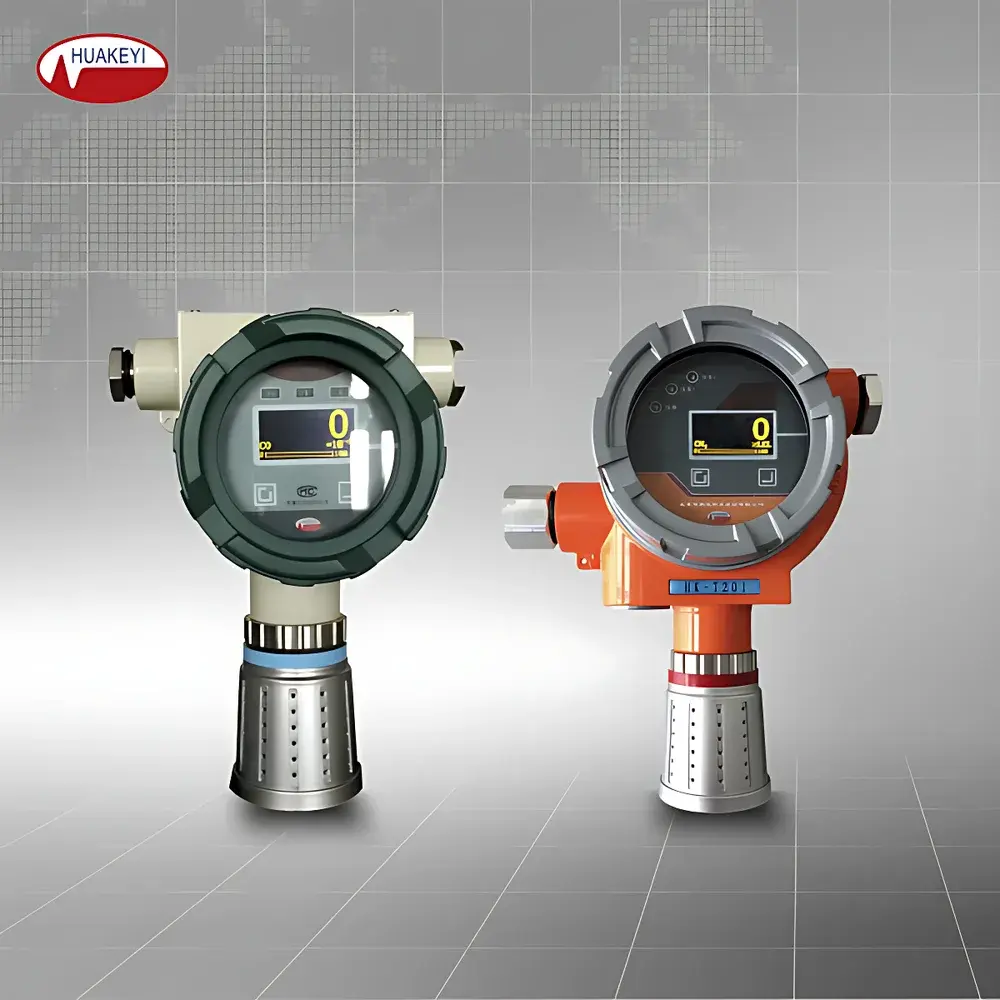
Huakeyi HK-7200A/7201 Toxic Gas Detector
| Brand | Huakeyi |
|---|---|
| Origin | Beijing, China |
| Model | HK-7200A/7201 |
| Instrument Type | Fixed-mount (online) gas detector |
| Detectable Gases | HCN, CO, and other toxic gases |
| Response Time (T90) | ≤15 s |
| Measurement Accuracy | ±1% FS |
| Measurement Range | (0–100)% LEL |
| Detection Principles | Infrared (IR), Electrochemical (EC), Metal Oxide Semiconductor (MOS), Photoionization Detection (PID) |
| Display | Dual-language OLED (Chinese/English) |
| Output Signals | 4–20 mA analog + optional RS485 Modbus RTU |
| Power Supply | DC 18–30 V |
| Enclosure Rating | IP66 |
| Explosion Protection | Exd II CT6Gb |
| Compliance Standards | GB 15322.1–2003, GB 12358–2006 |
Overview
The Huakeyi HK-7200A/7201 Toxic Gas Detector is a fixed-mount, intrinsically robust ambient air quality monitor engineered for continuous, real-time detection of hazardous toxic gases—including hydrogen cyanide (HCN), carbon monoxide (CO), and other volatile compounds—in industrial environments. Designed for deployment in control rooms or distributed monitoring networks, the device operates on multiple detection principles—namely infrared (IR), electrochemical (EC), metal oxide semiconductor (MOS), and photoionization detection (PID)—to ensure broad-spectrum compatibility with diverse target analytes. Its architecture follows a modular host-sensor paradigm: a single universal detector housing accommodates interchangeable smart sensors, each self-identifying its measurement principle, gas specificity, range, and calibration parameters upon insertion. This design enables rapid field reconfiguration without firmware updates or manual configuration, supporting operational continuity during maintenance or process changes.
Key Features
- Multi-principle platform: Unified host supports IR, EC, MOS, and PID sensor modules—covering flammable, toxic, and volatile organic compounds (VOCs) across industrial safety applications.
- Hot-swappable smart sensors: Plug-and-play installation with automatic recognition of gas type, range, zero/span values, and diagnostic status; no tools or service intervention required.
- Embedded 32-bit microcontroller: Enables high-speed signal processing, real-time T90 response compensation, and dual-stage alarm logic with configurable thresholds.
- Dual-language OLED display: High-contrast, wide-temperature (-40 °C to +70 °C) screen with intuitive menu navigation in English and Chinese; visible under direct sunlight or low-light conditions.
- Flexible power architecture: Compatible with centralized bus-powered configurations (e.g., via controller backplane) or decentralized zone-specific DC 18–30 V supplies—reducing wiring complexity and infrastructure dependency.
- Magnetic pen & optional IR remote operation: Touchless interface for safe, glove-compatible interaction in hazardous or contaminated zones—eliminating mechanical button wear and ingress risks.
- Industrial-grade construction: Surface-mount technology (SMT) PCB assembly enhances thermal stability and long-term reliability; IP66-rated enclosure resists dust ingress and high-pressure water jets.
- Comprehensive diagnostics: Onboard sensor health monitoring includes drift detection, baseline validation, and fault-flagging with visual and relay-based alerts.
Sample Compatibility & Compliance
The HK-7200A/7201 is validated for ambient air sampling via natural diffusion—requiring no external pump or sample conditioning for standard installations. Sensor selection determines applicable gas coverage: electrochemical modules target HCN, CO, H2S, Cl2, NO2, and SO2; IR variants detect hydrocarbons (e.g., CH4, C3H8) and CO2; MOS sensors address halogenated VOCs (e.g., chloroform, perchloroethylene); PID modules cover broad-spectrum VOCs at sub-ppm levels. All configurations comply with Chinese national standards GB 15322.1–2003 (for combustible gas detectors) and GB 12358–2006 (for toxic gas detectors), and meet Exd II CT6Gb explosion protection requirements for use in Zone 1 hazardous areas per IEC 60079-0 and IEC 60079-1. While not certified to ATEX or UL 2075, its electrical and mechanical design aligns with internationally recognized functional safety expectations for continuous emission monitoring systems (CEMS) and process safety management (PSM) frameworks.
Software & Data Management
The detector outputs standardized 4–20 mA analog signals with optional RS485 Modbus RTU digital communication (addressable up to 247 nodes). Analog output supports integration into legacy DCS/PLC systems without protocol translation, while Modbus enables bidirectional parameter access—including real-time concentration, sensor temperature, diagnostic codes, and alarm history. The device logs internal events (e.g., sensor insertion, calibration, fault initiation) with timestamped entries stored in non-volatile memory. Though it lacks native cloud connectivity or FDA 21 CFR Part 11-compliant audit trails, its deterministic output behavior and traceable calibration metadata support GLP/GMP-aligned validation protocols when deployed within qualified SCADA or MES ecosystems. Configuration and calibration are performed locally via magnetic pen or IR remote—no PC software or network exposure required.
Applications
- Petrochemical refineries: Continuous monitoring of HCN in amine regeneration units and CO in furnace exhaust stacks.
- Liquefied petroleum gas (LPG) terminals: Detection of hydrocarbon leaks in loading/unloading zones and vapor recovery systems.
- Chemical manufacturing plants: Area surveillance for chlorine, ammonia, or phosgene in synthesis and storage areas.
- Pharmaceutical clean utilities: Monitoring of solvent vapors (e.g., acetone, methanol) in HVAC return ducts using PID modules.
- Natural gas distribution stations: Combustible gas leak detection at compressor skids and metering stations.
- Underground parking facilities: CO accumulation monitoring for ventilation control integration.
FAQ
What detection principles does the HK-7200A/7201 support?
It supports infrared (IR), electrochemical (EC), metal oxide semiconductor (MOS), and photoionization detection (PID) — each implemented via field-replaceable smart sensor modules.
Can the same host unit detect both combustible and toxic gases?
Yes — the universal host accepts any compatible sensor module; users select IR for hydrocarbons or CO₂, EC for HCN/CO, MOS for halogenated VOCs, or PID for broad-spectrum organics.
Is calibration required after sensor replacement?
No — smart sensors store factory calibration coefficients and gas-specific parameters; the host auto-loads them upon insertion, enabling immediate operation.
What is the maximum cable length for 4–20 mA signal transmission?
Up to 1000 meters using 2.5 mm² shielded twisted-pair cable under standard electromagnetic interference conditions.
Does the device meet international explosion protection standards?
It carries the Exd II CT6Gb marking per GB 3836.1–2010 / GB 3836.2–2010, equivalent to IEC 60079-0 and IEC 60079-1 for flameproof enclosures in Group II C atmospheres.







