
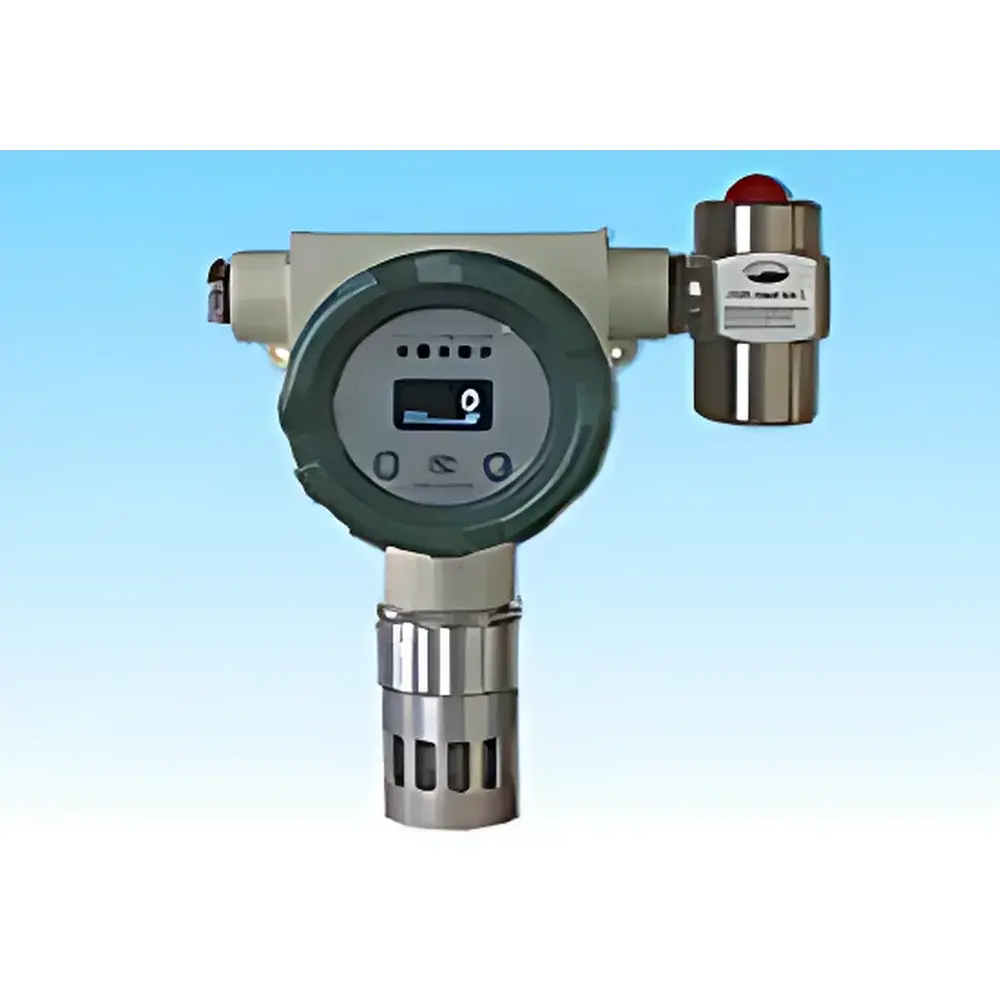
HK-7200A Metal Oxide Semiconductor (MOS) Toxic Gas Detector
| Origin | Beijing |
|---|---|
| Manufacturer Type | Authorized Distributor |
| Origin Category | Domestic (PRC) |
| Model | HK-7200A |
| Price | Upon Request |
| Detection Principle | Metal Oxide Semiconductor (MOS) |
| Display | OLED, Bilingual (Chinese/English) |
| Operating Temperature | -40 °C to +70 °C |
| Atmospheric Pressure Range | 86–106 kPa |
| Measurement Range Options | 0–100 ppm, 0–200 ppm, 0–500 ppm, 0–1000 ppm, 0–2000 ppm |
| Resolution | 1 ppm |
| Accuracy | ±5% FS |
| Response Time (T90) | ≤30 s |
| Alarm Output | Dual-level visual (LED) and relay |
| Signal Outputs | 4–20 mA, CAN bus, RS485 |
| Transmission Distance | 4–20 mA ≤1000 m (2.5 mm² cable), CAN ≤10 km, RS485 ≤1.2 km |
| Power Supply | DC 18–30 V |
| Wiring | 3-wire or 4-wire configuration |
| Power Consumption | ≤2 W |
| Explosion Protection | Ex d IIC T6 Gb |
| Ingress Protection | IP66 |
| Compliance Standard | GB 12358–2006 |
| Sampling Method | Natural diffusion |
| Sensor Interface | Hot-swappable, plug-and-play MOS sensor module |
| Firmware Architecture | 32-bit embedded microcontroller |
Overview
The HK-7200A is a field-deployable, intrinsically robust toxic gas detector engineered for continuous ambient air monitoring in industrial, utility, and municipal environments. It employs metal oxide semiconductor (MOS) sensing technology — a well-established, cost-effective, and stable solid-state detection method widely used for broad-spectrum detection of reducing toxic gases including carbon monoxide (CO), hydrogen sulfide (H₂S), nitrogen dioxide (NO₂), chlorine (Cl₂), ammonia (NH₃), and volatile organic compounds (VOCs) at trace concentrations. Unlike electrochemical or PID-based detectors, MOS sensors operate on the principle of surface conductivity modulation: when target gas molecules adsorb onto the heated metal oxide surface (typically SnO₂, WO₃, or ZnO), they alter the material’s resistivity in proportion to gas concentration. This analog resistance change is linearized, temperature-compensated, and digitized by the integrated 32-bit embedded microcontroller — enabling high reproducibility across wide thermal gradients (−40 °C to +70 °C) and long-term baseline stability.
Key Features
- Modular architecture with universal host unit supporting hot-swappable MOS sensor cartridges — no firmware reconfiguration required upon sensor replacement
- Dual-mode human interface: magnetic stylus for local operation and bidirectional infrared remote control for safe-distance commissioning and calibration verification
- High-contrast, wide-viewing-angle OLED display with bilingual (English/Chinese) menu navigation and real-time status indicators (operational, Level 1 alarm, Level 2 alarm, fault)
- Flexible power architecture: compatible with centralized bus-powered deployment (e.g., in distributed control systems) or independent zone-supplied operation (DC 18–30 V)
- Industrial-grade construction: flameproof enclosure rated Ex d IIC T6 Gb per IEC 60079-1 and IP66-rated for outdoor use in dust-laden, rain-exposed, or high-humidity locations
- Multi-protocol digital output support: CAN bus (ISO 11898-2 compliant, up to 10 km loop distance), RS485 (up to 1.2 km, Modbus RTU-ready), and industry-standard 4–20 mA analog output with HART-compatible signal integrity
Sample Compatibility & Compliance
The HK-7200A is designed for ambient air sampling via passive diffusion — eliminating moving parts, pumps, or consumables. Its MOS sensor modules are pre-calibrated for over 30 common industrial toxicants and can be user-configured for custom gas-response profiles within defined ppm-range bands (0–100 ppm to 0–2000 ppm). Each sensor undergoes factory calibration against NIST-traceable reference standards and includes built-in self-diagnostic routines that monitor heater voltage, baseline resistance drift, and signal-to-noise ratio. The device complies fully with GB 12358–2006 (General Requirements for Gas Detectors), and its mechanical and electrical design aligns with international safety frameworks including IEC 61508 (SIL2-capable architecture) and IEC 60079 series for hazardous area instrumentation. While not certified to UL 2075 or EN 45544, its performance envelope meets functional safety requirements for non-SIL-critical leak detection and personnel exposure warning applications.
Software & Data Management
Data acquisition and configuration are managed through the optional HK-ConfigSuite PC application (Windows-based), which supports batch parameter upload/download, event log export (CSV), alarm threshold programming, and sensor lifetime tracking. All configuration changes are timestamped and stored in non-volatile memory with audit trail capability — supporting GLP-aligned documentation practices. When integrated into larger SCADA or EMS platforms via CAN or RS485, the HK-7200A transmits time-stamped concentration values, diagnostic flags (e.g., “sensor aging,” “temperature out-of-range”), and alarm state transitions. The 4–20 mA output is linearly scaled and optionally HART-enabled for remote diagnostics without interrupting primary signal transmission.
Applications
- Continuous monitoring of toxic gas accumulation in substation cable trenches, transformer vaults, and switchgear rooms
- Leak detection and perimeter monitoring in chlorine dosing stations, ammonia refrigeration plants, and wastewater treatment facilities
- Ambient air quality surveillance in industrial parks, near chemical storage zones, and confined-space entry points
- Integration into fire and gas safety systems (FGS) as a complementary detection layer alongside point-type electrochemical or infrared sensors
- Mobile deployment on environmental inspection vehicles or temporary site monitoring trailers where ruggedness and low power consumption (<2 W) are critical
FAQ
What gases can the HK-7200A detect?
The detector is optimized for reducing toxic gases detectable by MOS technology — including CO, H₂S, NO₂, Cl₂, NH₃, SO₂, and select VOCs. Sensor-specific cross-sensitivity profiles are provided in the technical datasheet for each interchangeable cartridge.
Is field calibration possible?
Yes — zero and span calibration can be performed using certified gas cylinders and the magnetic stylus or infrared remote. Calibration intervals are recommended every 6 months or after exposure to sensor-poisoning agents (e.g., silicones, phosphates).
Can multiple HK-7200A units be networked?
Yes — via CAN bus (daisy-chain topology, up to 10 km) or RS485 (multi-drop, up to 32 nodes), enabling centralized data aggregation without additional gateways.
Does it support explosion-proof installation in Zone 1 areas?
Yes — the Ex d IIC T6 Gb rating certifies suitability for Group IIC gas atmospheres (e.g., hydrogen, acetylene) in Zone 1 and Zone 2 hazardous locations per IEC 60079-0 and IEC 60079-1.
How is sensor failure detected and reported?
The embedded diagnostics continuously validate heater function, baseline resistance stability, and signal linearity. Any deviation beyond configurable thresholds triggers a “SENSOR FAULT” LED, relay output, and CAN/RS485 event code — logged with timestamp and severity level.
Related Products







