
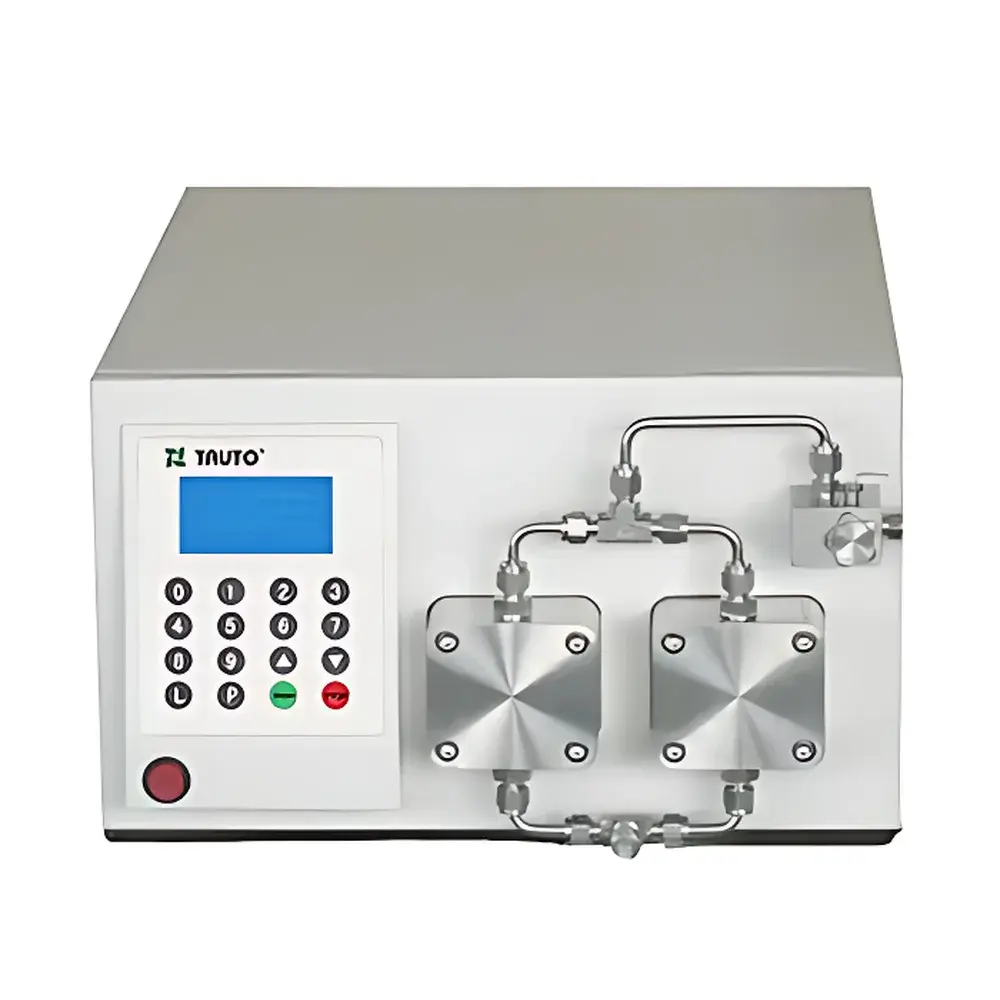
Tongtian TBP1H02S High-Performance Dual-Piston Constant Flow Pump
| Brand | Tongtian |
|---|---|
| Origin | Shanghai, China |
| Model | TBP1H02S |
| Pressure Range | 0–2.0 MPa |
| Flow Rate Range | 1–100 mL/min |
| Pressure Pulsation | ≤0.05 MPa |
| Pressure Accuracy | ≤±0.10 MPa |
| Flow Setting Error | ≤±2% (1–50 mL/min), ≤±1.5% (50–100 mL/min) |
| Flow Repeatability | ≤±1.5% (1–50 mL/min), ≤±1% (50–100 mL/min) |
| Power Supply | 220 V ±10%, 50/60 Hz |
| Power Consumption | 75 W |
| Dimensions | 270 × 400 × 190 mm |
| Weight | 17 kg |
| Wetted Materials Options | 316L Stainless Steel (L), Pure Titanium (T), PEEK (K), PTFE (F) |
| Flow Path Components | Imported Ruby Ball Valves, Ceramic Plungers |
| Communication Interface | RS232 |
Overview
The Tongtian TBP1H02S High-Performance Dual-Piston Constant Flow Pump is an engineered solution for precise, pulse-free liquid delivery in mid-pressure analytical and preparative applications. Based on dual-piston reciprocating displacement architecture with active flow compensation, it delivers stable volumetric flow rates across its full operating range (1–100 mL/min) while maintaining pressure stability up to 2.0 MPa. Unlike single-piston or peristaltic alternatives, the dual-piston design—coupled with microprocessor-controlled phase offset and real-time pressure feedback—minimizes hydraulic pulsation (<0.05 MPa), ensuring consistent fluid dynamics critical for HPLC feed, solvent delivery in extraction systems, continuous reaction monitoring, and automated sample introduction. Its modular wetted path—configured with ruby ball valves and ceramic plungers—provides chemical inertness against aggressive organic solvents, acids, and bases, supporting long-term reliability in demanding laboratory and pilot-scale environments.
Key Features
- Dual-piston architecture with synchronized phase control to suppress pressure ripple and enhance flow continuity
- Four selectable wetted-path material configurations: 316L stainless steel (L), pure titanium (T), PEEK (K), and PTFE (F), enabling compatibility with corrosive, high-purity, or ultra-low-metal applications
- Imported ruby ball check valves and ceramic plunger rods ensure exceptional wear resistance and extended service life under continuous operation
- Modular, tool-free pump head access allows maintenance—including valve replacement and plunger inspection—without system shutdown
- Integrated overpressure protection and automatic flow calibration routines compliant with routine instrument qualification protocols
- Large-bore flow path design (standard 2 mm / 3 mm / 6 mm tubing ports; optional 1/8″ BSP/NPT fittings) mitigates clogging risk associated with narrow-bore chromatographic pumps
- Intelligent air elimination system with multi-stage degassing geometry reduces entrained gas artifacts in low-viscosity or volatile solvent delivery
Sample Compatibility & Compliance
The TBP1H02S supports a broad spectrum of liquid samples—including aqueous buffers, acetonitrile/methanol gradients, chlorinated solvents, concentrated acids (e.g., HCl, HNO₃), and alkaline solutions—when configured with appropriate wetted materials (e.g., Ti or PTFE for HF or hot NaOH). Its construction meets general-purpose laboratory equipment safety standards (IEC 61010-1), and its sealed, dust-resistant housing complies with IP54-rated environmental protection requirements. While not certified for GMP production environments out-of-the-box, the pump’s repeatable performance (flow repeatability ≤±1%), traceable pressure/flow logging via RS232, and memory-retained operational parameters support integration into GLP-compliant workflows. Optional firmware upgrades may enable audit-trail functionality aligned with FDA 21 CFR Part 11 data integrity expectations when deployed with validated host software.
Software & Data Management
Equipped with a standard RS232 serial interface, the TBP1H02S communicates bidirectionally with Windows-based host applications for remote configuration and real-time monitoring. The native control software provides:
- Live display of actual pressure, setpoint pressure, and programmed flow rate
- Time-synchronized pressure trend visualization with user-defined sampling intervals
- Dual-mode parameter entry: direct numeric input or incremental step adjustment for rapid optimization
- Programmable timer function for scheduled start/stop cycles (e.g., overnight solvent flushes or timed reagent addition)
- Persistent storage of up to 10 user-defined method profiles, including pressure limits, flow ramps, and hold durations
- Export-capable log files (.csv) containing timestamped pressure, flow, and status flags for post-run analysis and regulatory documentation
No proprietary drivers are required; communication follows ASCII command protocol compatible with LabVIEW, Python (pySerial), and MATLAB instrumentation toolboxes.
Applications
The TBP1H02S serves as a robust fluidic engine across multiple technical domains:
- HPLC and preparative LC mobile phase delivery where pulse dampening improves baseline stability and detector sensitivity
- Continuous-flow synthesis reactors requiring stoichiometric reagent dosing at elevated backpressures
- Supercritical fluid extraction (SFE) co-solvent pumping with methanol or ethanol in CO₂ systems
- Environmental water analysis—automated filtration, SPE cartridge conditioning, and extract concentration
- Pharmaceutical dissolution testing per USP , delivering standardized media at constant flow under variable viscosity conditions
- Material science slurry dispensing for battery electrode coating or catalyst ink deposition
FAQ
What is the maximum allowable backpressure for continuous operation?
The pump is rated for continuous operation at up to 2.0 MPa (290 psi); sustained operation above this threshold triggers automatic shutdown via integrated pressure cutoff.
Can the TBP1H02S be integrated into a PLC-controlled process line?
Yes—RS232 commands support discrete I/O mapping and SCADA-compatible polling; Modbus RTU conversion is achievable via third-party protocol gateways.
Is flow calibration traceable to national standards?
Factory calibration uses gravimetric NIST-traceable reference standards; users may perform in-house recalibration using certified flow meters meeting ISO 4064 Class B accuracy requirements.
How often should ruby valves be replaced under typical lab usage?
With proper solvent filtration (≤0.45 µm) and avoidance of particulates, ruby valves typically exceed 12 months of daily operation before performance drift exceeds specification limits.
Does the pump support gradient programming?
No—gradient formation requires external mixing or dual-pump synchronization; the TBP1H02S operates as a single-channel constant-flow source with programmable flow ramps but no onboard mixing capability.



