Niklas W.N.5/01 Laboratory Seed Coater
| Brand | Niklas |
|---|---|
| Origin | Germany |
| Model | W.N.5/01 |
| Instrument Type | Laboratory-scale seed coating system |
| Moisture Measurement Range (%) | 0–100 |
| Minimum Weighing Resolution (g) | 0.1 |
| Sample Mass Capacity (g) | 0–100 |
| Heating Temperature Range (°C) | Ambient to 80 |
| Power Supply | 3-phase, 400 V / 50 Hz, 2.0 kW |
| Dimensions (L×W×H) | 1200 × 700 × 1300 mm |
| Weight | 170 kg |
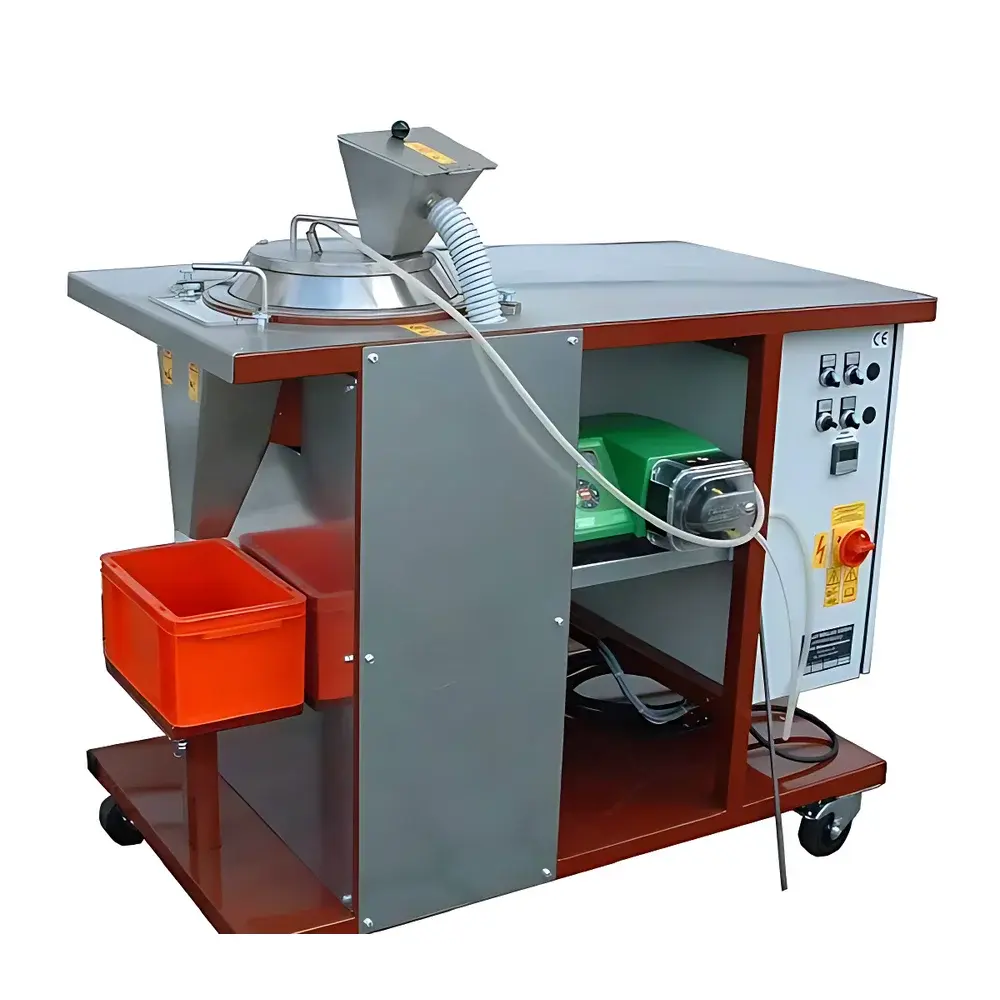
| Construction | Stainless steel working surface with four swivel casters |
| Dust Extraction | Integrated recirculating suction system with filter bag |
| Compressed Air Required | No |
Overview
The Niklas W.N.5/01 Laboratory Seed Coater is a precision-engineered, benchtop-scale batch coater designed for controlled, reproducible application of liquid pesticides, fungicides, biostimulants, polymers, and dry flow-enhancing powders onto diverse seed types—including small, irregular, low-density, or highly absorptive seeds such as tomato, carrot, spinach, lettuce, beet, sunflower, rapeseed, and cereal grains. Unlike industrial continuous coaters, the W.N.5/01 operates on the principle of controlled rotational tumbling within a conical mixing chamber, where seed motion is precisely directed along the inner wall and through a defined parabolic trajectory. This geometry enables uniform exposure to atomized liquid spray—delivered via a centrally mounted rotating disc—and simultaneous or sequential introduction of dry additives through dedicated dosing ports. The system integrates gravimetric or volumetric seed metering, programmable timing logic (via optional multifunction timer), and closed-loop air recirculation with particulate filtration—ensuring operator safety, environmental containment, and consistent coating homogeneity at the single-seed level. Its design reflects decades of agronomic process engineering by Niklas GmbH, grounded in ISO 9001-certified manufacturing and aligned with EU Plant Protection Product (PPP) Regulation (EC) No 1107/2009 requirements for efficacy validation and residue characterization.
Key Features
- Stainless steel conical mixing chamber with ergonomic access and manual discharge valve—capable of handling up to 6 L (≈100 g typical seed mass) per batch
- Rotating spray disc generating fine, uniform droplets (<50 µm Sauter mean diameter) that penetrate the seed parabola and impinge on upward-moving seeds along the chamber wall
- Integrated dust extraction system with HEPA-class filter bag; filtered air recirculated into chamber to maintain inert atmosphere and eliminate cross-contamination
- No compressed air requirement—liquid atomization achieved purely via mechanical rotation energy
- Compliance-ready construction: ESH-compliant guarding, IP54-rated electrical enclosure, and grounding per IEC 60204-1
- Modular accessory interface supporting optional semi-automated dosing: peristaltic pump (30–320 mL/min), powder metering unit (100–600 mL/min), and calibrated timing controller
Sample Compatibility & Compliance
The W.N.5/01 accommodates seeds ranging from ultra-fine grass species (≤0.5 mm) to large dicotyledonous seeds (e.g., maize kernels). Its adjustable cone top covers—with 3- or 6-bypass configurations—optimize residence time and tumble dynamics for low-mass, high-surface-area seeds. All contact surfaces comply with FDA 21 CFR Part 177.2600 (food-contact plastics) and EU Regulation (EC) No 1935/2004. The system supports method development for OECD Test Guideline 208 (Seedling Emergence and Seedling Growth Toxicity) and EPPO Standard PP 1/207 (Efficacy Evaluation of Seed Treatments). Documentation packages include full traceability logs for calibration of weighing modules, timer offsets, and volumetric dispensers—enabling audit readiness under GLP (OECD Principles) and internal quality management systems.
Software & Data Management
While the base W.N.5/01 operates via manual mode with analog controls, all optional dosing modules integrate with a DIN-rail-mounted multifunction timer featuring RS-485 Modbus RTU output. This enables synchronization with external lab data acquisition systems (e.g., LabVIEW, SCADA) for timestamped logging of start/stop events, pump activation duration, and powder feed intervals. Calibration certificates for peristaltic tubing wear compensation and powder flow linearity are provided with each accessory. Raw weight data from the integrated 0.1 g resolution scale can be exported via USB or serial interface for integration into LIMS platforms compliant with ISO/IEC 17025:2017 clause 7.7 (Results Reporting).
Applications
- Formulation screening of novel seed-applied biocontrol agents under controlled lab conditions
- Residue distribution analysis for regulatory dossier preparation (EFSA, EPA, PMRA)
- Coating uniformity assessment using dye-tracer imaging and SEM-EDS surface mapping
- Optimization of polymer film thickness and drying kinetics for pelleted vegetable seeds
- Validation of dose-response relationships in pathogen challenge assays (e.g., Fusarium spp. on wheat)
- Training and SOP development for certified seed treatment facilities seeking ISO 9001 or ISTA accreditation
FAQ
Is the W.N.5/01 suitable for Good Laboratory Practice (GLP) studies?
Yes—when equipped with calibrated timers, traceable weighing modules, and documented maintenance records, it meets OECD GLP principles for non-clinical laboratory studies.
Can the system handle viscous slurries or suspensions?
Yes—optional high-torque peristaltic pumps and wide-bore spray nozzles support viscosities up to 500 mPa·s (measured at 25°C, spindle L3, Brookfield DV2T).
Does Niklas provide IQ/OQ documentation templates?
Yes—standard qualification protocols (Installation Qualification, Operational Qualification) are available upon request and align with Annex 15 of the EU GMP Guidelines.
What maintenance intervals are recommended for the rotating spray disc assembly?
Visual inspection every 50 operating hours; dynamic balancing verification every 500 hours; replacement of bearing assemblies every 2,000 hours or per manufacturer’s service bulletin.
Is remote diagnostics supported?
Not natively—but the RS-485 interface allows integration with third-party predictive maintenance platforms via Modbus register polling.