
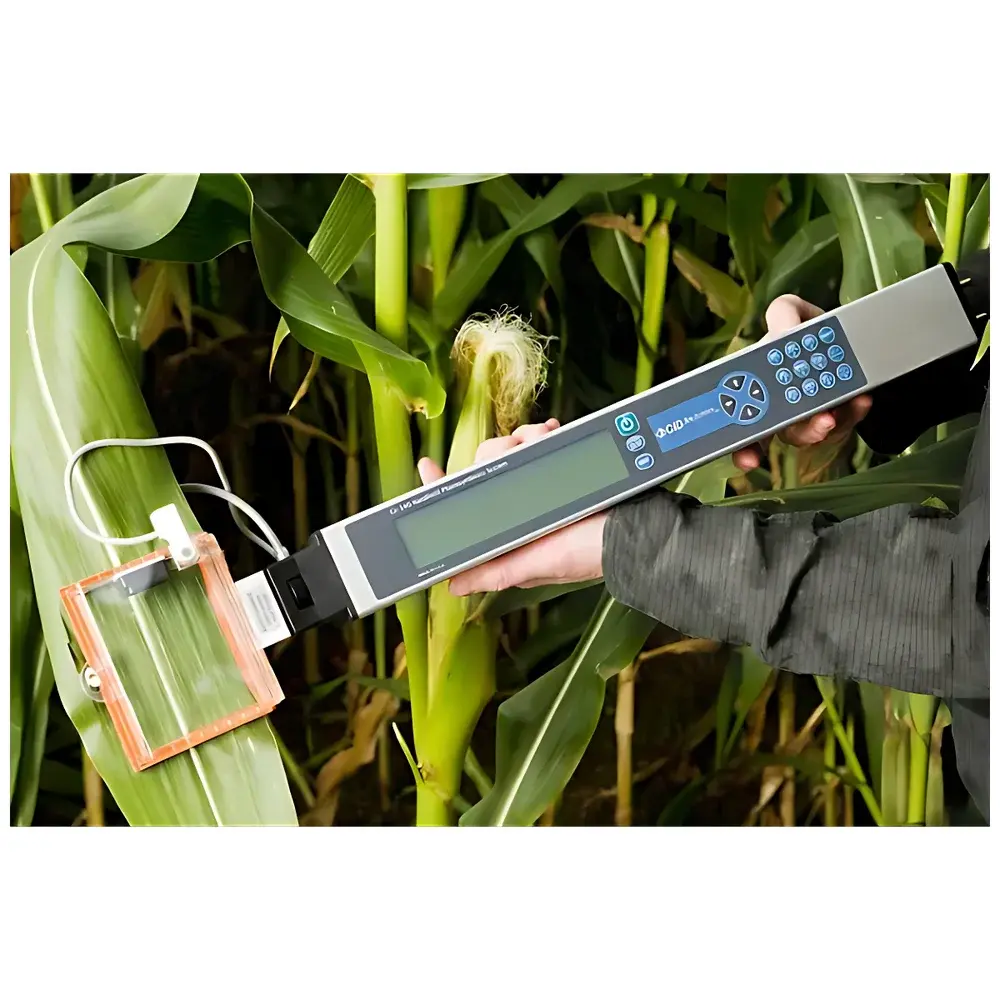
CID CI-340 Portable Photosynthesis Measurement System
| Brand | CID Inc. (USA) |
|---|---|
| Origin | USA |
| Model | CI-340 |
| CO₂ Range | 0–2000 ppm (standard), 0–3000 ppm (optional) |
| PAR Range | 0–2500 µmol·m⁻²·s⁻¹ |
| Flow Rate | 100–1000 mL/min |
| Operating Temp | 0–45 °C |
| Operating RH | 5–95% RH (non-condensing) |
| Battery Life | 4–6 h (standard operation), up to 10 h with low-power configuration |
| Weight | 1.5 kg (with leaf chamber & Li-ion battery) |
| Data Storage | 4 MB flash memory (~1.6 million data points) |
| Display | 40×6-character LCD (320×64 pixels) |
| Interface | USB |
| CO₂ Sensor | NDIR, 1 Hz chopper frequency, <2% accuracy, 0.1 ppm resolution |
| Humidity Sensor | Capacitive, 0–2100% RH, ±2% RH @10% RH, ±3.5% RH @90% RH |
| PAR Sensor | GaAsP photodiode with cosine correction, 400–700 nm, ±5 µmol·m⁻²·s⁻¹ accuracy |
| Air Temp Sensor | Thermocouple, –15–50 °C, ±0.1 °C |
| Leaf Temp Sensor | Non-contact infrared, –10–50 °C, ±0.3 °C |
Overview
The CID CI-340 Portable Photosynthesis Measurement System is a field-deployable, open- or closed-path gas exchange analyzer engineered for high-fidelity, real-time quantification of plant physiological responses under natural or controlled conditions. Based on non-dispersive infrared (NDIR) CO₂ detection and precision environmental sensing, the CI-340 applies the principles of Farquhar-von Caemmerer-Berry biochemical modeling to derive net photosynthetic rate (An), stomatal conductance (gs), transpiration rate (E), intercellular CO₂ concentration (Ci), and related biophysical parameters. Its modular architecture supports both single-leaf and canopy-level measurements across diverse vegetation types—including broadleaf, narrowleaf, coniferous, bryophyte, and even non-plant respiratory substrates such as soil, fruits, seeds, and arthropods—enabling rigorous ecological and agronomic fieldwork in challenging environments (e.g., forest understories, alpine zones, and fragmented agroecosystems).
Key Features
- Ultra-portable design: Total system mass of 1.5 kg includes integrated leaf chamber, rechargeable 7.2 V Li-ion battery (4400 mAh), and all core sensors—optimized for extended backpack-based surveys.
- Dual-path operation: Selectable open-system (ambient air reference) or closed-loop (recirculated air) configurations to accommodate variable experimental constraints and ambient CO₂ stability.
- High-temporal-resolution acquisition: Capable of acquiring full gas exchange parameter sets—including An, gs, E, Ci, PAR, Tair, Tleaf, RH, and flow rate—at 1 Hz sampling frequency, enabling dynamic response analysis to rapid environmental transitions.
- Modular environmental control: Interchangeable, independently operated accessory modules (CI-301LA, CI-301AD, CI-510CS, CI-510CF) allow precise, programmable manipulation of photosynthetic photon flux density (PPFD), CO₂ partial pressure, water vapor pressure, leaf temperature, and fluorescence excitation—supporting A/Ci, A/Q, and A/T response curve generation.
- Integrated PAR and leaf temperature sensing: On-board cosine-corrected quantum sensor (400–700 nm) and non-contact infrared pyrometer eliminate external calibration drift and spatial misalignment errors common in distributed probe setups.
- Robust data integrity architecture: 4 MB internal flash memory retains >1.6 million timestamped records; USB interface enables direct transfer to Windows/Linux platforms without proprietary drivers.
Sample Compatibility & Compliance
The CI-340 accommodates an extensive range of sample geometries via 11 interchangeable leaf chambers—including flat, narrow, cylindrical, succulent, and soil respiration configurations—with chamber surface areas spanning 6.25 cm² to 3.98 L volume. This flexibility ensures adherence to ASTM E2913-13 (Standard Guide for Measuring Plant Gas Exchange) and ISO 17025-compliant measurement traceability when paired with certified calibration gases (e.g., NIST-traceable CO₂ standards). The system’s humidity and temperature operating envelope (0–45 °C, 5–95% RH non-condensing) meets ICH Q5C stability testing environmental ranges, supporting post-harvest physiology studies under regulatory-aligned conditions. All firmware and data logging routines are structured to support GLP-compliant audit trails where required.
Software & Data Management
Data collection and post-processing are performed using CID’s proprietary CI-340 Control & Analysis Software (v5.x), compatible with Windows 10/11. The software provides real-time visualization of all measured and derived parameters, automated calculation of intrinsic water-use efficiency (iWUE = An/gs) and instantaneous carboxylation efficiency (An/Ci), and export to CSV, Excel, or MATLAB-compatible formats. Raw sensor outputs—including analog voltage traces from CO₂, humidity, and PAR channels—are retained alongside processed variables, facilitating third-party algorithm integration and uncertainty propagation analysis per GUM (JCGM 100:2008). No cloud dependency or subscription model is required; local storage and offline analysis are fully supported.
Applications
- Field-based ecophysiology: Quantifying light-saturated An, drought-induced stomatal limitation, and thermal optima across species gradients in biodiversity hotspots.
- Agronomic phenotyping: High-throughput screening of cultivars for photosynthetic efficiency, mesophyll conductance, and stress resilience under variable irrigation or elevated CO₂ treatments.
- Forest canopy research: Vertical profiling of photosynthetic capacity using custom-built canopy chambers coupled via CI-301CC interface.
- Post-harvest physiology: Monitoring respiratory quotient (RQ) and metabolic heat production in stored horticultural commodities and seed banks.
- Soil–plant–atmosphere continuum (SPAC) studies: Simultaneous measurement of foliar gas exchange and soil CO₂ efflux using CI-301SR soil respiration chamber.
- Non-vascular plant and microbial metabolism: Characterizing CO₂ exchange kinetics in bryophytes, lichens, and fungal mycelia under controlled microclimate conditions.
FAQ
What is the maximum sampling frequency for simultaneous gas exchange and fluorescence measurements?
When paired with the Junior-PAM fluorometer (CI-510CF), the CI-340 maintains 1 Hz gas exchange acquisition while synchronizing fluorescence pulse sequences (Fo, Fm, Fm′, qP, NPQ, Y(NPQ), rETR) via TTL-triggered communication—no data interpolation or time-stamp alignment required.
Can the CI-340 operate unattended for overnight measurements?
Yes—when configured with low-flow settings (100–300 mL/min) and optional external power (12 V DC input), the system supports continuous logging for >24 h; internal battery runtime is extended to ~10 h using the CI-340BP external battery pack.
Is the CO₂ sensor factory-calibrated, and what is its recalibration interval?
Each NDIR sensor is individually calibrated against NIST-traceable standard gases prior to shipment; CID recommends annual verification using zero air and 500 ppm span gas—full recalibration is available through CID-certified service centers.
Does the system comply with FDA 21 CFR Part 11 requirements for electronic records?
While the CI-340 itself does not include role-based access control or digital signature functionality, its raw binary data files and metadata structure are fully compatible with validated LIMS or ELN platforms that implement Part 11 controls—making it suitable for regulated preclinical plant bioactivity studies.
How is PAR sensor cosine response error minimized during angled irradiance conditions?
The integrated GaAsP photodiode incorporates a precision-ground optical diffuser with cosine correction optimized to <±3% deviation at 60° zenith angle, meeting ISO 9060:2018 Class B spectral responsivity specifications for photosynthetic photon flux measurement.




