
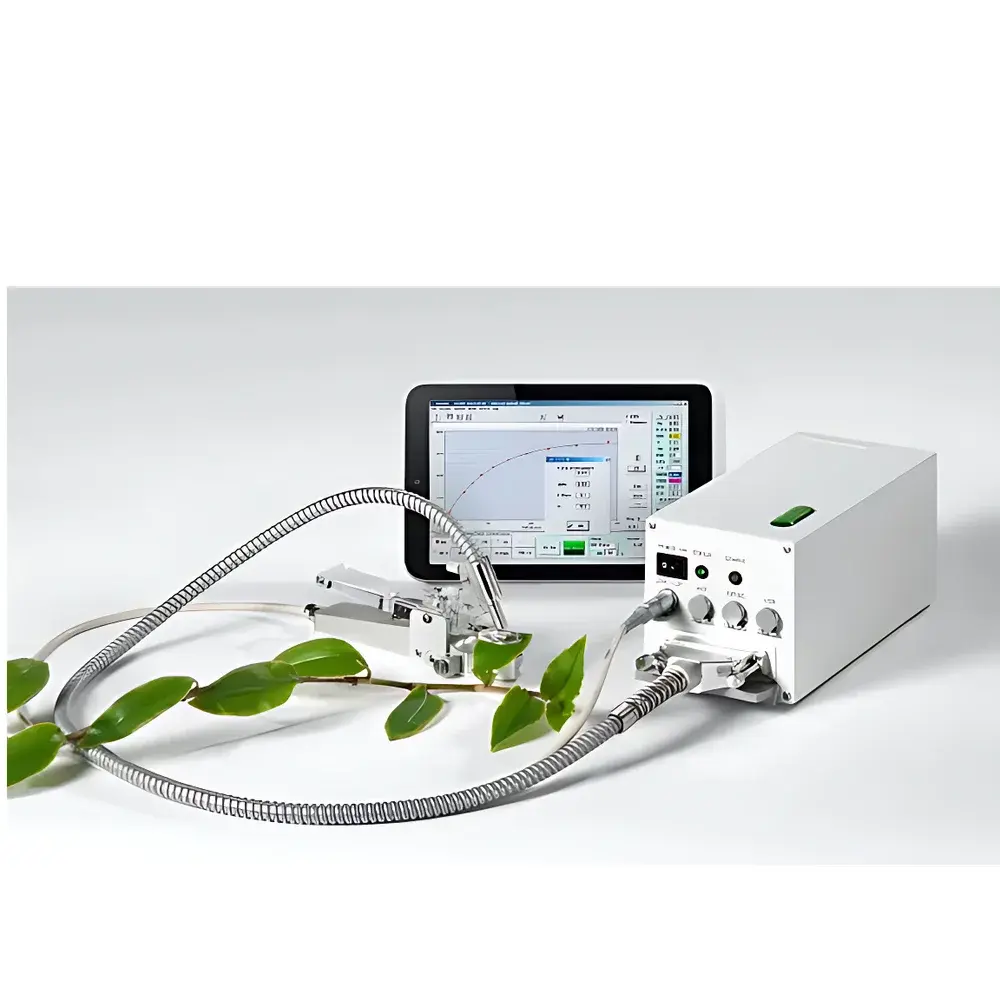
English Product Name
| Brand | WALZ |
|---|---|
| Origin | Germany |
| Model | PAM-2500 |
| Excitation Light | Red LED (modulated, multi-frequency selectable) |
| Actinic Light | Blue LED (up to 800 µmol·m⁻²·s⁻¹), Red LED (up to 4000 µmol·m⁻²·s⁻¹) |
| Far-Red Light | 750 nm LED |
| Saturation Pulse | Red LED (up to 25,000 µmol·m⁻²·s⁻¹) |
| Single-/Multi-Turnover Flash | Red LED (12,500 / 25,000 µmol·m⁻²·s⁻¹) |
| Measured Parameters | Fo, Fm, F, Fo′, Fm′, Fv/Fm, Y(II) [ΔF/Fm′], qL, qP, qN, NPQ, Y(NPQ), Y(NO), ETR, C/Fo, PAR, leaf temperature |
| Operating System | Windows-based embedded interface |
| Compliance | Designed for field-deployable GLP-aligned experimental workflows |
Overview
The WALZ PAM-2500 is a field-portable, pulse-amplitude modulated (PAM) chlorophyll fluorometer engineered for quantitative, non-invasive assessment of photosynthetic performance in vivo. It operates on the principle of kinetic fluorescence induction analysis, leveraging modulated measuring light and saturating pulses to resolve photochemical and non-photochemical quenching processes within Photosystem II (PSII). The instrument captures rapid fluorescence transients (O–I–D–P and O–J–I–P phases), slow-phase relaxation kinetics, and light-response relationships—including rapid light curves (RLCs)—enabling robust inference of electron transport rate (ETR), quantum yield of PSII (Y(II)), photochemical quenching (qP), and non-photochemical quenching (NPQ). Its dual-wavelength actinic system (blue + red LEDs) supports species-specific spectral optimization, while far-red illumination (750 nm) ensures complete dark-adapted state recovery by oxidizing PSI acceptors. Designed for deployment in remote ecological sites, agricultural plots, and aquatic sampling stations, the PAM-2500 integrates a ruggedized Windows-based interface with real-time data visualization—eliminating dependency on external laptops in field settings.
Key Features
- Field-optimized portable architecture with integrated battery operation and IP54-rated enclosure for dust/moisture resistance
- Dual-band actinic light source: independently controllable blue LED (≤800 µmol·m⁻²·s⁻¹) and red LED (≤4000 µmol·m⁻²·s⁻¹) for tailored excitation across plant functional types
- High-intensity saturation pulses (up to 25,000 µmol·m⁻²·s⁻¹) and configurable single-/multi-turnover flashes (12,500 / 25,000 µmol·m⁻²·s⁻¹) for precise QA⁻/QB redox kinetics and S-state analysis of the oxygen-evolving complex
- Real-time acquisition of >15 standardized fluorescence parameters—including qL (linear electron transport estimate), Y(NO) (non-regulated energy dissipation), and C/Fo (connectivity index)—calculated per IUPAC and ASTM E2912-23 conventions
- Onboard Windows OS with dedicated software enabling immediate visualization of OJIP transients, RLCs, NPQ relaxation kinetics, and pre-flash effect profiles without external computing hardware
- Modular optical interface supporting interchangeable fiber-optic configurations: leaf clips (standard & Arabidopsis-specific), suspension chambers, and large-surface mounting fixtures
Sample Compatibility & Compliance
The PAM-2500 accommodates diverse photosynthetic samples without destructive preparation: intact leaves (C3, C4, CAM), bryophytes, lichens, macroalgae, phytoplankton suspensions, and microalgal biofilms. Its fiber-optic coupling permits measurements under natural or controlled irradiance regimes, including submergence-compatible setups using optional magnetic stirrers and cuvette holders. All firmware and data logging protocols adhere to principles of traceable experimental design as defined in ISO 17025:2017 (General requirements for competence of testing and calibration laboratories) and support audit-ready metadata tagging—including operator ID, GPS coordinates (via optional Bluetooth module), ambient PAR, and leaf temperature. While not FDA 21 CFR Part 11-certified out-of-the-box, raw data export (ASCII/CSV) and time-stamped parameter logs facilitate integration into validated GxP-compliant workflows when deployed within institutional GLP/GMP frameworks.
Software & Data Management
The embedded Windows application provides three operational modes: (1) Field Simplified Mode—streamlined interface for rapid Fo/Fm screening; (2) Advanced Measurement Mode—with synchronized multi-parameter display, customizable trigger thresholds, and dynamic baseline correction; and (3) Kinetic Analysis Mode—for high-resolution OJIP transient capture at up to 10 µs resolution. Data are stored internally (SD card) with automatic timestamping, sensor synchronization (PAR/temperature via 2065-M probe), and hierarchical folder structure aligned with experimental replication logic. Export formats include .csv (for MATLAB/Python post-processing), .xls (for Excel-based statistical analysis), and .png/.svg (publication-ready transient plots). Software updates are delivered via USB or network connection, maintaining backward compatibility with legacy PAM file structures for longitudinal dataset harmonization.
Applications
The PAM-2500 serves as a primary tool in environmental stress physiology—quantifying drought-induced photoinhibition, heavy metal toxicity effects on PSII integrity, and UV-B damage kinetics. It supports crop breeding programs through high-throughput screening of Fv/Fm and Y(II) under controlled abiotic stress gradients. In marine and freshwater ecology, it enables in situ assessment of phytoplankton community photophysiology during bloom dynamics or pollutant exposure assays. Its portability and low power demand make it suitable for canopy-level measurements in forest understories, alpine tundra transects, and greenhouse phenotyping platforms. Additional use cases include validation of remote sensing reflectance indices (e.g., PRI, NDVI), calibration of chlorophyll fluorescence models (e.g., FLUORIS, PROSPECT-D), and method development for ISO 10260-based ecotoxicity testing protocols.
FAQ
Does the PAM-2500 require a laptop for field operation?
No—the instrument features an integrated Windows-based touchscreen interface with onboard processing, eliminating dependency on external computers during measurement.
Can it measure submerged aquatic samples?
Yes—when paired with the optional suspension chamber (2030-S) and magnetic stirrer, it supports stable fluorescence kinetics in liquid-phase microalgal cultures and phytoplankton suspensions.
What is the spectral range of the actinic light sources?
Blue LED peak emission: 455 ± 10 nm; Red LED peak emission: 625 ± 10 nm; Far-red LED: 750 ± 15 nm.
Is temperature compensation applied during fluorescence calculation?
Yes—leaf temperature is measured concurrently via integrated thermistor (or optional 2065-M probe), and all quenching parameters (e.g., NPQ, qP) are corrected using empirically derived thermal deactivation coefficients per published Walz et al. (2010) methodology.
How is data traceability ensured for regulatory submissions?
Raw intensity traces, parameter tables, and metadata (time, location, operator, instrument ID) are exported in machine-readable formats compatible with LIMS integration and satisfy minimum reporting requirements of OECD Test Guideline 200 and ISO 14442:2021 for photosynthetic toxicity assays.
Related Products




