
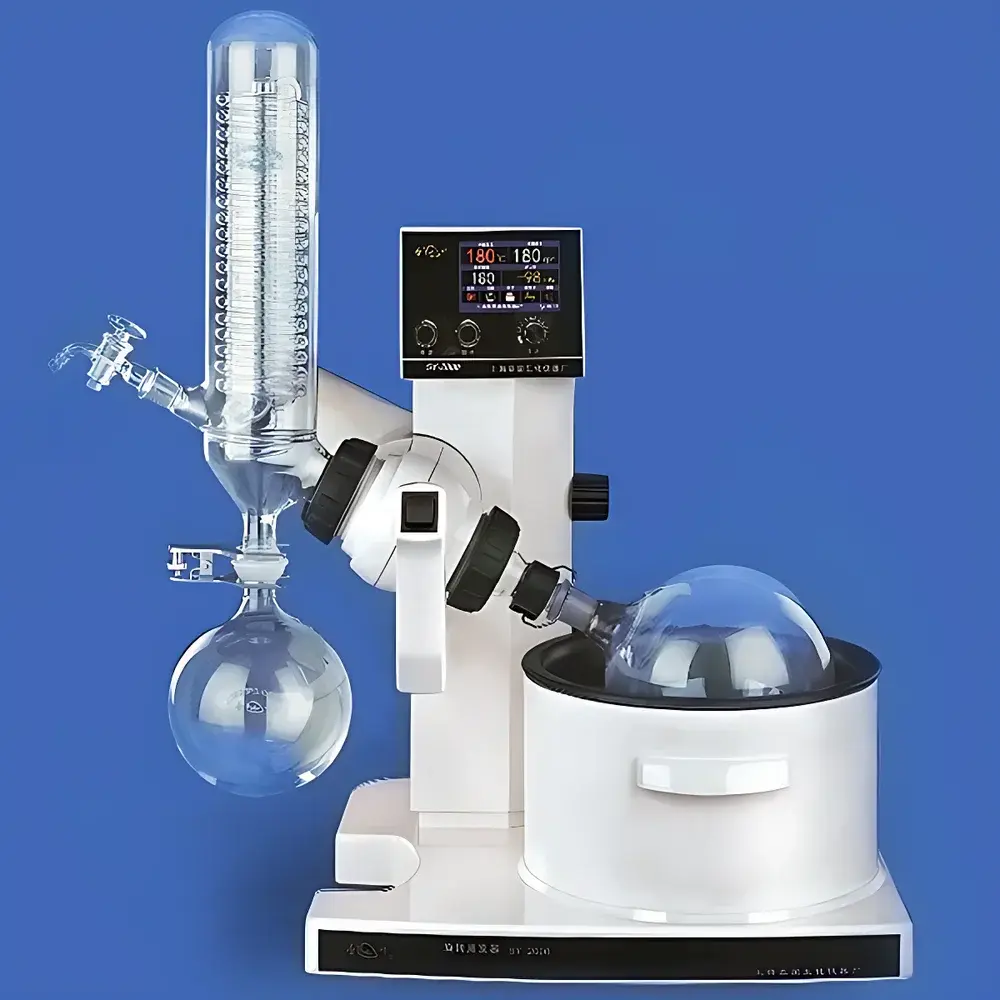
Shanghai Yarong SY-2000 Rotary Evaporator
| Brand | Shanghai Yarong |
|---|---|
| Model | SY-2000 |
| Evaporation Flask Capacity | 50–2000 mL |
| Ultimate Vacuum Range | −0.01 to −0.095 MPa (built-in vacuum controller, accuracy ±0.2–0.5%) |
| Rotation Speed | 0–200 rpm |
| Temperature Control Range | Ambient to 180 °C (PID-controlled, LED digital display) |
| Temperature Accuracy | ±1 °C (water bath), ±2 °C (oil bath) |
| Condenser Type | Ground-glass dual-path reflux condenser |
| Effective Condensing Area | 0.15 m² |
| Heating Bath Compatibility | Water and oil baths |
| Display | Full-color LCD screen with independent time setting, real-time temperature/rotation readout |
Overview
The Shanghai Yarong SY-2000 Rotary Evaporator is an engineered solution for efficient, reproducible solvent removal under reduced pressure in research and quality control laboratories. Based on the fundamental principle of rotary evaporation—simultaneous application of reduced pressure, controlled heating, and continuous sample rotation—the SY-2000 facilitates rapid concentration, purification, and recovery of heat-sensitive compounds without thermal degradation. Its modular architecture integrates a high-efficiency ground-glass dual-path condenser, precision PID temperature regulation, and a built-in vacuum control system capable of stable operation across a wide negative pressure range (−0.01 to −0.095 MPa). Designed for versatility in both academic and industrial settings, the SY-2000 supports routine applications in natural product isolation, pharmaceutical intermediate processing, polymer synthesis workups, and analytical sample preparation.
Key Features
- Integrated Vacuum Management: Built-in vacuum controller enables precise, programmable setpoint adjustment within −0.01 to −0.095 MPa, with repeatability better than ±0.5% of full scale—critical for method transfer and SOP compliance.
- Dual-Mode Heating Bath: Compatible with both water and oil baths; temperature regulated via PID algorithm with digital LED feedback, ensuring stability within ±1 °C (water) or ±2 °C (oil) across the full 20–180 °C operating range.
- Optimized Condensation Efficiency: Ground-glass dual-path reflux condenser provides 0.15 m² effective cooling surface area, minimizing vapor bypass and maximizing solvent recovery—especially advantageous for low-boiling solvents (e.g., diethyl ether, dichloromethane) and high-throughput workflows.
- Intuitive Full-Color LCD Interface: Displays real-time values for bath temperature, rotation speed, vacuum level, and user-defined timer; supports independent parameter locking and multi-step program storage for unattended operation.
- Robust Mechanical Design: Sealed gear motor with variable-speed drive (0–200 rpm), PTFE-coated shaft, and corrosion-resistant stainless-steel frame ensure long-term reliability under continuous use in organic solvent environments.
Sample Compatibility & Compliance
The SY-2000 accommodates standard ISO-K (29/32, 35/20) ground-glass joints and accepts evaporation flasks from 50 mL to 2000 mL—enabling scalable processing from micro-scale screening to pilot-batch purification. Its sealed vacuum pathway and chemically inert wetted materials (borosilicate glass, PTFE, silicone) support compatibility with common laboratory solvents including acetone, methanol, ethyl acetate, hexane, and chloroform. The instrument meets general safety requirements per IEC 61010-1 for laboratory electrical equipment and is suitable for use in GLP-compliant environments when operated within documented procedures. While not certified to specific ISO/IEC 17025 or FDA 21 CFR Part 11 standards out-of-the-box, its digital logging capability (via optional RS-485 or USB export) supports audit-ready data capture when integrated into validated laboratory information management systems (LIMS).
Software & Data Management
The SY-2000 operates as a standalone unit with no proprietary software dependency. All operational parameters—including start/stop timestamps, temperature ramps, vacuum profiles, and rotation sequences—are displayed and retained in non-volatile memory for up to 99 cycles. Data export functionality (via USB interface) allows CSV-formatted logs to be transferred for traceability, trending analysis, or inclusion in electronic lab notebooks (ELN). When deployed in regulated environments, users may configure external data acquisition systems to record analog outputs (0–10 V or 4–20 mA signals for temperature/vacuum) with timestamped metadata aligned to internal clocks—supporting ALCOA+ principles (Attributable, Legible, Contemporaneous, Original, Accurate, Complete, Consistent, Enduring, Available).
Applications
- Concentration of natural extracts (e.g., plant alkaloids, essential oils) under gentle conditions to preserve volatile terpenes and thermolabile glycosides.
- Removal of reaction solvents following Grignard, Suzuki, or amidation reactions—particularly where residual solvent limits must meet ICH Q3C guidelines.
- Purification of synthetic intermediates prior to crystallization or chromatographic analysis (HPLC, GC-MS).
- Preparative-scale drying of lyophilized fractions or solvent-exchanged biopolymer solutions.
- Routine QC sample preparation in pharmaceutical manufacturing, including API dissolution testing and extractables/leachables workflow support.
FAQ
What flask sizes are compatible with the SY-2000?
The SY-2000 accepts standard ground-glass joint flasks ranging from 50 mL to 2000 mL, with optimal performance observed using 500 mL and 1000 mL round-bottom flasks for most routine applications.
Can the SY-2000 be used with corrosive solvents such as hydrochloric acid or trifluoroacetic acid?
No. While the condenser and flask are borosilicate glass, the vacuum seal components and bath chamber gaskets are not chemically resistant to strong mineral acids or halogenated acids; use only with organic solvents and aqueous solutions at pH 4–10.
Is the vacuum controller programmable for multi-step pressure ramps?
Yes—the built-in controller supports up to three sequential vacuum setpoints with user-defined dwell times, enabling controlled distillation of solvent mixtures with differing boiling points.
Does the SY-2000 include a chiller or refrigerated circulator?
No. A separate recirculating chiller (recommended: −20 °C minimum outlet temperature) must be connected to the condenser’s coolant ports for optimal condensation efficiency with low-boiling solvents.
How is calibration verification performed for temperature and vacuum sensors?
Temperature calibration is verified using a NIST-traceable RTD probe immersed in the bath; vacuum calibration requires a secondary reference gauge (e.g., capacitance manometer) connected in parallel to the system manifold—both procedures are outlined in the included technical manual.



