
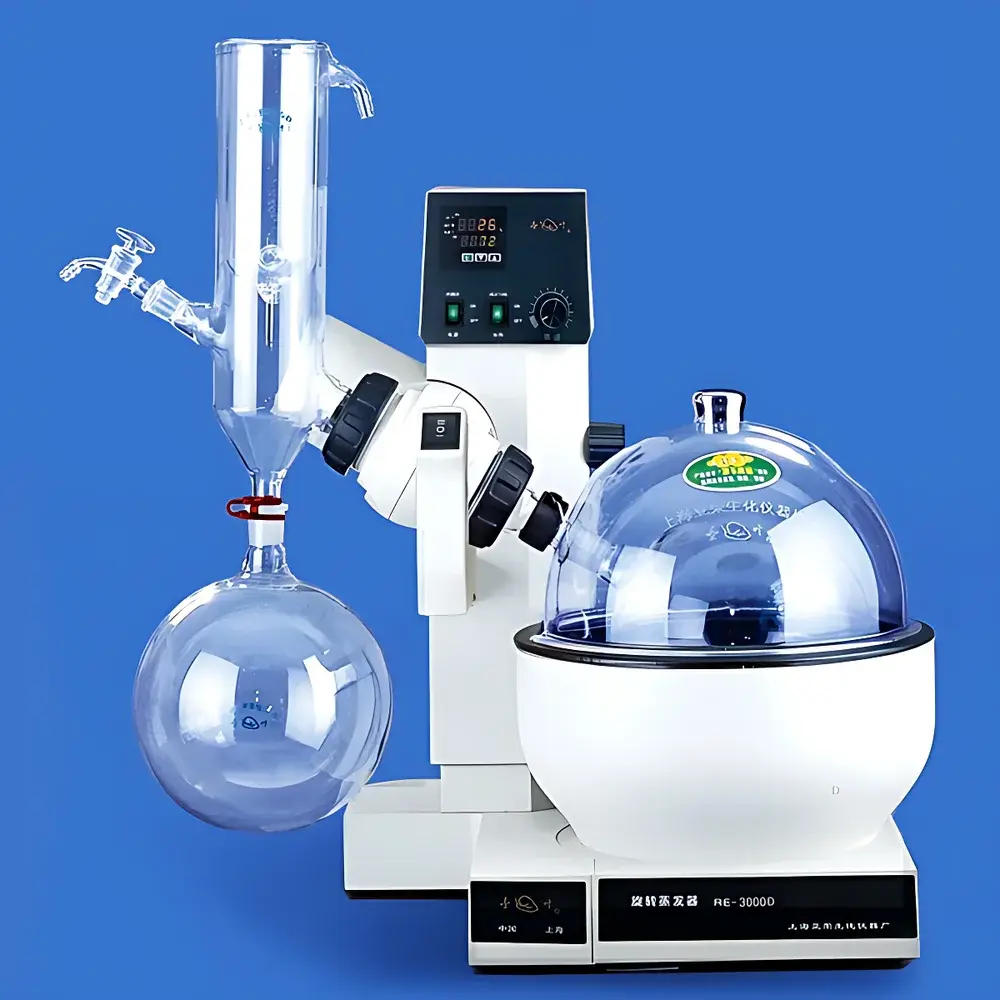
Jinye RE-3000D Rotary Evaporator
| Brand | Jinye |
|---|---|
| Origin | Shanghai, China |
| Manufacturer Type | Direct Manufacturer |
| Model | RE-3000D |
| Evaporation Flask Capacity | 50–3000 mL |
| Rotation Speed Range | 0–200 rpm |
| Temperature Control | PID-controlled heating bath with digital display, ambient to 99 °C |
| Temperature Accuracy | ±1 °C |
| Condenser Type | Cold-trap (dry-ice-cooled) |
Overview
The Jinye RE-3000D Rotary Evaporator is a precision-engineered laboratory instrument designed for efficient solvent removal, concentration, and purification under reduced pressure. Operating on the principle of rotary evaporation—where simultaneous rotation, vacuum application, and controlled bath heating reduce the boiling point of solvents—the RE-3000D enables rapid, gentle, and reproducible evaporation of heat-sensitive compounds. Its cold-trap condenser, optimized for dry-ice cooling (−78 °C), ensures high condensation efficiency for low-boiling solvents such as diethyl ether, acetone, dichloromethane, and ethyl acetate. The system is engineered for stability across extended operation cycles and integrates seamlessly into workflows requiring scalable sample processing—from analytical-scale extractions to pilot-scale batch concentration in R&D and quality control laboratories.
Key Features
- PID-controlled heating bath with digital temperature display, offering precise thermal regulation from ambient to 99 °C with ±1 °C accuracy—critical for maintaining compound integrity during concentration.
- Stepless electronic speed control (0–200 rpm) enabling fine-tuned optimization of film formation and evaporation rate across diverse viscosities and flask sizes.
- Cold-trap condenser design utilizing dry-ice coolant, delivering consistent sub-zero surface temperatures for maximal condensate recovery and minimal solvent loss or backstreaming.
- Robust stainless-steel and borosilicate glass construction compliant with standard laboratory chemical resistance requirements; all wetted parts are inert and non-contaminating.
- Integrated vacuum seal and adjustable lifting mechanism for safe, repeatable flask positioning—reducing operator intervention and mechanical stress on joints and seals.
- Modular architecture supporting optional upgrades including vacuum controllers, solvent traps, and inert gas purging kits for oxygen-sensitive applications.
Sample Compatibility & Compliance
The RE-3000D accommodates standard ground-glass jointed evaporating flasks ranging from 50 mL to 3000 mL, facilitating both small-volume analytical recoveries and larger preparative batches. It is compatible with common organic solvents, aqueous mixtures, and moderately aggressive media (e.g., dilute acids/bases), provided appropriate glassware selection and vacuum line protection are applied. The unit meets general safety requirements outlined in IEC 61010-1 for laboratory electrical equipment and conforms to material compatibility guidelines per ISO 8573-1 for compressed air–assisted systems (when used with optional nitrogen purge). While not certified for GMP manufacturing environments out-of-the-box, its design supports audit-ready documentation practices—including manual log entries for temperature setpoints, rotation speed, and run duration—aligning with GLP traceability expectations.
Software & Data Management
The RE-3000D operates via standalone hardware controls without embedded firmware or network connectivity. All operational parameters—including bath temperature, rotation speed, and runtime—are manually configured and monitored through front-panel digital displays. For laboratories requiring electronic recordkeeping, the device is compatible with external data loggers (e.g., USB-connected thermocouple readers or programmable PLC interfaces) that capture time-stamped temperature and speed values. When integrated into validated workflows, users may implement SOP-driven manual entry protocols aligned with FDA 21 CFR Part 11 principles—such as dual-operator verification for critical parameter changes and bound logbook archiving—to support regulatory submissions and internal quality audits.
Applications
- Concentration of natural product extracts in phytochemistry and nutraceutical development.
- Solvent exchange and intermediate isolation in synthetic organic chemistry and API process development.
- Removal of volatile reaction byproducts prior to crystallization or lyophilization in biopharmaceutical formulation.
- Routine QC sample preparation for HPLC, GC, or mass spectrometry analysis—particularly where residual solvent interference must be minimized.
- Dehydration and stabilization of labile compounds in fine chemical synthesis, including esters, lactones, and terpenoids.
- Teaching applications in university chemistry and chemical engineering laboratories, emphasizing vacuum thermodynamics and mass transfer fundamentals.
FAQ
What types of solvents are most effectively recovered using the dry-ice cold trap?
Solvents with boiling points below 60 °C—such as ether, pentane, chloroform, and THF—achieve >95% condensation efficiency under typical operating conditions (≤20 mbar vacuum, −78 °C condenser surface).
Can the RE-3000D be used under inert atmosphere?
Yes—via optional two-neck flask configuration and nitrogen/argon inlet adapter, enabling solvent evaporation without oxidation of air-sensitive products.
Is calibration documentation provided with the unit?
Factory calibration certificates for the digital temperature sensor and tachometer are available upon request; users are advised to perform periodic verification per internal QA procedures.
What maintenance is required for long-term reliability?
Routine inspection of PTFE vacuum seals, periodic cleaning of the condenser coil with ethanol, and annual verification of bath heater response time and thermal uniformity are recommended.
Does the unit comply with CE or UL safety standards?
The RE-3000D meets general laboratory equipment safety benchmarks per IEC 61010-1; CE marking is not applied as it is manufactured for domestic and export markets requiring local certification alignment.
Related Products



