
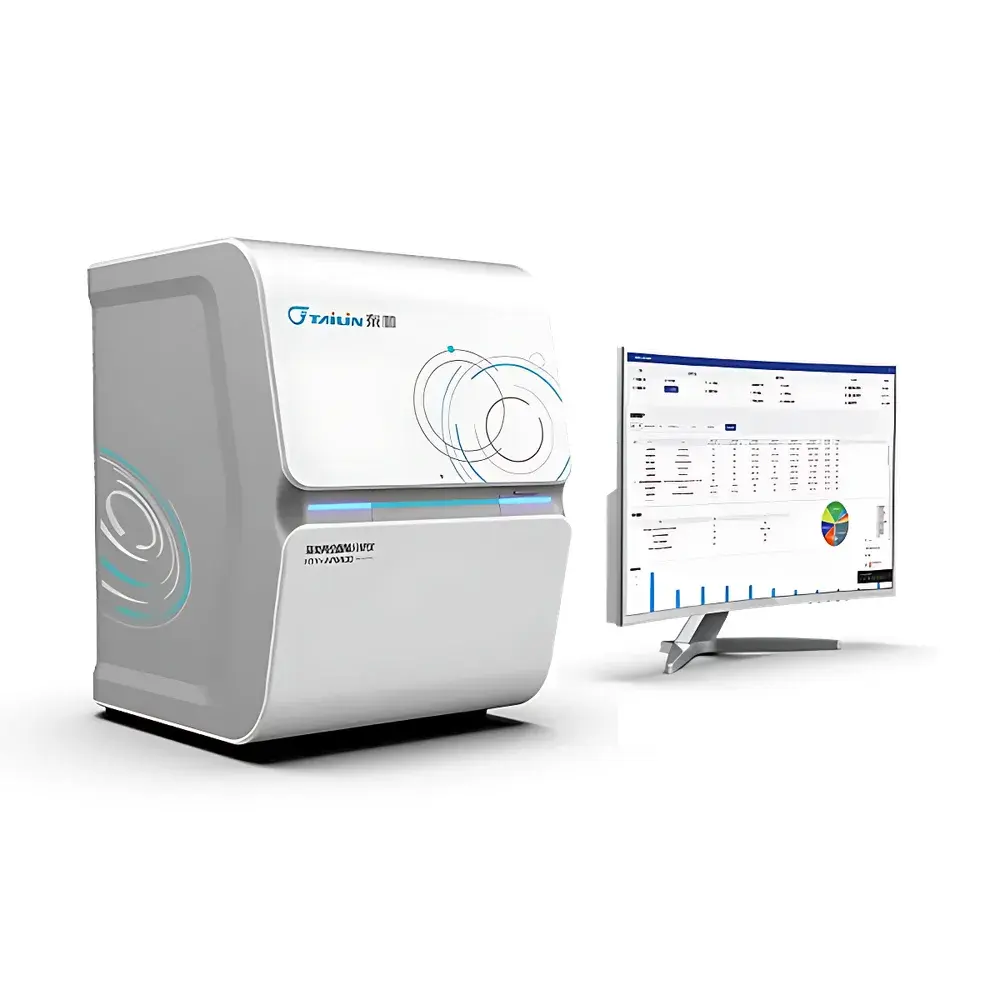
Tailin HTY-APM100 Intelligent Algae and Protozoan (Giardia/Cryptosporidium) Analysis System
| Brand | Tailin |
|---|---|
| Origin | Zhejiang, China |
| Manufacturer Type | Manufacturer |
| Origin Category | Domestic |
| Model | HTY-APM100 |
| Pricing | Upon Request |
Overview
The Tailin HTY-APM100 Intelligent Algae and Protozoan (Giardia/Cryptosporidium) Analysis System is an integrated digital microscopy platform engineered for standardized, high-throughput biological water quality assessment. It implements automated brightfield and phase-contrast imaging combined with deep learning–based object detection to perform morphological identification, spatial localization, and quantitative enumeration of protozoan cysts (Giardia lamblia and Cryptosporidium parvum) and phytoplankton taxa in filtered water samples. Designed in alignment with regulatory workflows for drinking water safety and aquatic ecosystem health monitoring, the system bridges laboratory-grade microscopy with computational image analytics—enabling reproducible, audit-ready analysis without manual taxonomic expertise. Its dual-mode architecture supports seamless transition between protozoan detection (per EPA 1623.1/GB/T 5750.12-2023) and algal community profiling (per HJ 1215-2021, HJ 1216-2021), making it suitable for routine compliance testing as well as ecological status evaluation under HJ 1295-2023 and HJ 1296-2023.
Key Features
- Dual-Mode Operational Architecture: One instrument supports two independent analytical workflows—“Protozoan Detection Mode” optimized for immunofluorescence-labeled oocyst/cyst enumeration, and “Algal Analysis Mode” configured for unstained or chlorophyll-a–stained phytoplankton identification and biovolume estimation.
- Faster R-CNN–Based Recognition Engine: Trained on a peer-reviewed, SciPress-licensed reference database covering ≥140 algal genera and species-level morphotypes of Giardia and Cryptosporidium; model supports incremental retraining using user-annotated datasets to improve local strain recognition accuracy over time.
- Fully Automated Slide Handling: Five-channel scanning stage enables concurrent processing of up to five prepared membrane filters; auto-focus, multi-zoom mosaic stitching, and adaptive illumination ensure consistent image quality across heterogeneous sample regions.
- Regulatory-Ready Data Output: Generates traceable digital records including raw image stacks, annotated detection maps, cell-level metadata (size, shape, intensity, location), summary statistics (density, biomass, dominance index), and exportable CSV/PDF reports compliant with GLP documentation requirements.
- Ergonomic Human-Machine Interface: Physical tactile controls for rapid slide loading, mode switching, and emergency pause; touchscreen interface with context-sensitive workflow guidance reduces operator training time and minimizes procedural deviation.
Sample Compatibility & Compliance
The HTY-APM100 accepts standard 25 mm or 47 mm polycarbonate or mixed-cellulose ester (MCE) membrane filters post-immunomagnetic separation (IMS) or filtration-concentration procedures. It is validated for use with fluorescently labeled antibody assays (e.g., Merifluor® Crypto/Giardia) and common algal staining protocols (e.g., Lugol’s iodine, acridine orange). The system conforms to methodological requirements specified in GB/T 5750.12-2023 (drinking water microbiological testing), CJ/T 141-2018 (urban water supply quality verification), HJ 1215-2021 and HJ 1216-2021 (phytoplankton enumeration standards), and the provisional technical guidelines HJ 1295-2023 and HJ 1296-2023 for riverine and lacustrine ecological monitoring. All image acquisition parameters, algorithm versioning, and user actions are logged with timestamps and operator IDs to support FDA 21 CFR Part 11–aligned audit trails.
Software & Data Management
The embedded Tailin APM Suite v3.x provides centralized control of hardware operations, real-time visualization, and post-acquisition analytics. Image data are stored in DICOM-compliant format with embedded EXIF metadata (magnification, exposure, objective lens ID, filter set). Quantitative outputs—including cell counts per unit volume, biovolume calculations via geometric approximation, Shannon-Wiener diversity indices, and relative abundance heatmaps—are generated automatically. Export modules support CSV, Excel (.xlsx), PDF (with embedded hyperlinked images), and structured JSON for LIMS integration. Role-based access control (RBAC), electronic signatures, and version-controlled software updates ensure compliance with ISO/IEC 17025 and GLP data integrity principles.
Applications
- Drinking water utilities performing routine Cryptosporidium/Giardia surveillance per national regulatory frameworks
- Environmental monitoring agencies conducting seasonal phytoplankton community assessments in rivers, reservoirs, and coastal zones
- Public health laboratories executing outbreak investigations requiring rapid protozoan confirmation and strain-level prevalence mapping
- Third-party testing laboratories seeking ISO/IEC 17025 accreditation for waterborne pathogen and algal toxin precursor screening
- Research institutions studying eutrophication dynamics, harmful algal bloom (HAB) forecasting, or climate-driven shifts in freshwater plankton composition
FAQ
Does the HTY-APM100 require external fluorescence excitation sources or filter cubes?
No—the system integrates solid-state LED excitation at 470 nm and 530 nm with tunable emission filtering, eliminating the need for external lamp housings or manual filter wheel changes.
Can users add custom algal morphotypes to the recognition library?
Yes—via the “Model Retraining Portal” in APM Suite, certified operators may upload annotated image sets and initiate supervised fine-tuning of the base Faster R-CNN model.
Is raw image data storage included in the base configuration?
Yes—standard 2 TB RAID-1 internal storage retains full-resolution image stacks for ≥6 months; optional NAS or cloud archive integration is available via API.
What level of technical support is provided for method validation?
Tailin offers on-site IQ/OQ protocol execution, ASTM D5905-compliant precision studies, and co-validation assistance with regional certification bodies upon request.
Does the system support batch processing of historical slide archives?
Yes—retrospective analysis of archived glass slides or digitized TIFF stacks is supported using the offline “Legacy Slide Interpreter” module with adjustable focus depth interpolation.
Related Products







