
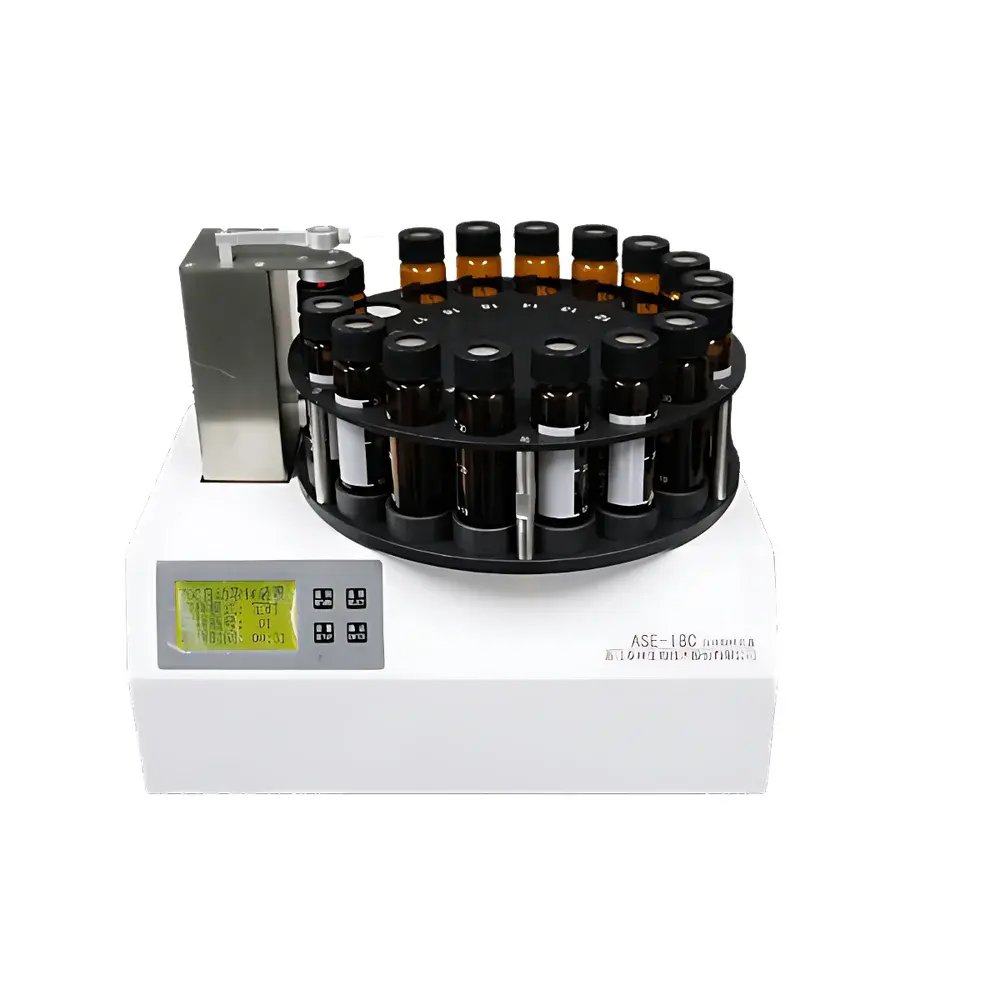
Tailin Biotech ASE-18C Fully Automated TOC Sampling System (18-Position)
| Brand | Tailin Biotech |
|---|---|
| Origin | Zhejiang, China |
| Manufacturer Type | OEM/ODM Manufacturer |
| Regional Classification | Domestic (China) |
| Model | ASE-18C |
| Power Supply | 100–240 VAC, 50/60 Hz |
| Rated Power | 40 W |
| Sample Capacity | 18 vials per cycle |
| Dimensions | 380 × 320 × 340 mm (W × D × H) |
| Compatible TOC Analyzers | HTY-DI1000-PL, HTY-DI1500, HTY-GM2000, HTY-GM3000 |
| Operating Modes | Analyzer-Synchronized (Online) Mode & Time-Based (Scheduled) Mode |
| Bottle Detection | Integrated optical/vacuum-based presence sensing |
| Maintenance Requirement | Minimal |
Overview
The Tailin Biotech ASE-18C Fully Automated TOC Sampling System is an engineered interface designed to eliminate manual intervention in total organic carbon (TOC) analysis workflows for pharmaceutical water systems, purified water (PW), water for injection (WFI), and clean steam condensate. It operates on a precision pneumatic-driven carousel architecture with integrated bottle presence detection, enabling unattended, repeatable sampling across 18 standardized vials per sequence. Unlike generic autosamplers, the ASE-18C is purpose-built for seamless integration with Tailin’s HTY-DI and HTY-GM series offline TOC analyzers—leveraging native communication protocols (RS-232 or TTL-level digital handshake) to synchronize sample presentation with instrument readiness. Its core function is to reduce operator dependency, minimize ambient air intrusion during vial handling, and ensure consistent dwell time between sampling events—critical factors influencing oxidation efficiency and measurement reproducibility in high-sensitivity TOC quantification (detection limit < 0.1 ppb C).
Key Features
- 18-position rotary carousel with passive vial retention—no clamps or motorized grippers—to ensure mechanical stability and long-term positional repeatability.
- Intelligent bottle detection system combining vacuum feedback and optical sensing to confirm vial presence prior to aspiration, preventing dry-run cycles and reducing baseline drift caused by air entrainment.
- Dual operational modes: Online mode enables real-time coordination with HTY-DI/GM analyzers via hardware-triggered handshaking; Scheduled mode supports time-defined sampling intervals (e.g., every 15, 30, or 60 minutes) independent of analyzer status.
- Low-power design (40 W max) optimized for continuous operation in controlled environments—compatible with ISO 14644-1 Class 5–7 cleanrooms when installed adjacent to analytical instrumentation.
- Front-access loading tray with tactile alignment guides—no tools or alignment fixtures required—supporting rapid vial exchange using standard 40 mL borosilicate glass vials with PTFE-lined caps.
- No internal pumps, valves, or wetted components—eliminating cross-contamination risk and eliminating scheduled maintenance associated with fluidic path degradation.
Sample Compatibility & Compliance
The ASE-18C accommodates industry-standard 40 mL TOC sample vials conforming to USP , EP 2.2.44, and ASTM D5905 specifications. Its non-invasive, open-loop sample transfer architecture ensures full compatibility with oxidant-sensitive matrices—including hydrogen peroxide-treated PW and ozone-sanitized distribution loops—without introducing catalytic residues or altering redox potential. The system meets electromagnetic compatibility requirements per IEC 61326-1 for laboratory use and complies with electrical safety standards IEC 61010-1. While not certified as GMP-compliant out-of-the-box, its deterministic behavior, absence of software-configurable logic, and audit-ready operational logs (when paired with compatible HTY analyzers supporting 21 CFR Part 11) support qualification under FDA, EMA, and PMDA regulatory frameworks.
Software & Data Management
The ASE-18C operates as a firmware-controlled peripheral with no embedded operating system or user-facing software interface. All configuration—including mode selection, timing parameters (in Scheduled mode), and handshake timeout thresholds—is performed exclusively through the host TOC analyzer’s control panel or remote terminal interface. When connected to HTY-DI1500 or HTY-GM3000 units equipped with Tailin’s T-Link™ firmware (v3.2+), the sampler contributes timestamped event metadata—including vial position ID, detection confirmation status, and cycle completion flag—to the analyzer’s raw data file (.CSV or .XML). This enables traceability mapping from analytical result to physical sample location without requiring third-party LIMS integration.
Applications
- Continuous monitoring of pharmaceutical water systems during validation (IQ/OQ/PQ) and routine surveillance per EU GMP Annex 1 and USP .
- Unattended batch release testing of WFI in multi-shift manufacturing environments.
- Synchronization with TOC analyzers during thermal validation studies where temporal resolution of organic carbon spikes must correlate precisely with temperature ramp profiles.
- Supporting ASTM D8078-compliant microbial recovery assessment by enabling timed sampling before and after sanitization cycles without operator presence in classified zones.
- Integration into centralized water monitoring networks using Modbus RTU gateways for aggregated system-level trending (requires optional HTY-IO module).
FAQ
Does the ASE-18C require calibration or periodic verification?
No. As a mechanical and pneumatic positioning device without metrological sensors, it does not require calibration. Verification is limited to functional checks—e.g., confirming vial detection response and carousel indexing accuracy—performed during annual instrument qualification.
Can it be used with non-Tailin TOC analyzers?
Not natively. Communication relies on proprietary hardware-level signaling protocols specific to HTY-DI/GM platforms. Custom interface development would require access to Tailin’s technical documentation and firmware SDK, which is not publicly available.
Is the unit suitable for installation inside a laminar flow hood?
Yes—provided ambient temperature remains within 15–30 °C and relative humidity stays below 70% non-condensing. Its fanless thermal design and low EM emission profile meet typical containment enclosure requirements.
What happens if a vial is missing during a scheduled cycle?
The system halts progression to the next position and logs a “vial absent” event. No purge gas is introduced, and no vacuum draw occurs—preserving system integrity and avoiding contamination of downstream analyzer components.
Does it support barcode scanning or RFID vial identification?
No. Identity tracking is position-based only. Vial-specific metadata must be managed externally via LIMS or spreadsheet linkage using position index (1–18) as the primary key.
Related Products







