
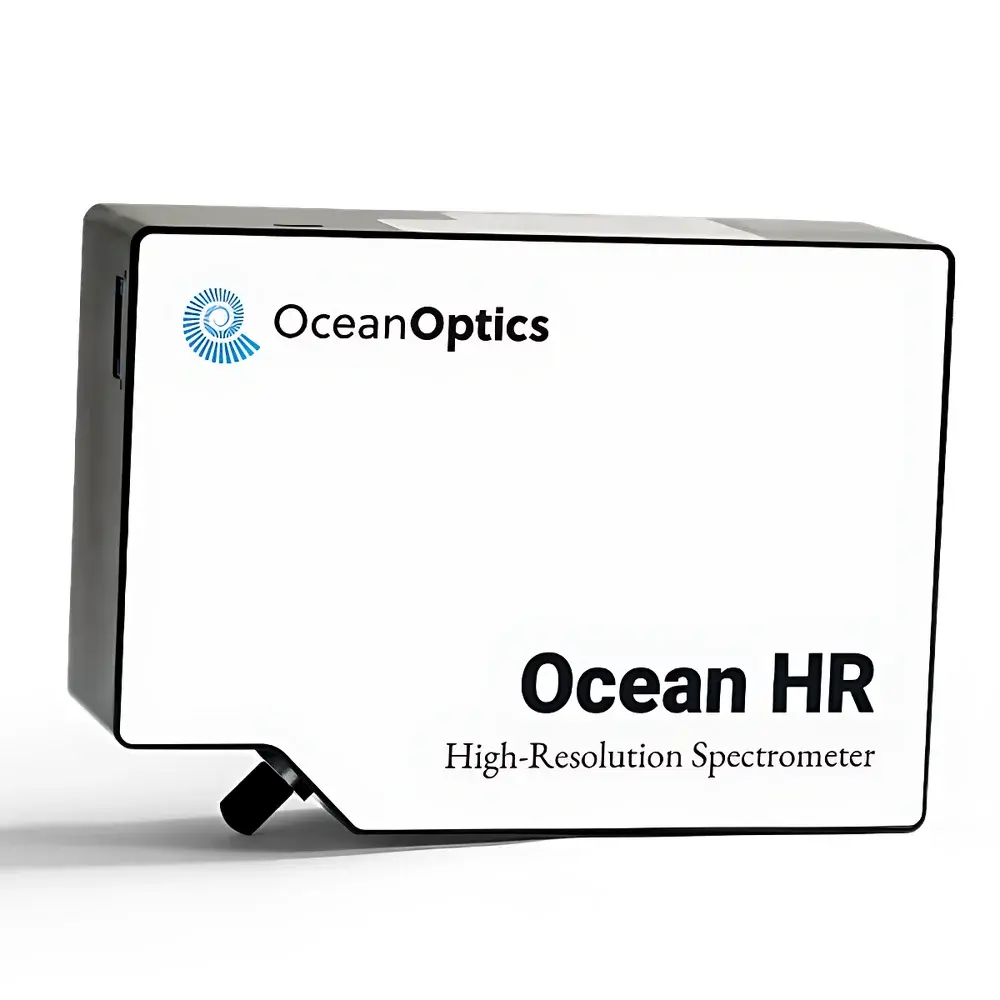
Ocean Optics Ocean HR4 High-Resolution Fiber Optic Spectrometer
| Brand | Ocean Optics |
|---|---|
| Origin | USA |
| Manufacturer Type | Original Equipment Manufacturer (OEM) |
| Import Status | Imported |
| Model | Ocean HR4 |
| Price | Upon Request |
| Spectral Range | 220–1050 nm (configurable by grating and slit) |
| Optical Resolution (FWHM) | 0.13–1.16 nm (dependent on optical configuration) |
| Signal-to-Noise Ratio | 3000:1 (in high-speed averaging mode) |
| Dynamic Range | 1300:1 (single-scan) |
Overview
The Ocean Optics Ocean HR4 is a high-resolution, compact fiber optic spectrometer engineered for precision spectral analysis across ultraviolet, visible, and near-infrared (UV-VIS-NIR) domains. Based on Czerny-Turner optical architecture with optimized aberration correction and thermally stabilized optics, the HR4 delivers exceptional wavelength fidelity and low stray light performance—critical for resolving closely spaced emission or absorption features in complex spectra. Its modular design supports customizable configurations including selectable diffraction gratings, entrance slits (5–200 µm), and detector options (e.g., back-thinned CCD), enabling tailored optimization for application-specific requirements such as plasma monitoring, laser line profiling, atomic emission spectroscopy, or thin-film interference characterization. Designed and manufactured in the United States, the HR4 adheres to ISO 9001-certified production protocols, ensuring consistent inter-unit reproducibility (< ±0.2 nm wavelength shift across production lot) and long-term calibration stability.
Key Features
- High optical resolution: Configurable FWHM from 0.13 nm to 1.16 nm, achieved via interchangeable gratings and precision-machined slit assemblies
- Extended spectral coverage: 220–1050 nm range, scalable through grating selection—supporting UV-VIS (220–850 nm), VIS-NIR (350–1050 nm), or full-range UV-NIR configurations
- Low-stray-light optical path: Optimized baffling, black-anodized internal surfaces, and high-efficiency holographic gratings reduce stray light to < 0.05% at 600 nm
- Thermal stability: Integrated temperature stabilization (±0.1 °C control) minimizes thermal drift of spectral peak position (< 0.005 nm/°C)
- High-speed data acquisition: USB 3.0 interface enables up to 4 kHz full-spectrum readout (with region-of-interest binning); onboard FPGA supports real-time dark correction and pixel normalization
- Rugged OEM-ready form factor: Aluminum housing with IP50-rated enclosure; operating temperature range: 5–40 °C; humidity tolerance: 10–90% RH (non-condensing)
Sample Compatibility & Compliance
The Ocean HR4 interfaces seamlessly with standard SMA 905 fiber optic cables (core diameters 50–600 µm), enabling flexible integration into flow cells, cuvette holders, plasma probes, or remote sensing setups. It supports direct coupling to collimating optics, integrating spheres (e.g., ISP-REF for reflectance), and fiber-coupled light sources including deuterium-halogen lamps, LEDs, and pulsed lasers. The instrument complies with IEC 61326-1 (EMC for laboratory equipment), RoHS 2011/65/EU, and CE marking requirements. For regulated environments, firmware supports optional NIST-traceable wavelength and intensity calibration certificates (certified per ISO/IEC 17025:2017), and raw spectral data export formats (CSV, HDF5, and vendor-neutral JDX) facilitate compliance with FDA 21 CFR Part 11 and GLP/GMP documentation workflows.
Software & Data Management
The HR4 is fully supported by OceanView™ v3.x software (Windows/macOS/Linux), providing intuitive spectral acquisition, real-time peak detection, multi-curve overlay, and quantitative analysis modules including absorbance, transmittance, and fluorescence quantum yield calculation. Application programming interfaces (APIs) are available for Python (oceanoptics-python), MATLAB, LabVIEW, and C/C++, enabling embedded control in automated test systems. All spectral acquisitions include embedded metadata (timestamp, integration time, temperature, slit width, grating ID), supporting audit-trail generation for quality assurance. Data files retain EXIF-like headers compliant with ASTM E131-22 (Standard Terminology Relating to Molecular Spectroscopy), facilitating interoperability with LIMS and ELN platforms.
Applications
- Semiconductor process control: In-situ monitoring of plasma etch endpoints via atomic line identification (e.g., Cl 837.59 nm, F 703.71 nm)
- Photoluminescence and electroluminescence characterization of quantum dots, perovskites, and OLED materials
- UV-Vis-NIR reflectance and transmittance measurements for optical coatings and photovoltaic absorber layers
- Gas-phase emission spectroscopy for combustion diagnostics and environmental monitoring (e.g., NO, OH*, CH* radicals)
- Educational and research spectroscopy labs requiring benchtop-grade resolution without cryogenic cooling
- OEM integration into handheld Raman analyzers, portable LIBS systems, and inline pharmaceutical blend uniformity monitors
FAQ
What determines the actual resolution of the Ocean HR4 in my setup?
Resolution is defined by the combination of grating groove density, entrance slit width, and focal length. A 2400 l/mm grating with 5 µm slit yields ~0.13 nm FWHM at 400 nm; wider slits or lower groove density increase throughput at the expense of resolution.
Can the HR4 be calibrated for radiometric accuracy?
Yes—NIST-traceable irradiance and radiance calibration kits (e.g., HL-3-CAL with cosine corrector) are available, enabling absolute intensity measurement per CIE 127:2007 and ISO 13406-2 standards.
Is the HR4 compatible with third-party triggering and synchronization?
Yes—it supports TTL-level external trigger input (rising/falling edge), hardware shutter control, and programmable delay generators for time-resolved spectroscopy (e.g., pump-probe, gated detection).
How often does the HR4 require recalibration?
Under stable thermal conditions and normal handling, wavelength calibration remains valid for ≥12 months; intensity calibration is recommended annually or after optical component replacement.
Does the HR4 support real-time spectral processing on-device?
No onboard DSP is included; all processing occurs on the host PC. However, the USB 3.0 interface ensures sub-millisecond latency for closed-loop feedback applications when paired with appropriate host-side algorithms.




