
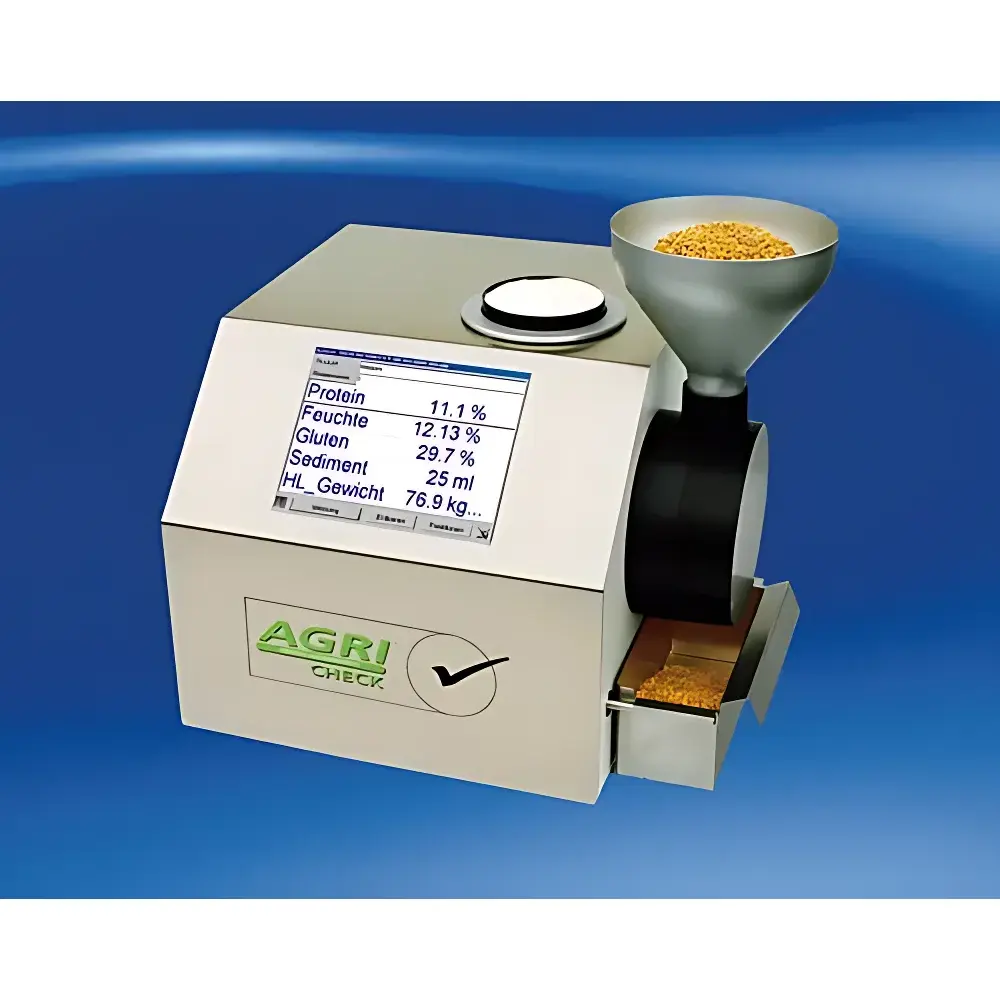
Bruins AgriCheck Plus Dual-Mode Near-Infrared Spectrometer
| Brand | Bruins |
|---|---|
| Origin | Germany |
| Model | AgriCheck Plus |
| Instrument Type | Laboratory NIR Spectrometer |
| Principle | Grating-based Scanning Monochromator (Dual-Beam) |
| Wavelength Range | 730–1100 nm and 1400–2500 nm |
| Spectral Resolution | 0.5 nm |
| Scan Time | ~45 s |
| Sampling Modes | Transmission (for whole grains) and Diffuse Reflectance (for ground/powdered samples) |
| Chemometrics Software | RIMP |
| Dimensions | 385 × 420 × 385 mm |
| Weight | 21 kg |
| Power Supply | 220–240 V / 50 Hz |
| Power Consumption | 45 W |
| Sample Capacity | 650 mL (whole grain), 60 mL (ground) |
| Auto-sampler | 16-position independent sub-sample measurement |
| Rotating Sample Cup | Integrated for homogenized samples |
| Environmental Protection | IP54-rated dust- and moisture-resistant enclosure |
| Interface Ports | USB, Ethernet, Parallel |
| Optional Accessories | Built-in bulk density module, temperature probe, thermal receipt printer, barcode scanner, external keyboard/mouse |
Overview
The Bruins AgriCheck Plus is a dual-mode laboratory near-infrared (NIR) spectrometer engineered for high-reproducibility quantitative analysis across the entire agricultural value chain—from intact cereal grains to processed feed, flour, and specialty food matrices. Unlike conventional single-mode NIR systems, the AgriCheck Plus integrates two physically distinct optical pathways within a single robust architecture: a transmission channel optimized for whole-kernel analysis and a diffuse reflectance channel calibrated for heterogeneous powdered, granular, or pasty samples. Its core optical engine employs a patented dual-beam grating scanning monochromator, delivering full-spectrum acquisition across two non-contiguous NIR regions (730–1100 nm and 1400–2500 nm) with a fixed spectral resolution of 0.5 nm. This design ensures linearity, photometric stability, and long-term wavelength fidelity—critical prerequisites for method transfer and regulatory compliance in QC/QA environments. The instrument operates under Windows-based control and meets fundamental requirements for GLP-aligned data integrity, including audit-trail-capable software logging and secure user access management.
Key Features
- Dual optical path architecture: Independent transmission and diffuse reflectance channels eliminate cross-mode interference and enable method-specific calibration validation.
- Patented dual-beam grating monochromator: Provides inherent baseline stability and minimizes drift during extended operation—essential for multi-shift production labs.
- Integrated bulk density module: Measures grain volumetric mass (kg/hL) automatically during transmission analysis; values are embedded directly into analytical reports without manual entry.
- Temperature-compensated acquisition: Optional PT100 temperature probe synchronizes spectral collection with ambient and sample thermal state, reducing moisture-related bias in hygroscopic matrices.
- 16-position auto-sampler: Supports unattended sequential analysis of whole-grain sub-samples with individual weight normalization and statistical outlier detection per position.
- Rotating sample cup system: Ensures homogeneous presentation of ground materials during reflectance measurement—critical for reproducible particle-size-independent results.
- IP54-rated enclosure: Protects optical and electronic subsystems against dust ingress and incidental moisture exposure in mill-floor or feed plant environments.
Sample Compatibility & Compliance
The AgriCheck Plus accommodates an industry-leading breadth of agricultural specimens without hardware modification. Whole grains—including wheat, durum wheat, barley, maize, soybean, paddy rice, brown rice, oats, rye, triticale, sorghum, and millet—are analyzed via transmission mode using standardized 650 mL fill volumes. Ground and processed materials—including wheat flour, bran, soy meal, sunflower meal, rapeseed cake, beet pulp, peanut meal, alfalfa meal, tea leaves, spices, pet food, and aquafeed—are measured in diffuse reflectance mode using 60 mL rotating cups. All measurements comply with ASTM E1655 (Standard Practices for Infrared Multivariate Quantitative Analysis) and ISO 12099 (Animal feeding stuffs — Guidelines on the application of near infrared spectroscopy). Method validation documentation supports alignment with FDA 21 CFR Part 11 requirements for electronic records and signatures when paired with RIMP software’s audit-trail and electronic signature modules.
Software & Data Management
RIMP (Robust Instrumental Modeling Platform) is the factory-installed chemometrics suite, developed and maintained by Bruins’ in-house application scientists. It provides full lifecycle support for calibration development, validation, and deployment—including PLS, PCR, and SVM regression modeling, spectral preprocessing (SNV, MSC, derivatives), outlier diagnostics (Mahalanobis distance, residual analysis), and performance monitoring (bias, RMSEP, R²). Calibration models are fully portable across all Bruins NIR platforms (AgriCheck series, GrainScan, FeedScan), enabling centralized model governance and cross-site harmonization. Data export supports CSV, XML, and LIMS-compatible formats via Ethernet or USB. Remote maintenance capability allows authorized service engineers to diagnose firmware status, optical alignment, and detector health without on-site visits—reducing instrument downtime.
Applications
The AgriCheck Plus delivers validated quantitative results for key compositional parameters across diverse agrifood sectors. In grain trading and elevator QA, it measures moisture, protein, starch, and test weight for contractual compliance. In milling operations, it monitors ash content, damaged starch, and gluten index in real time. For compound feed manufacturers, it quantifies crude protein, ether extract, fiber fractions (NDF, ADF), lysine, and mycotoxin screening surrogates. In specialty food production, it verifies authenticity of cocoa butter, detects adulteration in olive oil powders, and controls moisture in instant beverages. Application databases—pre-built for over 30 commodity categories—are provided at no cost for three initial products; custom model development is supported through Bruin’s global application lab network using client-supplied reference data and spectra.
FAQ
Does the AgriCheck Plus require annual recalibration by the manufacturer?
No. The patented optical design and internal reference beam ensure long-term wavelength and photometric stability. Users perform routine performance verification using NIST-traceable ceramic standards; full recalibration is only required if physical impact or environmental extremes compromise alignment.
Can existing calibrations from other Bruins instruments be loaded directly?
Yes. RIMP uses a unified model file format (.rimpcal) compatible across all Bruins NIR platforms. No revalidation is needed when transferring models between AgriCheck Plus, GrainScan, or FeedScan units—only instrument-specific validation checks are recommended.
Is the system compliant with GMP/GLP documentation requirements?
When configured with RIMP’s optional Electronic Signature and Audit Trail module, the system satisfies core elements of FDA 21 CFR Part 11, EU Annex 11, and ISO/IEC 17025 for accredited testing laboratories.
What sample preparation is required for whole-grain analysis?
None beyond standard cleaning and removal of foreign material. The instrument accepts clean, dry, unbroken kernels directly into the hopper—no grinding, sieving, or conditioning is necessary.
How is measurement repeatability ensured for heterogeneous ground samples?
The rotating sample cup rotates at 60 rpm during acquisition, averaging signal across ≥12 spatial positions per scan. Combined with RIMP’s spectral homogeneity assessment, this ensures representative sampling even for poorly mixed feeds or coarse flours.





