
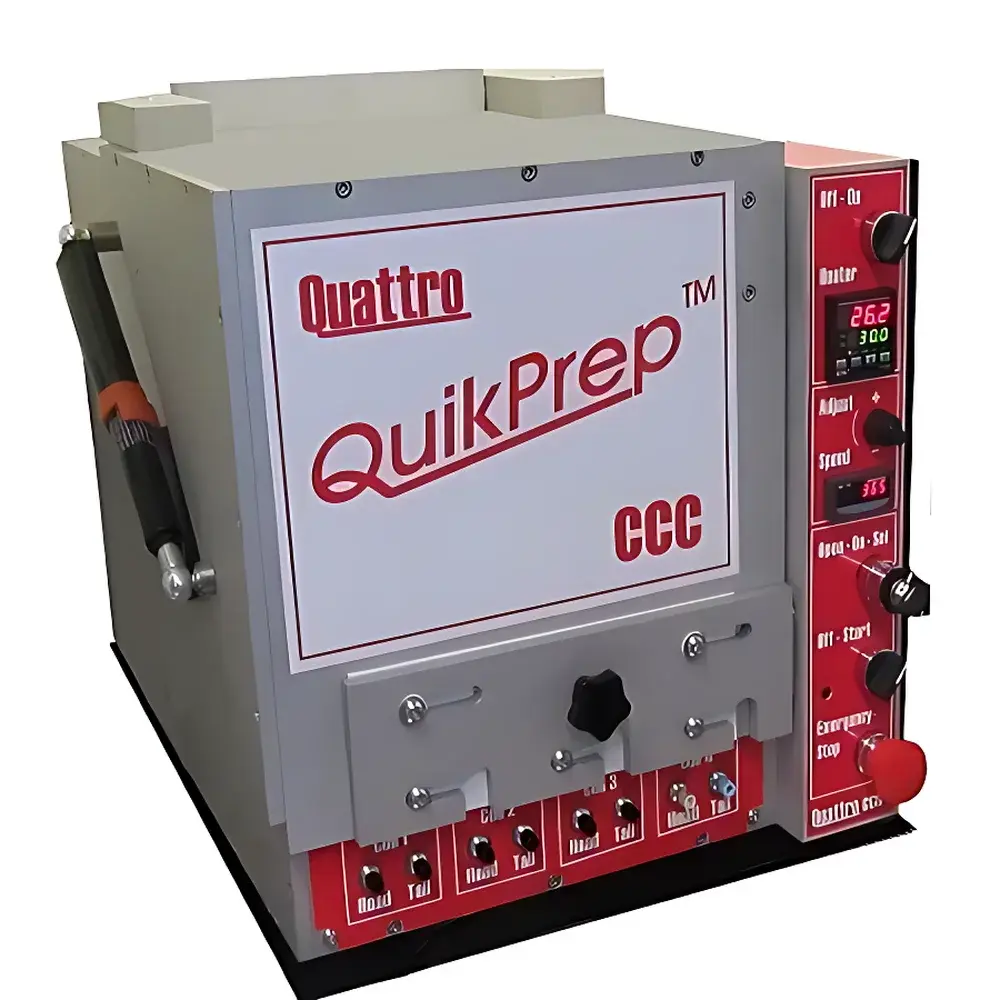
AECS QuickPrep High-Speed Counter-Current Chromatography (HSCCC) System
| Brand | AECS |
|---|---|
| Origin | United Kingdom |
| Manufacturer Type | Authorized Distributor |
| Origin Category | Imported |
| Model | QuickPrep |
| Pricing | Upon Request |
Overview
The AECS QuickPrep High-Speed Counter-Current Chromatography (HSCCC) System is a precision-engineered, solvent-based liquid–liquid partition chromatography platform that operates without a solid stationary phase. Unlike conventional HPLC or flash chromatography, HSCCC relies on the differential partitioning of analytes between two immiscible liquid phases under high centrifugal force—generated via a planetary (sun–earth) motion mechanism—ensuring stable retention of the stationary phase while enabling efficient solute separation. The QuickPrep system implements a dual-channel, bidirectional solvent delivery architecture optimized over more than a decade of AECS research in CCC hydrodynamics and rotor dynamics. Its design eliminates irreversible adsorption, minimizes sample degradation, and delivers high reproducibility for natural product isolation, pharmaceutical purification, metabolite fractionation, and chiral separations—particularly where thermal lability or matrix complexity precludes silica-based methods.
Key Features
- World’s only manufacturer producing both High-Performance Centrifugal Partition Chromatography (HPCPC) and High-Speed CCC (HSCCC) instruments under one technical platform.
- Scalable architecture supporting analytical (7.5 mL), laboratory-preparative (up to 750 mL), pilot-scale (3 L), and process-scale (48 L) applications—all compatible with a single core instrument base.
- Modular coil configuration: supports 1-, 2-, or 4-coil setups on one or two independent rotor axes, enabling parallel or sequential separations without hardware reconfiguration.
- Multi-material coil options: PTFE (chemically inert, low-pressure), stainless steel (moderate pressure, broad pH compatibility), and titanium alloy (high-pressure, extreme pH/corrosive solvent resistance).
- Precision planetary motion with optimized β-value (ratio of coil radius to rotation radius) to maximize G-force generation and stationary phase retention (>95% retention typical across flow ranges).
- Integrated safety engineering: interlocked safety door, power-fail brake engagement, anti-drop door chain, rear-mounted containment housing, emergency stop button, and key-activated start.
- Air-purged rotor chamber to prevent solvent vapor accumulation and ensure long-term bearing integrity.
- Standard speed range: 0–860 rpm; optional high-speed drive: 0–2500 rpm for enhanced resolution in low-viscosity systems.
Sample Compatibility & Compliance
The QuickPrep accommodates a wide polarity spectrum—from nonpolar terpenoids and lipids to polar glycosides, alkaloids, peptides, and organic acids—by selecting appropriate biphasic solvent systems (e.g., hexane/ethyl acetate/methanol/water, chloroform/methanol/water). Coil diameters range from 0.5 mm to 3.7 mm (with LabPrep/PilotPrep models supporting up to 12.5 mm), permitting seamless integration with online mass spectrometry (CCC–MS) for 0.5–1.0 mm PTFE coils. All systems comply with CE marking requirements per Directive 2014/30/EU (EMC) and 2014/35/EU (LVD). Electrical and solvent handling subsystems are physically segregated to meet IEC 61010-1 safety standards for laboratory equipment. For regulated environments, optional audit-trail-capable automation modules support alignment with GLP and 21 CFR Part 11 data integrity expectations when paired with validated software configurations.
Software & Data Management
The QuickPrep supports both manual operation and fully automated workflows via the AECS AutoControl™ module, which provides digital PID regulation of rotational speed, temperature (optional), flow rate, and valve sequencing. Real-time parameter logging—including rpm, backpressure, UV absorbance (when coupled with external detector), and fraction collector triggers—is timestamped and exportable in CSV or ASCII format. Optional vibration and leak sensors feed into the control interface for predictive maintenance alerts. System configuration files, method templates, and calibration records are stored with user-defined metadata and version control. All firmware updates are delivered via secure USB or Ethernet connection with cryptographic signature verification.
Applications
- Isolation of bioactive compounds from plant, marine, or microbial extracts—especially where silica interaction causes decomposition or racemization.
- Preparative purification of natural product standards for NMR, MS, and biological assay validation.
- Separation of enantiomers using chiral aqueous–organic two-phase systems.
- Downstream processing of fermentation broths and bioreactor harvests without column fouling.
- Method development for orthogonal purification strategies in QC/QA laboratories supporting USP <621>, EP 2.2.46, and ISO 17025-accredited workflows.
- Scale-up studies bridging discovery (mg) to clinical batch (g–kg) production using identical retention mechanisms across coil sizes.
FAQ
What distinguishes HSCCC from traditional column chromatography?
HSCCC uses a liquid stationary phase retained by centrifugal force—eliminating solid support-related issues such as irreversible adsorption, channeling, or active site variability.
Can the QuickPrep be integrated with mass spectrometry?
Yes—coils with inner diameters of 0.5–1.0 mm (PTFE construction) are compatible with standard ESI-MS interfaces for real-time CCC–MS coupling.
How is stationary phase retention maintained during operation?
Through precise optimization of the planetary motion profile, β-value geometry, and rotational speed–flow rate correlation—achieving >95% retention across validated operating ranges.
What coil materials are available, and how do they differ in application?
PTFE offers maximum chemical inertness for aggressive solvents; stainless steel balances pressure tolerance and cost for routine prep work; titanium alloy enables operation at elevated pressures and extreme pH (e.g., 0.1 M HCl or 1 M NaOH).
Is method transfer between coil sizes linear?
Yes—due to the identical physical separation principle, retention times and selectivity scale predictably with coil volume, enabling robust scale-up from analytical to process scale without re-optimization.




