
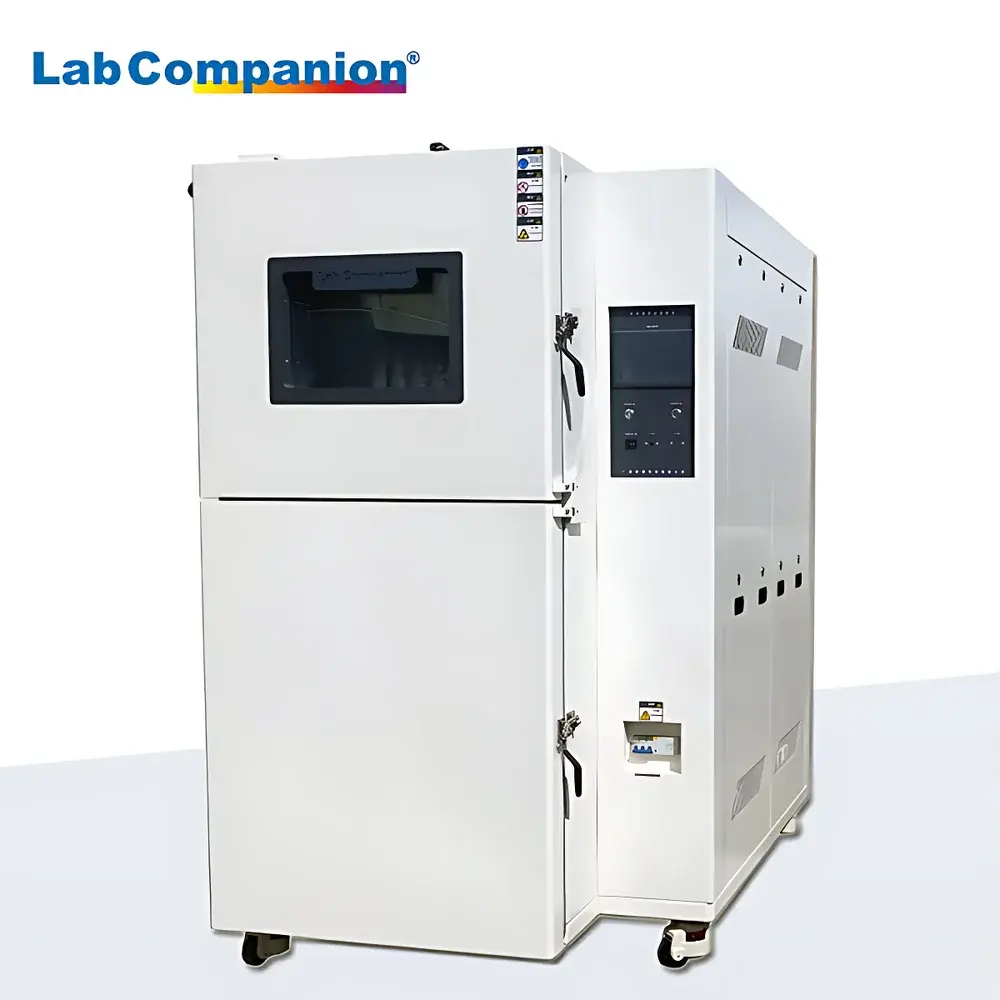
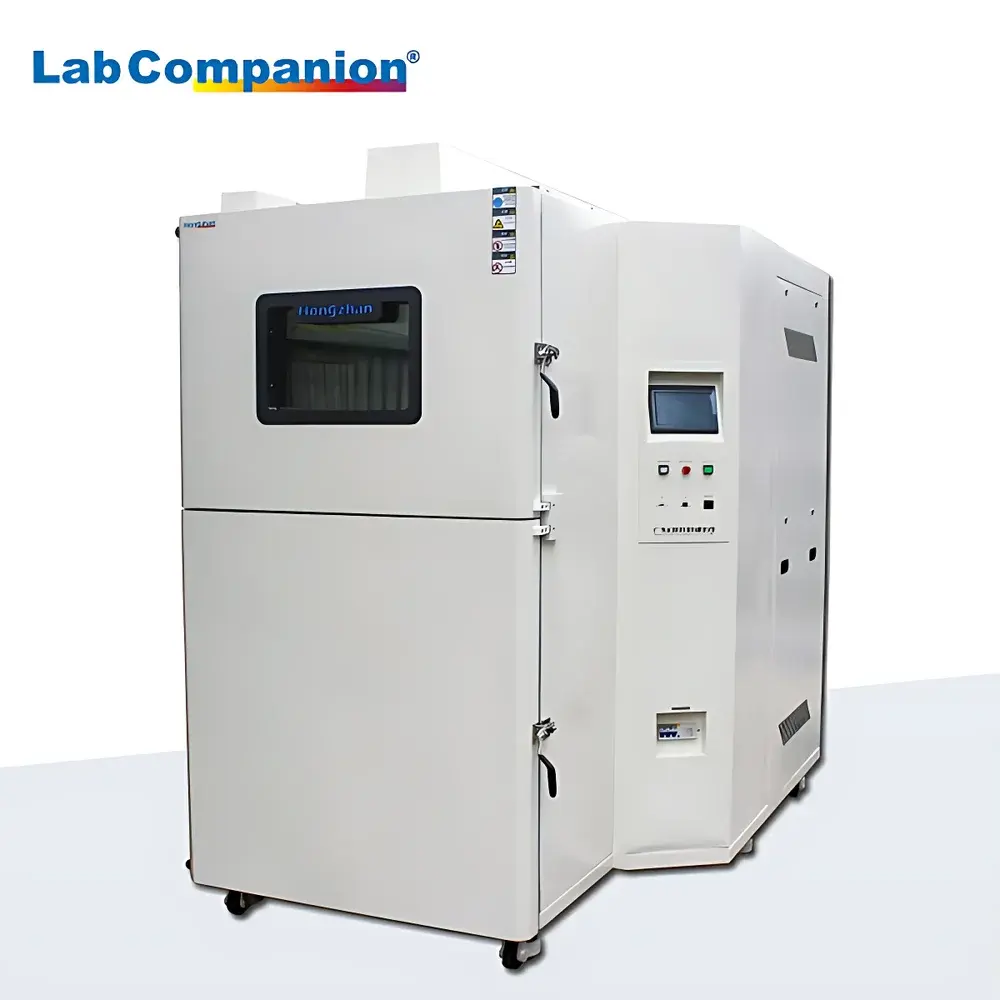
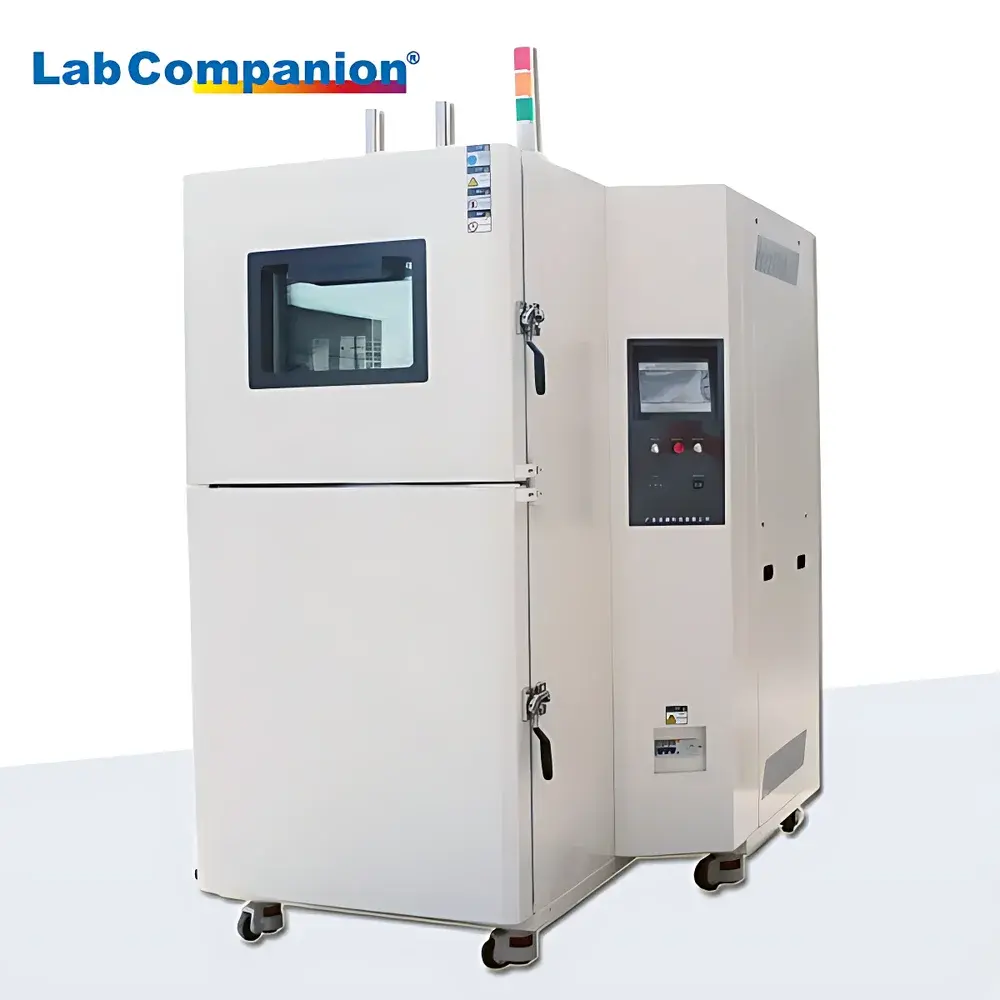
LabCompanion CTL-120W Two-Zone Thermal Shock Test Chamber
| Brand | LabCompanion |
|---|---|
| Origin | Guangdong, China |
| Manufacturer Type | Direct Manufacturer |
| Model | CTL-120W |
| High-Temperature Range | +60 °C to +200 °C |
| Low-Temperature Range | 0 °C to −70 °C |
| Thermal Shock Range | −40 °C to +150 °C |
| Temperature Stability | ±2 °C |
| Ramp-Up Rate | R.T. → +200 °C in ≈40 min |
| Ramp-Down Rate | R.T. → −70 °C in ≈60 min |
| Transfer Time | ≤5 s |
| Temperature Recovery Time | ≤5 min |
| Internal Dimensions (W×H×D) | 500×610×400 mm |
| External Dimensions (W×H×D) | 2720×1050×1950 mm |
| Construction | Cold-Rolled Steel Outer Shell w/ Ivory Powder Coating |
| Inner Chamber | 1.2 mm 304 Mirror-Finish Stainless Steel |
| Insulation | Eco-Friendly Glass Fiber (Non-Hazardous Waste Class) |
| Refrigeration | Air-Cooled (A) or Water-Cooled (W) Configuration |
| Compressor | Imported Hermetic Scroll Compressor |
| Temperature Sensor | Armored Pt100 RTD |
| Controller | Siemens S7-1200 PLC + Embedded PlatinumV1.0 Control Software |
| HMI | 7″ Color TFT Touchscreen |
| Data Interface | USB (CSV export, non-hot-pluggable), RJ45 Ethernet (for optional PlatinumV1.0 PC Monitoring Software) |
| Power Supply | AC 380 V, 50 Hz, 3-Phase + PE |
| Total Installed Capacity | 32 kVA |
| Compliance | GJB 150.3–150.5, GB/T 2423.1–2423.2 |
Overview
The LabCompanion CTL-120W Two-Zone Thermal Shock Test Chamber is an engineered solution for accelerated reliability evaluation of electronic components, aerospace assemblies, automotive modules, and precision optical devices under extreme, rapid thermal transitions. Unlike single-chamber cyclic systems, this dual-compartment design physically separates the high-temperature and low-temperature zones—enabling true thermal shock testing via mechanical basket transfer. The system operates on the principle of controlled, repeatable thermal displacement: test specimens are rapidly moved between independently stabilized chambers using a pneumatically actuated lift-and-transfer mechanism with ≤5 s dwell-free transit time. This architecture eliminates thermal inertia interference and ensures strict adherence to MIL-STD-810G Method 503.5, IEC 60068-2-14, and JESD22-A104D protocols. Its ±2 °C temperature uniformity across the 500×610×400 mm test volume (per GB/T 5170.2–2017) supports validation of solder joint integrity, encapsulant delamination resistance, and CTE mismatch behavior under defined thermal stress gradients.
Key Features
- Dual independent chamber architecture: High-temp zone (+60 °C to +200 °C) and low-temp zone (0 °C to −70 °C), each with dedicated refrigeration and heating circuits
- High-reproducibility transfer mechanism: Pneumatic lift-and-swing basket with position feedback sensors and mechanical end-stop redundancy
- Thermal recovery time ≤5 min post-transfer—verified per IEC 60068-3-10 Annex A—ensuring minimal dwell-induced thermal equilibration
- Siemens S7-1200 PLC-based control system with embedded PlatinumV1.0 firmware, supporting deterministic cycle sequencing, alarm logging, and real-time PID parameter tuning
- 7″ industrial-grade resistive touchscreen HMI with multilingual UI (English, Chinese, Korean), password-protected configuration levels, and on-screen calibration traceability
- Eco-compliant insulation: Non-hazardous glass fiber matrix with zero ozone-depleting potential (ODP = 0), certified per ISO 14001 manufacturing practices
- Modular refrigeration: Optional air-cooled (A) or water-cooled (W) condensing units—selected based on facility cooling infrastructure and ambient heat rejection constraints
Sample Compatibility & Compliance
The CTL-120W accommodates standard test specimens up to 45 kg (including fixture mass) and supports DIN 40041-compliant mounting plates. Its stainless steel interior (ASTM A240 Type 304, 1.2 mm gauge) resists corrosion from outgassed volatiles during high-temp exposure. The chamber meets full requirements of GJB 150.3A (high-temp exposure), GJB 150.4A (low-temp exposure), and GJB 150.5A (temperature shock), as verified by third-party calibration reports traceable to NIM (China National Institute of Metrology). It also satisfies GB/T 2423.1 (cold) and GB/T 2423.2 (dry heat) for extended environmental qualification. Optional IQ/OQ documentation packages are available to support GLP/GMP-regulated laboratories requiring 21 CFR Part 11-compliant audit trails when paired with PlatinumV1.0 PC monitoring software.
Software & Data Management
All operational data—including setpoints, chamber actuals, basket position status, compressor discharge temperature, and alarm timestamps—are logged at 1 Hz resolution and stored locally in CSV format via the front-panel USB interface. Files retain ISO 8601-compliant timestamps and are structured for direct import into MATLAB, Python pandas, or JMP for statistical process control (SPC) analysis. The RJ45 Ethernet port enables integration with LabCompanion’s PlatinumV1.0 PC Monitoring Suite (sold separately), which provides centralized management of up to 32 chambers, role-based user access control, electronic signature support, and automated report generation compliant with ISO/IEC 17025 clause 7.8. Data integrity is preserved through write-once filesystem partitioning and SHA-256 checksum verification on all exported datasets.
Applications
- Qualification testing of PCBAs subjected to reflow soldering thermal profiles
- Reliability screening of MEMS sensors and optoelectronic packages (e.g., VCSEL arrays, LiDAR transceivers)
- Failure mode analysis of conformal coatings and underfill materials under repeated ΔT cycling
- Validation of hermetic seal integrity in medical implant housings per ISO 10993-12
- Aerospace component stress screening per MIL-HDBK-344A and ECSS-Q-ST-30-01C
- Automotive ECU thermal endurance assessment aligned with AEC-Q200 Rev D
FAQ
What is the difference between two-box and single-box thermal shock configurations?
Two-box systems maintain independent, stable temperature zones and achieve faster, more repeatable shock transitions via physical specimen transfer—ideal for standards requiring defined dwell times and minimal thermal lag. Single-box designs rely on rapid air circulation and are subject to greater thermal inertia.
Can the CTL-120W be validated for ISO/IEC 17025 compliance?
Yes—when equipped with NIST-traceable Pt100 probes and operated with documented IQ/OQ protocols, the system supports uncertainty budgets required for accredited laboratory use.
Is water-cooling mandatory for continuous operation at −70 °C?
Water-cooling (W variant) is recommended for uninterrupted 24/7 operation below −40 °C in ambient conditions exceeding 30 °C; air-cooled (A) models require adequate ventilation clearance and may exhibit longer stabilization times above 35 °C ambient.
Does the USB data export support real-time streaming to external DAQ systems?
No—the USB port is write-only and intended for post-test batch export; real-time acquisition requires Ethernet communication via the PlatinumV1.0 PC software suite.
Are custom chamber dimensions or extended temperature ranges available?
LabCompanion offers OEM engineering services for modified internal volumes, enhanced low-temp capability (e.g., −80 °C), and specialized chamber linings (e.g., electropolished 316L for semiconductor tool validation).



