
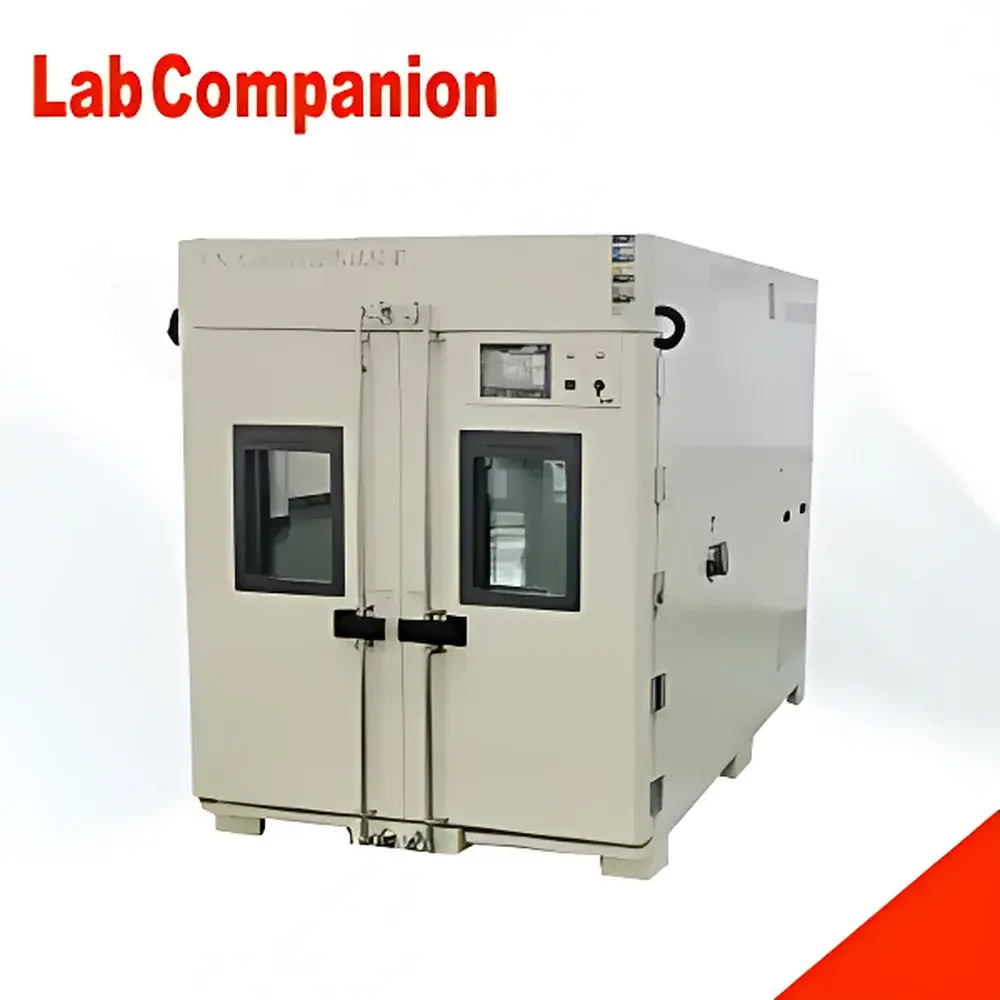
LabCompanion WP-4000 Walk-in Environmental Test Chamber
| Brand | LabCompanion |
|---|---|
| Origin | Guangdong, China |
| Manufacturer Type | Direct Manufacturer |
| Temperature Range | -73°C to +177°C |
| Refrigeration Method | Compressor-based Cooling |
| Explosion-Proof | Standard (Non-Explosion-Proof) |
| Temperature Fluctuation | ±0.5°C |
| Temperature Uniformity | ±2.0°C |
| Temperature Deviation | ±2.0°C |
| Heating Rate | 4–5°C/min |
| Cooling Rate | 4–5°C/min |
| Interior Dimensions (W×D×H) | 1970 × 2100 × 1020 mm |
| Certification | CE-compliant |
| Refrigerant | Environmentally Compliant HFC Blend |
| Humidity Control | Integrated Steam-Based Humidification System |
| Construction | Dual-Wall Insulated Stainless Steel Enclosure |
Overview
The LabCompanion WP-4000 Walk-in Environmental Test Chamber is an engineered solution for comprehensive thermal and humidity stress testing of industrial components, electronic assemblies, automotive modules, aerospace subsystems, and packaged pharmaceutical products. Designed in accordance with ISO 16750-4 (road vehicles), IEC 60068-2 (environmental testing standards), and ASTM D4332 (conditioning of plastics), this chamber employs a dual-wall vacuum-insulated stainless steel structure with high-density polyurethane foam (≥150 mm thickness) to minimize thermal bridging and ensure long-term energy efficiency. Its core thermodynamic architecture integrates a cascade two-stage compressor refrigeration system—capable of achieving -73°C without liquid nitrogen assist—alongside a precision PID-controlled electric heating train and a steam-jet humidification subsystem. The chamber operates across a full operational humidity range of 20–98% RH at temperatures from +10°C to +85°C, with optional extended low-humidity capability down to 10% RH via desiccant-assisted drying.
Key Features
- Robust structural integrity: 2.0 mm SUS304 stainless steel inner chamber and 1.5 mm cold-rolled steel outer shell with epoxy-powder coating
- High-efficiency refrigeration: Twin-scroll compressors with oil return management and refrigerant charge monitoring per ASHRAE Guideline 3
- Precision climate control: Dual-sensor feedback loop for temperature and humidity, with independent control algorithms optimized for transient response
- Real-time thermal mapping support: Six standardized sensor mounting ports (per IEC 60068-3-5) for validation-grade data acquisition during qualification runs
- Operator safety & accessibility: Full-height insulated swing door with magnetic seal, emergency stop button, and internal lighting compliant with EN 61000-6-4
- Energy-conscious operation: Variable-speed condenser fans and adaptive defrost logic reduce annual power consumption by up to 22% versus fixed-speed predecessors
Sample Compatibility & Compliance
The WP-4000 accommodates large-format test articles—including fully assembled control cabinets, battery packs (up to 1.2 m tall), medical imaging subsystems, and military-grade avionics enclosures—within its 1970 × 2100 × 1020 mm (W×D×H) workspace. Internal load capacity supports static loads up to 800 kg distributed across the standard perforated stainless steel floor grid. All materials in contact with the test environment meet RoHS Directive 2011/65/EU and REACH Annex XVII requirements. The system is CE-marked per Machinery Directive 2006/42/EC and Electromagnetic Compatibility Directive 2014/30/EU. It supports IQ/OQ documentation packages aligned with FDA 21 CFR Part 11 for regulated industries, including audit-trail-enabled parameter change logging and user-access-level configuration controls.
Software & Data Management
Control and monitoring are executed via the LabCompanion ETS-Link™ v4.2 platform—a Windows-based application compliant with IEC 62443-3-3 for industrial cybersecurity. The interface provides real-time trend visualization, multi-channel alarm management (email/SMS notification via optional GSM module), and automated report generation in PDF/CSV formats traceable to ISO/IEC 17025. Data integrity safeguards include write-protected historical logs, SHA-256 hash verification of archived test records, and configurable retention policies supporting GLP/GMP compliance. Remote access is enabled through TLS 1.2-secured HTTPS tunneling, with role-based authentication (admin/operator/viewer tiers) and session timeout enforcement.
Applications
- Accelerated life testing of lithium-ion battery modules under combined thermal cycling and humidity soak conditions (per UN 38.3 Section 4.4)
- Environmental stress screening (ESS) of printed circuit board assemblies prior to burn-in (per MIL-STD-883 Method 1010.10)
- Validation of packaging barrier performance for sterile medical devices (ISO 11607-1)
- Thermal shock evaluation of composite aircraft components using programmable ramp-and-soak profiles
- Stability studies for temperature-sensitive biologics under ICH Q5C and Q1A(R2) guidelines
- Pre-compliance testing for automotive electronics per AEC-Q200 and ISO 16750-4
FAQ
What is the maximum allowable ambient temperature for continuous operation?
The chamber is rated for continuous use in ambient environments up to 35°C, with derating applied above that threshold per ISO 16750-4 Annex B.
Can the WP-4000 be integrated into an existing facility SCADA system?
Yes—it features Modbus TCP and optional Profibus-DP interfaces, with full register mapping documentation supplied for PLC-level integration.
Is third-party calibration certification available?
Factory-calibrated sensors are supplied with NIST-traceable certificates; on-site UKAS-accredited calibration services can be arranged through authorized partners.
Does the system support custom test profile scripting beyond standard cycles?
ETS-Link™ includes a built-in script engine supporting Python 3.9-compatible syntax for conditional branching, dynamic setpoint modulation, and external trigger response.
What maintenance intervals are recommended for the refrigeration system?
Compressor oil analysis and refrigerant purity checks are advised every 2,000 operating hours; full system evacuation and recharge recommended every 5 years or after major component replacement.



