
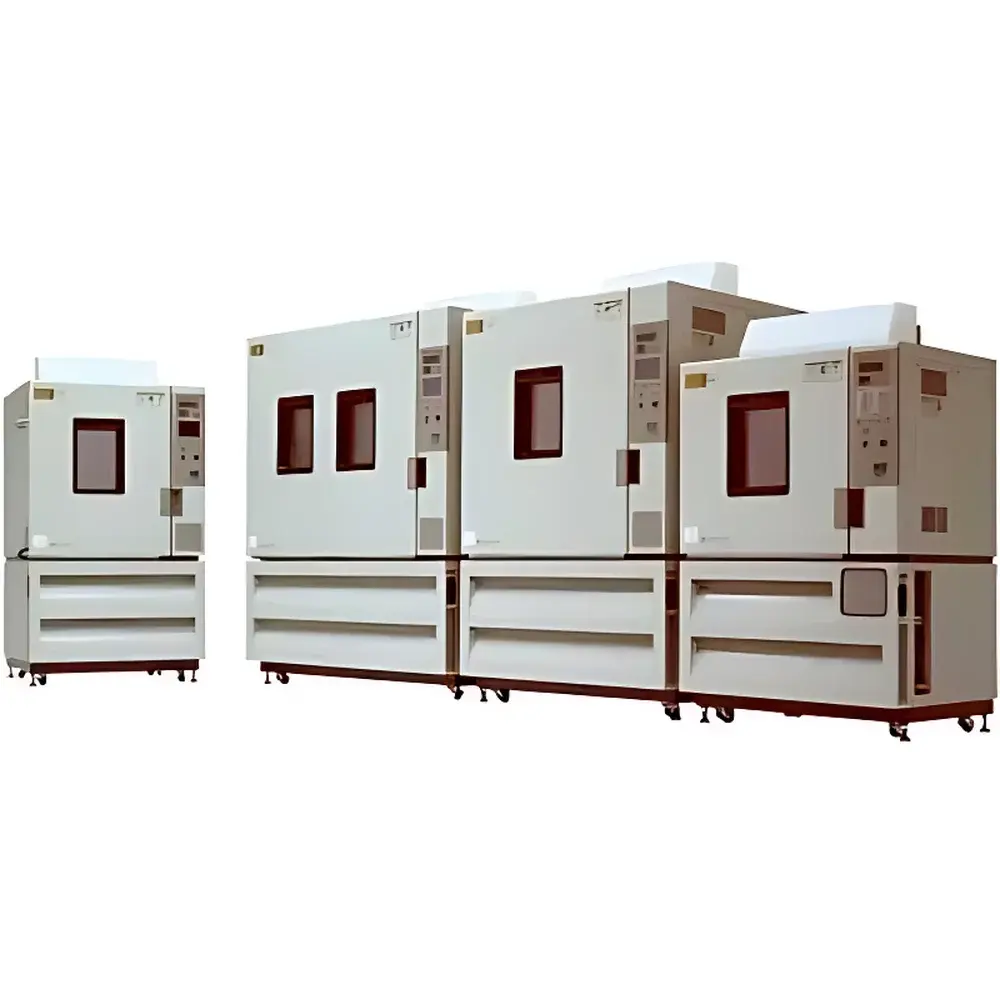
LabCompanion LC-1000S High-Low Temperature Alternating Environmental Test Chamber
| Brand | LabCompanion |
|---|---|
| Model | LC-1000S |
| Temperature Range | -70°C to +150°C |
| Temperature Uniformity | ±0.5°C |
| Temperature Accuracy | ±0.3°C |
| Internal Dimensions (W×D×H) | 1000×1000×1000 mm |
| External Dimensions (W×D×H) | 1500×1850×1520 mm |
| Construction | Interior – SUS304 stainless steel mirror finish |
| Insulation | Rigid polyurethane foam (glass wool used at +150°C) |
| Refrigeration System | Hermetic compressor-based cascade cooling |
| Control System | Korean-made PID controller with LCD interface, English-language UI, LAN port (optional), data logging & curve display |
| Compliance | GB/T 10592–2008, GB/T 2423.22–2012 |
| Power Supply | AC 380 V, 50 Hz |
| Weight | 600 kg |
Overview
The LabCompanion LC-1000S High-Low Temperature Alternating Environmental Test Chamber is an engineered solution for precise, repeatable thermal stress testing of electronic components, LED modules, automotive subsystems, and industrial materials under controlled cyclic temperature conditions. Based on forced-air convection and a dual-stage cascade refrigeration system, the chamber delivers stable thermal profiles across a wide operating range—from −70 °C to +150 °C—enabling both steady-state exposure and programmable thermal cycling per IEC 60068-2-14, MIL-STD-810H Method 502.5, and JEDEC JESD22-A104. Its robust mechanical architecture, high-efficiency insulation, and calibrated PT100 sensor array ensure traceable temperature control with ±0.3 °C accuracy and ±0.5 °C uniformity across the full 1 m³ test volume.
Key Features
- Programmable multi-step thermal cycling capability with up to 99 segments per profile, supporting ramp rates from 1 °C/min to 5 °C/min (dependent on setpoint delta)
- Dual-stage cascade refrigeration system using environmentally compliant HFC refrigerants, optimized for rapid cooling from ambient to −70 °C in ≤90 minutes
- Full-English, touch-enabled LCD controller with real-time graphing, alarm history, and built-in self-diagnostic functions
- Standard features include two adjustable stainless-steel shelves, Ø50 mm cable/port access hole with silicone gasket, interior LED lighting, and triple-layer insulated observation window
- Structural integrity ensured by SUS304 stainless steel interior (mirror-polished), corrosion-resistant exterior cladding, and 120 mm thick rigid polyurethane insulation (glass wool backup at elevated temperatures)
- Comprehensive safety suite: over-temperature cut-off, compressor overload protection, door interlock, and power-fail recovery with auto-resume functionality
Sample Compatibility & Compliance
The LC-1000S accommodates large-format test specimens—including LED luminaires, PCB assemblies, battery packs, and molded polymer housings—within its 1000 L internal volume. The chamber meets national and international environmental test standards including GB/T 10592–2008 (General Requirements for Temperature and Humidity Chambers), GB/T 2423.22–2012 (Test N: Temperature Change), and aligns with technical requirements referenced in ISO 16750-4 (Road Vehicles – Environmental Conditions), IPC-9701A (Performance Requirements for Lead-Free Solder Interconnections), and AEC-Q200 (Stress Test Qualification for Passive Components). Optional calibration certificates (NIST-traceable) and validation documentation (IQ/OQ protocols) are available to support GLP, GMP, and ISO/IEC 17025 laboratory accreditation.
Software & Data Management
The embedded controller supports local data logging of temperature, time, and alarm status with onboard storage for ≥30 days of continuous 1-second interval records. An optional LAN interface enables remote monitoring and control via TCP/IP, integration into centralized lab management systems (LIMS), and export of CSV-formatted datasets for post-test analysis. All logged data includes timestamp, setpoint deviation, and operational mode metadata—ensuring audit readiness for FDA 21 CFR Part 11-compliant environments when paired with user-defined electronic signature workflows. Firmware updates are delivered via USB flash drive with version-controlled release notes and change logs.
Applications
- Thermal shock evaluation of high-brightness LED packages and driver circuits under accelerated aging protocols
- Qualification testing of automotive ECUs, sensors, and infotainment displays per OEM-specific thermal cycling specifications
- Material compatibility assessment for adhesives, encapsulants, and conformal coatings exposed to extreme low-temperature brittleness and high-temperature creep
- Reliability screening of lithium-ion battery modules during charge/discharge cycles under varying ambient conditions
- Validation of packaging integrity for medical devices subjected to global shipping temperature excursions (e.g., WHO PQS, ISTA 3A)
- Research-grade thermal fatigue studies on solder joints, wire bonds, and die-attach interfaces using defined dwell/ramp sequences
FAQ
What is the standard temperature ramp rate for the LC-1000S?
The chamber achieves typical ramp rates of 3–4 °C/min between −40 °C and +85 °C under no-load conditions. Actual performance depends on load mass, thermal mass distribution, and setpoint transitions.
Does the LC-1000S support humidity control?
No—this model is a dry-thermal-only chamber. For combined temperature/humidity testing, consider the LabCompanion TH series environmental chambers.
Can the controller be integrated into a factory SCADA system?
Yes, via optional Ethernet (LAN) module with Modbus TCP protocol support and configurable register mapping for real-time parameter readout and alarm notification.
Is third-party calibration included with purchase?
Calibration is performed at the factory using NIST-traceable reference standards. A certificate of conformance is supplied; ISO/IEC 17025-accredited calibration is available as a value-added service.
What maintenance intervals are recommended for the refrigeration system?
Compressor oil and filter dryer replacement is advised every 24 months or 8,000 operating hours, whichever occurs first. Annual verification of refrigerant charge and condenser coil cleanliness is required for sustained performance.



