
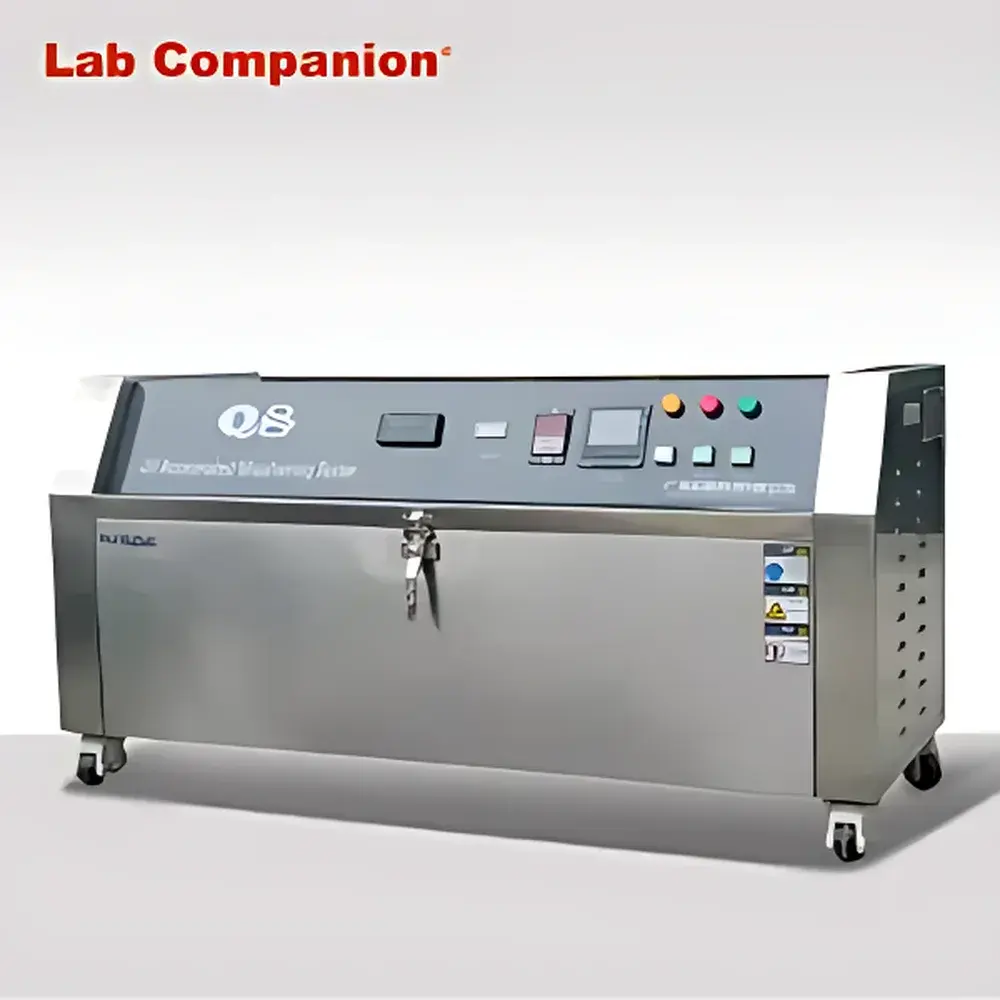
LabCompanion UV-B Advanced UV Aging Test Chamber
| Brand | LabCompanion |
|---|---|
| Origin | Guangdong, China |
| Manufacturer Type | Direct Manufacturer |
| Model | UV-B |
| Humidity Range | ≥95% R.H. |
| Lamp Power | 40 W per tube |
| Irradiance Range | <50 W/m² |
| Exposure Time Setting | 1–9999 s / min / h (adjustable) |
| Black Panel Temperature Range | 40–65 °C |
Overview
The LabCompanion UV-B Advanced UV Aging Test Chamber is an engineered environmental test system designed to accelerate material degradation under controlled ultraviolet (UV) radiation, moisture, and thermal cycling conditions. Based on the fundamental principles of photochemical aging—where UV photons induce bond scission, oxidation, and polymer chain breakdown—the chamber replicates key elements of natural outdoor exposure: UV irradiation (primarily in the UV-B spectral band, 280–320 nm), condensation-induced surface wetting, intermittent water spray, and dark/thermal recovery phases. Unlike broad-spectrum xenon arc or carbon arc testers, this chamber employs fluorescent UV lamps optimized for reproducible spectral output aligned with ISO 4892-3 and ASTM G154 standards. Its closed-loop architecture enables precise regulation of black panel temperature (BPT), relative humidity (>95% R.H.), and irradiance intensity—critical parameters governing reaction kinetics in polymeric coatings, automotive trim, roofing membranes, and packaging films.
Key Features
- Black panel temperature control (40–65 °C) using integrated aluminum sensor plates and high-stability PID heating regulation—ensuring surface temperature fidelity per ISO 4892-3 Annex A.
- Dual-mode exposure cycles: programmable alternation between UV irradiation (via 40 W UV-B fluorescent tubes) and condensation phase (controlled by saturated steam generation and plate cooling).
- Balanced Temperature and Humidity Control (BTHC) system delivering ≤±0.5 °C temperature fluctuation and ≤±2 °C uniformity across the test chamber workspace.
- Fixed-position UV radiometer probe with dedicated UV-B irradiance meter—enabling real-time monitoring and cumulative radiant exposure (J/m²) calculation without manual recalibration.
- Siemens touchscreen programmable controller with RS585 interface support—compatible with lab-wide data acquisition systems and audit-ready event logging.
- Stainless steel sample rack (48 positions) with adjustable tilt angle (0°–20°) to simulate real-world orientation effects on UV dose distribution.
- Integrated automatic water replenishment system with low-water level cutoff and leak-resistant reservoir design—ensuring uninterrupted condensation cycles over extended tests.
- Comprehensive safety architecture: leakage current protection, overtemperature cut-off, short-circuit alarm, and dry-run prevention for spray nozzles.
Sample Compatibility & Compliance
The UV-B chamber accommodates flat-panel specimens up to 150 mm × 75 mm × 10 mm (W × L × H) per slot, supporting standardized specimen holders per ASTM D4329, ISO 4892-3, and JIS D0205. It is validated for use in GLP-compliant laboratories performing accelerated weathering qualification per IEC 61215 (photovoltaic modules) and SAE J2020 (automotive exterior materials). The fixed UV-B spectral output—peaking near 313 nm—is traceable to NIST-calibrated reference detectors. All control firmware supports 21 CFR Part 11–compliant electronic signatures and audit trail generation when paired with optional validation packages.
Software & Data Management
The Siemens SIMATIC HMI interface provides intuitive cycle programming with up to 100 user-defined test profiles, each supporting multi-step sequences (e.g., 4 h UV @ 60 °C BPT → 4 h condensation @ 50 °C → 2 h dark recovery). Real-time graphs display BPT, chamber humidity, and irradiance values with timestamped export to CSV. Optional Ethernet gateway enables integration with LIMS platforms via Modbus TCP. Data logs include operator ID, parameter setpoints, deviation alerts, and hardware status flags—fully traceable for internal QA audits or regulatory submissions.
Applications
- Accelerated durability screening of automotive interior plastics (PP, TPO), exterior clearcoats, and headlamp lenses.
- UV resistance validation of architectural sealants, PVC roofing membranes, and geotextiles per ASTM D4329 Class I/II protocols.
- Photostability assessment of pharmaceutical packaging (blister foils, HDPE bottles) under ICH Q1B guidance.
- Quality control of UV-curable inks, adhesives, and optical films where yellowing, gloss loss, or delamination must be quantified.
- Comparative ranking of stabilizer packages (HALS, UV absorbers) in polyolefin formulations.
FAQ
What UV spectrum does the UV-B lamp emit, and how is it calibrated?
The standard lamp emits peak irradiance at 313 nm with a full-width half-maximum (FWHM) of ~10 nm, compliant with ISO 4892-3 Type B spectral requirements. Calibration is performed using a NIST-traceable UV-B radiometer; factory certificate included.
Can the chamber operate without condensation or spray cycles?
Yes—users may disable condensation and spray functions independently via the controller, enabling pure UV irradiation testing or dark thermal aging modes.
Is irradiance uniformity verified across the sample plane?
Yes—uniformity mapping per ASTM G155 Annex A confirms ±15% irradiance variation across the 48-position rack at nominal operating conditions.
Does the system support remote monitoring or integration with enterprise MES platforms?
With optional RS585-to-Ethernet bridge and LabCompanion OPC UA server license, real-time telemetry and alarm forwarding to SCADA or MES is fully supported.
What maintenance intervals are recommended for UV lamps and sensors?
Lamps require replacement every 1,600 hours of operation; radiometer probe calibration is recommended annually or after 500 h of continuous UV exposure. Maintenance logs are auto-recorded in the controller.



