
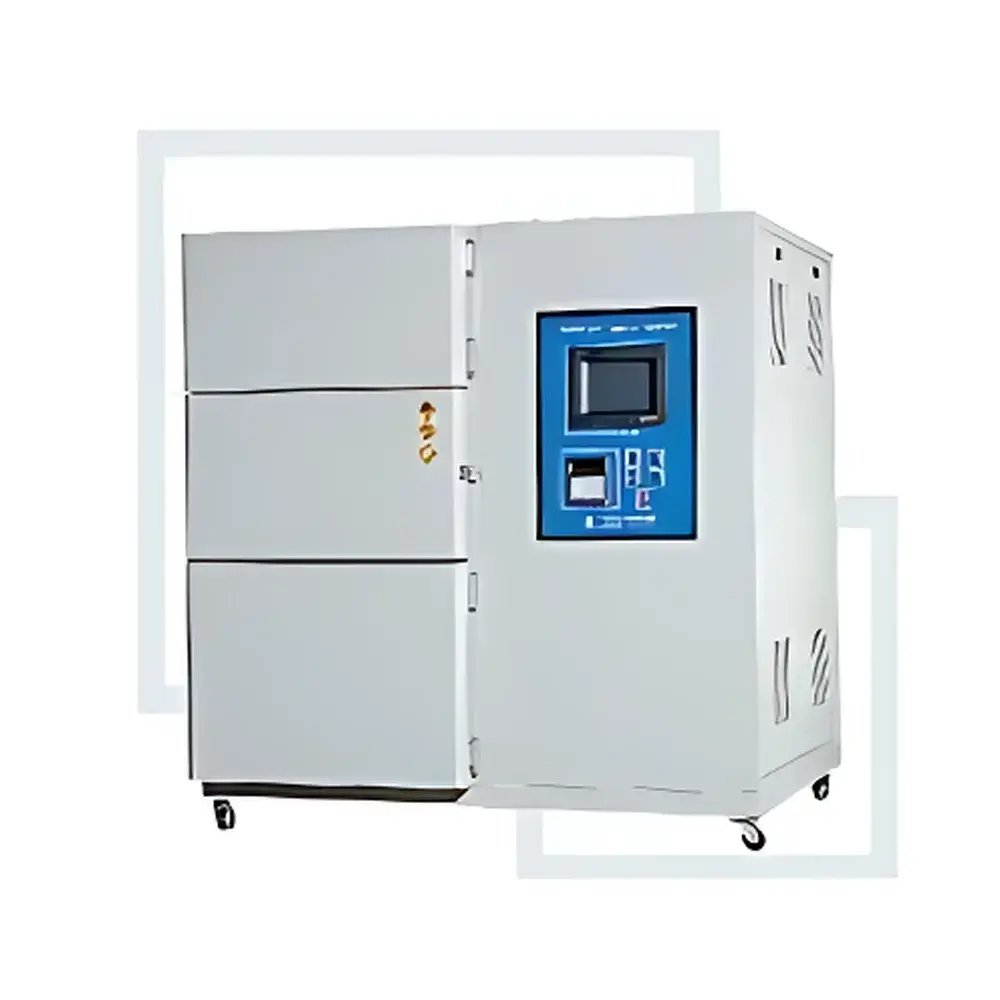
LabCompanion LTS-80-3PA Three-Zone Thermal Shock Test Chamber
| Brand | LabCompanion |
|---|---|
| Origin | Guangdong, China |
| Manufacturer Type | OEM/ODM Manufacturer |
| Country of Origin | China |
| Model | LTS-80-3PA |
| Pricing | Available Upon Request |
| Internal Chamber Dimensions (W×D×H) | 350×400×350 mm |
| External Dimensions (W×D×H) | 1520×1550×1950 mm |
| Max. Test Specimen Weight | 2 kg |
| High-Temperature Zone Range | +80 °C to +150 °C |
| Low-Temperature Zone Range | 0 °C to −65 °C |
| Preconditioning Temperature Range | +80 °C to +200 °C / 0 °C to −70 °C |
| Preconditioning Ramp-Up Time | ~25 min |
| Preconditioning Ramp-Down Time | ~70 min |
| Dwell Time per Temperature Zone | 25 min (adjustable) |
| Transfer Time (Cold ↔ Hot) | ≤5 min (adjustable) |
| Temperature Uniformity | ±2 °C |
| Power Supply | AC 3-phase, 220/380 V, 50/60 Hz |
Overview
The LabCompanion LTS-80-3PA Three-Zone Thermal Shock Test Chamber is an engineered environmental stress screening (ESS) system designed for high-fidelity thermal shock qualification of electronic components, automotive modules, aerospace assemblies, and other reliability-critical products. Unlike single- or dual-chamber configurations, this three-zone architecture—comprising independent high-temperature, low-temperature, and test specimen chambers—enables true static-sample testing: the test article remains stationary while ambient conditions rapidly alternate between extreme thermal states. This eliminates mechanical stress from sample transfer mechanisms and ensures repeatable, ISO/IEC 17025-aligned thermal transient profiles. The chamber operates on a forced-air convection principle with optimized airflow distribution, achieving rapid thermal transitions governed by precise PID-controlled refrigeration and heating circuits. It complies with key industry standards including MIL-STD-810H Method 503.5 (Temperature Shock), IEC 60068-2-14 (Change of Temperature), and JESD22-A104 (Temperature Cycling).
Key Features
- Three-zone isolation design: independent hot zone (+80 °C to +200 °C), cold zone (0 °C to −70 °C), and insulated test chamber—ensuring zero physical movement of specimens during cycling
- High-stability temperature control: ±2 °C uniformity across the 350 × 400 × 350 mm internal workspace, verified per ASTM E742 and IEC 60068-3-5
- Programmable dwell time (minimum 1 min, up to 9999 min per zone) and transfer interval (adjustable down to 3 seconds), supporting custom test protocols per customer specifications
- Dual-stage cascade refrigeration system with environmentally compliant R404A/R23 refrigerant blend, enabling stable sub-zero operation to −70 °C without liquid nitrogen dependency
- Industrial-grade PLC controller with 7-inch color touchscreen HMI, supporting multi-segment ramp-soak profiles, real-time data logging, and password-protected parameter management
- Robust stainless-steel interior (SUS304), double-layer vacuum-insulated walls, and silicone-sealed access door to minimize thermal leakage and ensure long-term calibration stability
Sample Compatibility & Compliance
The LTS-80-3PA accommodates specimens up to 2 kg and 350 × 400 × 350 mm in volume, making it suitable for PCBAs, connectors, sensors, battery packs, and small electromechanical assemblies. Its static-test configuration meets the requirements of AEC-Q200 (Automotive Electronic Components), IPC-9701 (Performance Qualification of Solder Attachments), and JEDEC J-STD-020 (Moisture Sensitivity Level classification). All thermal profiles are traceable to NIST-traceable reference sensors, and system validation reports—including temperature mapping (per ISO 14644-3 Annex B) and uncertainty analysis—can be generated for GLP/GMP-regulated environments. The unit supports optional IQ/OQ documentation packages aligned with FDA 21 CFR Part 11 requirements for electronic records and signatures.
Software & Data Management
Equipped with LabCompanion’s proprietary TC-Link™ software suite (Windows-based, USB/Ethernet interface), the LTS-80-3PA enables remote monitoring, automated report generation (PDF/CSV), and full audit trail functionality—including user login history, parameter change logs, and alarm event timestamps. Data export conforms to ASTM E2918 and ISO/IEC 17025 Clause 7.7 requirements for measurement uncertainty reporting. Optional integration with LIMS platforms via Modbus TCP or OPC UA is available for enterprise-level test data aggregation and SPC analysis.
Applications
- Failure mode identification in solder joint intermetallic growth, die attach delamination, and CTE mismatch-induced cracking
- Qualification of conformal coatings, potting compounds, and encapsulants under accelerated thermal fatigue
- Pre-screening of avionics hardware prior to flight qualification per DO-160 Section 4.3
- Reliability assessment of EV battery modules under repeated charge/discharge thermal transients
- Validation of packaging integrity for medical devices subjected to global shipping temperature excursions
FAQ
What distinguishes a three-zone thermal shock chamber from dual-chamber designs?
The three-zone architecture eliminates mechanical transfer arms, reducing vibration artifacts and enabling higher repeatability in thermal transition timing—critical for detecting subtle interfacial failures.
Can the LTS-80-3PA perform temperature cycling per JEDEC JESD22-A104?
Yes; its programmable dwell times, ramp rates, and thermal stability meet all mandatory parameters specified in JESD22-A104, including minimum 10-minute dwell and ≤5-minute transition windows.
Is calibration certification included with delivery?
Each unit ships with a factory calibration certificate referencing NIST-traceable thermistors; on-site IQ/OQ services and annual recalibration support are available upon request.
Does the system support remote diagnostics and firmware updates?
Yes—via secure Ethernet connection using LabCompanion’s TC-Link™ Remote Diagnostics Module (RDM), which provides real-time subsystem health monitoring and over-the-air firmware patches.
What safety protections are built into the chamber?
Dual redundant over-temperature cutoffs, refrigerant pressure monitoring, door interlock with emergency power-off, and leak detection for refrigerant circuits—fully compliant with IEC 61000-6-2 EMC and UL 61010-1 safety standards.



