
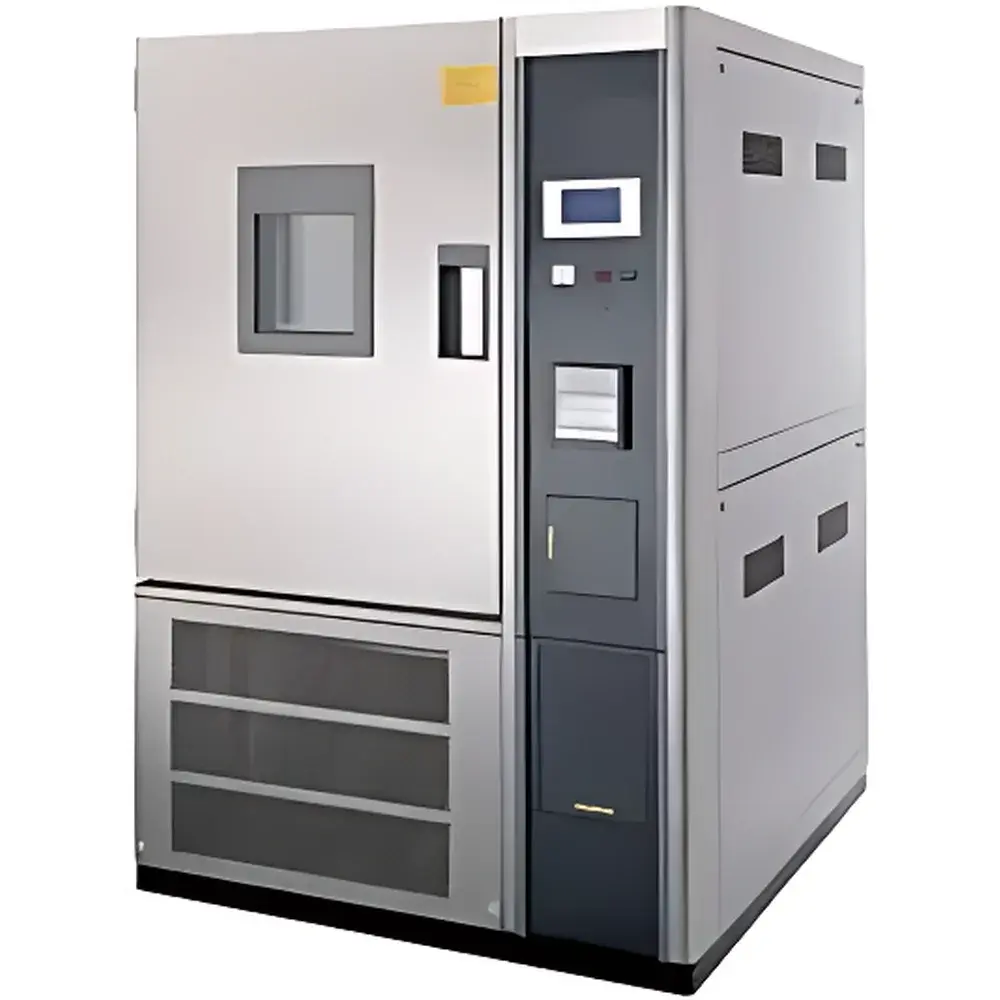
LabCompanion UC-150S High-Low Temperature Alternating Environmental Test Chamber
| Brand | LabCompanion |
|---|---|
| Model | UC-150S |
| Temperature Range (Standard Configuration) | -40 °C to +150 °C |
| Temperature Uniformity | ±0.5 °C |
| Temperature Accuracy | ±0.3 °C |
| Internal Dimensions (W×D×H) | 500 mm × 600 mm × 500 mm |
| External Dimensions (W×D×H) | 1000 mm × 1500 mm × 1000 mm |
| Internal Material | Mirror-Finished SUS304 Stainless Steel |
| Insulation | Rigid Polyurethane Foam (Glass Wool for >150 °C Operation) |
| Cooling System | Hermetic Compressor-Based Refrigeration |
| Control System | Korean-Made PID Controller with LCD Interface, LAN Optional |
| Power Supply | AC 380 V, 50 Hz |
| Compliance | GB/T 10592–2008, GB/T 2423.22–2012 |
Overview
The LabCompanion UC-150S High-Low Temperature Alternating Environmental Test Chamber is a precision-engineered thermal stress testing system designed for controlled, repeatable simulation of extreme ambient temperature cycling conditions. Based on forced-air convection and dual-stage refrigeration architecture, the chamber delivers stable, uniform thermal environments across its operational range of –40 °C to +150 °C. Its design adheres to internationally recognized environmental test standards—including GB/T 10592–2008 (equivalent to IEC 60068-3-5) and GB/T 2423.22–2012 (aligned with IEC 60068-2-14)—ensuring validity for qualification testing in electronics, automotive components, aerospace materials, and medical device packaging. The chamber’s robust mechanical construction, high-fidelity PID control loop, and thermally optimized insulation minimize thermal lag and overshoot—critical for accurate thermal shock and ramp-hold-cycle protocols required in reliability engineering and accelerated life testing.
Key Features
- High-stability temperature control with ±0.3 °C accuracy and ±0.5 °C uniformity across the entire working volume, verified per ISO/IEC 17025-compliant calibration procedures.
- Dual-mode operation: supports both constant (fixed-setpoint) and programmable multi-step cycling profiles, including ramp rates as low as 1 °C/min and as high as 3 °C/min (dependent on load and setpoint delta).
- Integrated PT100 Class A platinum resistance sensors mounted at multiple spatial locations ensure real-time monitoring of thermal distribution and enable automatic uniformity compensation.
- Hermetically sealed compressor-based refrigeration system with environmentally compliant R404A/R23 cascade configuration enables rapid cooling from +20 °C to –40 °C in ≤60 minutes under no-load conditions.
- Front-access observation window with double-layer low-emissivity glass and anti-fog heating prevents condensation during low-temperature operation while maintaining structural integrity.
- Standard 50 mm diameter test port with silicone gasket and optional brass feedthroughs allows integration of external instrumentation, power feeds, or data acquisition lines without compromising chamber seal integrity.
- Configurable interior shelving: two adjustable stainless-steel shelves (SUS304) with 50 mm vertical pitch support flexible sample arrangement and airflow optimization.
Sample Compatibility & Compliance
The UC-150S accommodates a broad spectrum of physical samples—including PCB assemblies, polymer enclosures, lithium-ion battery modules, optical sensors, and sterile medical packaging—without requiring modification to standard test fixtures. Internal dimensions (500 × 600 × 500 mm) provide sufficient volume for mid-scale production lots or full-system prototypes. All chamber materials comply with RoHS Directive 2011/65/EU and meet UL 61010-1 requirements for laboratory equipment safety. Thermal profiles generated by the UC-150S are fully traceable and audit-ready for GLP, GMP, and ISO 9001 quality systems. Optional LAN interface enables integration into enterprise-wide test management platforms supporting FDA 21 CFR Part 11 electronic record and signature compliance when paired with validated software.
Software & Data Management
The embedded Korean-manufactured controller features an English-language LCD interface with intuitive menu navigation and real-time graphical display of temperature curves. It supports up to 99 programmable cycles, each with up to 99 segments (ramp/halt/soak), and retains all settings after power interruption. Built-in data logging records temperature values at user-selectable intervals (1–600 seconds) to internal flash memory (≥30 days at 1-min intervals). Optional LAN module enables remote monitoring, profile upload/download, and synchronized timestamped data export via TCP/IP to third-party SCADA or LIMS systems. All logged data includes metadata (operator ID, chamber ID, test ID, calibration status) to satisfy ISO/IEC 17025 documentation requirements.
Applications
- Thermal cycling validation of electronic assemblies per JEDEC JESD22-A104 and MIL-STD-810H Method 502.7.
- Material coefficient of thermal expansion (CTE) characterization and interfacial delamination screening in multilayer substrates.
- Accelerated aging studies of elastomers, adhesives, and conformal coatings under alternating thermal stress.
- Pre-conditioning of automotive ECUs and ADAS sensors prior to vibration or EMC testing.
- Stability assessment of pharmaceutical primary packaging (e.g., blister cards, vials) per ICH Q1A(R2) guidelines.
- Qualification of aerospace-grade composites and thermal interface materials under extended low-temperature exposure.
FAQ
What temperature ranges are supported by the UC-150S model?
The standard UC-150S operates from –40 °C to +150 °C; optional configurations extend to –60 °C or –70 °C using enhanced cascade refrigeration.
Is the chamber suitable for humidity-controlled testing?
No—the UC-150S is a dry-thermal-only chamber. For combined temperature/humidity profiling, consider the LabCompanion TH series.
Can the controller be calibrated in-house?
Yes—field calibration is supported using NIST-traceable PT100 reference probes; full calibration certificates are available upon request.
Does the system include alarm logging and event history?
Yes—over-temperature, sensor fault, door-open, and power failure events are time-stamped and retained in non-volatile memory for ≥12 months.
What is the maximum recommended thermal load for reproducible performance?
For optimal uniformity and control stability, total thermal mass should not exceed 15 kg; thermal inertia of loaded samples must be accounted for in ramp-rate planning.
Related Products



