
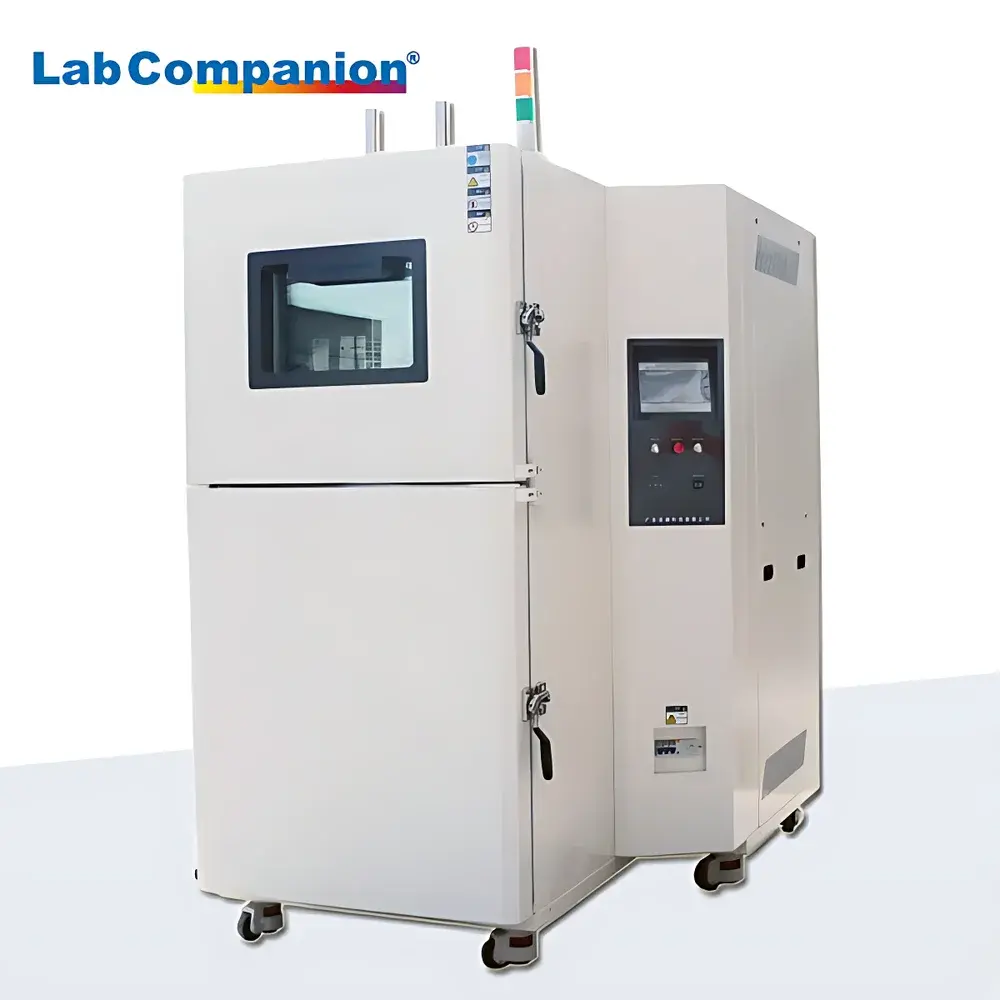
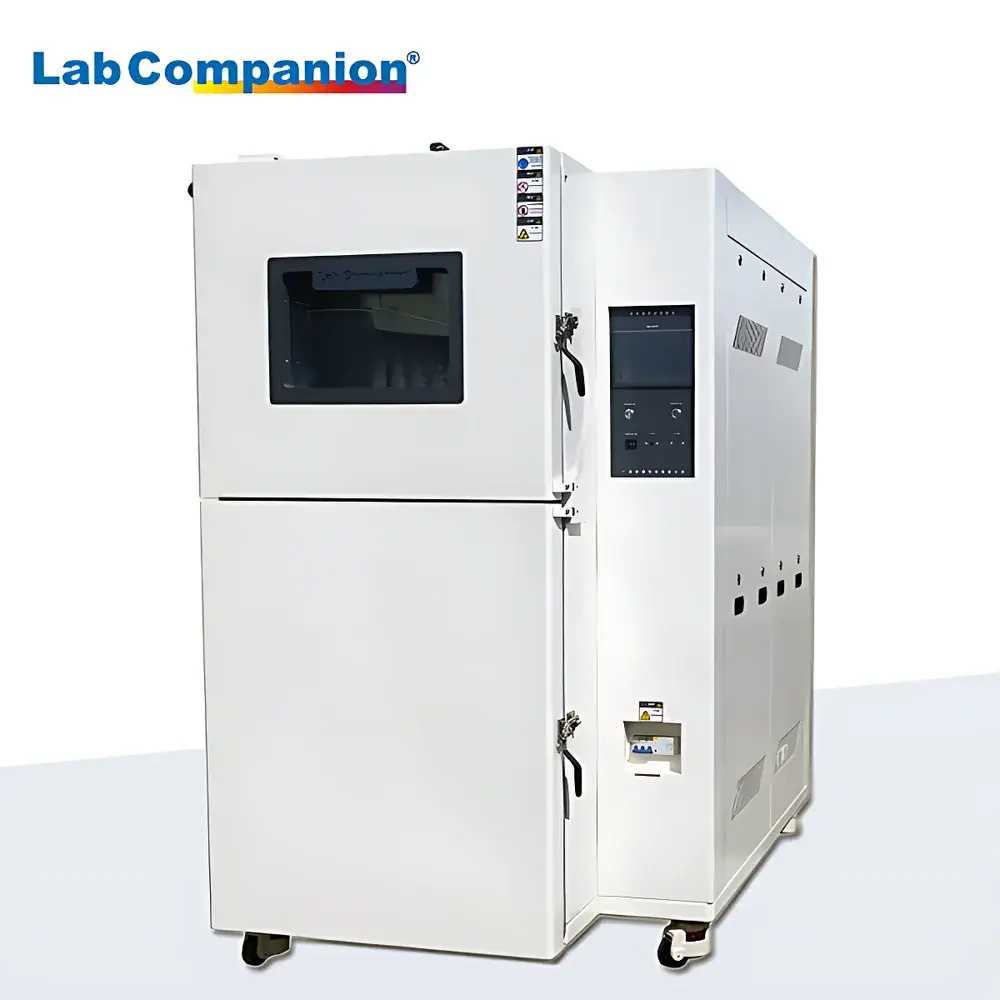
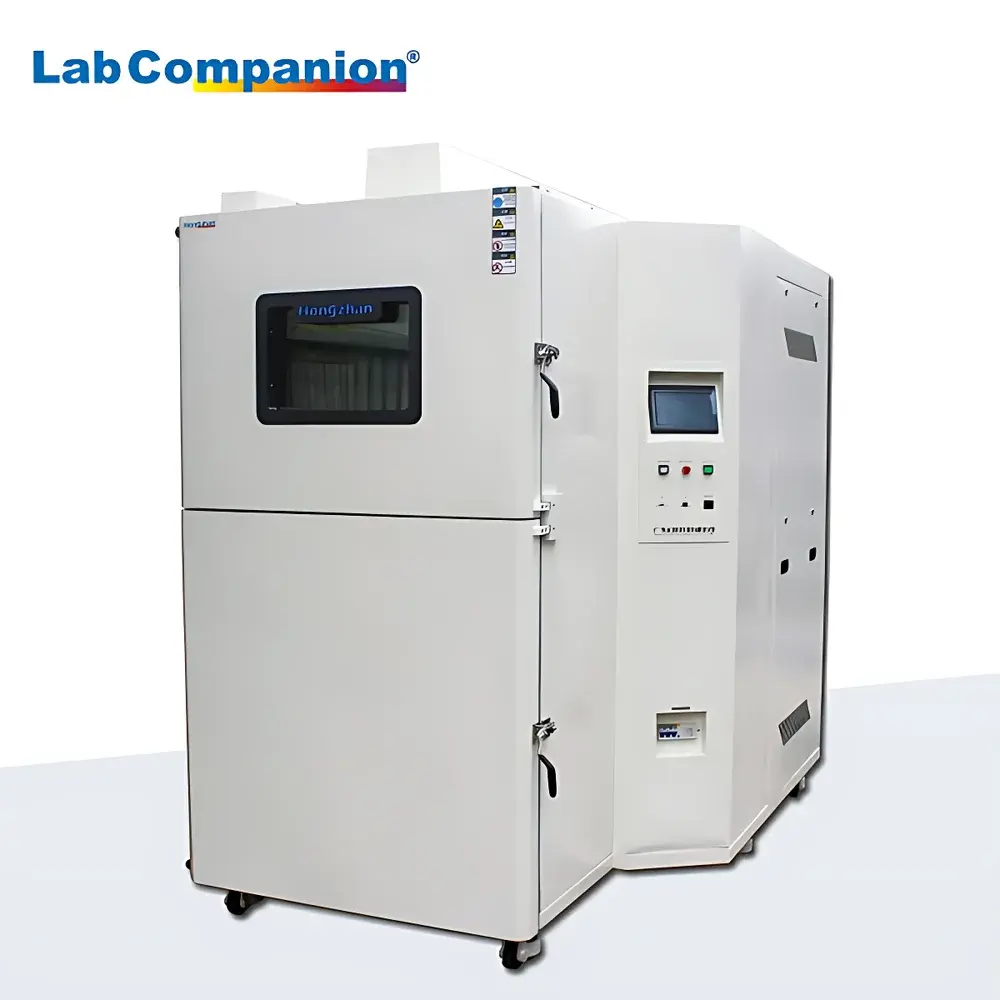
LabCompanion CTL-180A Thermal Shock Test Chamber
| Brand | LabCompanion |
|---|---|
| Origin | Guangdong, China |
| Manufacturer Type | Direct Manufacturer |
| Model | CTL-180A |
| High-Temperature Range | +60 °C to +200 °C |
| Low-Temperature Range | 0 °C to −70 °C |
| Thermal Shock Range | −40 °C to +150 °C |
| Temperature Stability | ±2 °C |
| Heating Rate | R.T. → +200 °C in ~40 min |
| Cooling Rate | R.T. → −70 °C in ~60 min |
| Internal Dimensions (W×H×D) | 600 × 660 × 450 mm |
| External Dimensions (W×H×D) | 2920 × 1100 × 2150 mm |
| Transfer Time | ≤5 s |
| Temperature Recovery Time | ≤5 min |
| Temperature Uniformity | ≤±2 °C (−65 °C to +150 °C) |
| Temperature Fluctuation | ≤±0.5 °C (per GB/T 5170.1–1996) |
| Construction | Exterior — Powder-coated cold-rolled steel |
| Refrigeration System | Air-cooled or water-cooled (optional), equipped with imported compressors |
| Temperature Sensor | Armored Pt100 RTD |
| Controller | Siemens PLC module integrated with LabCompanion PlatinumV1.0 embedded control software + 7-inch color TFT touch screen interface |
| Data Interface | USB port (CSV logging of setpoints, actual values, timestamps |
| Power Supply | AC 380 V, 50 Hz, 3-phase 4-wire + PE |
| Total Installed Capacity | 36 kVA |
| Compliance | GJB 150.3–150.5, GB/T 2423.1–2423.2 |
Overview
The LabCompanion CTL-180A Thermal Shock Test Chamber is an industrial-grade environmental test system engineered for rapid, repeatable, and highly controlled thermal cycling between extreme high- and low-temperature zones. It operates on the two-chamber static air transfer principle—featuring physically isolated high-temperature and low-temperature compartments—and utilizes a horizontal basket-type specimen carrier that moves samples between zones via pneumatic or servo-driven linear motion. This architecture enables precise, reproducible thermal shock profiles required for evaluating material integrity, solder joint reliability, packaging adhesion, and electronic component survivability under accelerated aging conditions. Designed in accordance with MIL-STD-810G, IEC 60068-2-14, and national military standards GJB 150.3 (high temperature), GJB 150.4 (low temperature), and GJB 150.5 (temperature shock), the CTL-180A delivers deterministic thermal transitions critical for qualification testing in aerospace, automotive electronics, semiconductor packaging, and defense subsystem validation.
Key Features
- Independent dual-zone configuration: Separate +60 °C to +200 °C heating chamber and 0 °C to −70 °C cooling chamber, eliminating cross-contamination and enabling stable boundary conditions.
- High-speed transfer mechanism: Basket movement completed within ≤5 seconds, minimizing dwell time at intermediate temperatures and ensuring sharp thermal transients.
- Precision temperature recovery: ≤5 minutes to re-stabilize target temperature after sample transfer, verified across the full operational range (−65 °C to +150 °C).
- Robust thermal insulation: 150 mm thick non-hazardous glass fiber layer minimizes energy loss and maintains uniform internal thermal distribution.
- Industrial-grade control architecture: Siemens S7-1200 PLC core with real-time deterministic logic execution, paired with a 7-inch capacitive-touch HMI running LabCompanion’s PlatinumV1.0 embedded firmware—supporting multi-step programmable profiles, alarm history, and event logging.
- Traceable data acquisition: Onboard USB interface logs timestamped CSV files containing setpoint, measured chamber temperature, elapsed time, and cycle count; compatible with LabCompanion’s PlatinumV1.0 PC-based analysis suite for curve generation and statistical reporting.
- Scalable network integration: Standard RJ45 Ethernet port supports TCP/IP-based remote monitoring and centralized fleet management—up to 32 chambers managed from a single host workstation with role-based access control.
Sample Compatibility & Compliance
The CTL-180A accommodates test specimens up to 600 × 660 × 450 mm (W×H×D) internal volume, with a maximum load mass of 50 kg. Its stainless steel interior (ASTM A240 Type 304, 1.2 mm thickness) ensures corrosion resistance during repeated condensation/frost cycles and compatibility with cleaning agents used in cleanroom-adjacent QA labs. The chamber meets mandatory requirements for GLP-compliant environmental testing workflows: all temperature readings derive from calibrated, armored Pt100 sensors traceable to NIM (National Institute of Metrology, China); controller firmware implements audit-trail functionality—including user login events, parameter modifications, and manual overrides—with timestamped records stored internally and exportable via USB. Certification documentation includes factory calibration reports aligned with GB/T 5170.1–1996 (electrical measurement instruments) and compliance verification against GJB 150.3/4/5 and GB/T 2423.1–2423.2 test methods.
Software & Data Management
LabCompanion PlatinumV1.0 control software provides ISO/IEC 17025-aligned data integrity features: write-protected log files, immutable timestamping, and electronic signature support for test report generation. CSV-formatted datasets include column headers compliant with ASTM E2928-13 (Standard Guide for Data Recording in Environmental Testing), facilitating import into LIMS platforms or statistical process control (SPC) tools such as Minitab or JMP. Optional PlatinumV1.0 PC monitoring software enables remote start/stop, real-time graphing, alarm escalation via email/SNMP traps, and automated PDF report generation—including pass/fail evaluation against user-defined tolerance bands. All communication protocols adhere to IEC 62443-3-3 cybersecurity guidelines; firmware updates require signed binary packages authenticated via SHA-256 hash verification.
Applications
- Electronics reliability screening: Identification of intermetallic growth, die attach delamination, and wire bond fatigue in PCBAs subjected to JEDEC JESD22-A104D thermal shock profiles.
- Aerospace component validation: Qualification of avionics enclosures, optical sensor housings, and composite fasteners per DO-160 Section 4.5 (Temperature Shock).
- Automotive ECUs and ADAS modules: Stress testing per ISO 16750-4 Annex C for cold-start thermal cycling durability.
- Medical device packaging: Accelerated aging of sterile barrier systems (e.g., Tyvek® pouches) under cyclic humidity-free thermal extremes.
- Materials science research: Investigation of coefficient-of-thermal-expansion (CTE) mismatch effects in multilayer ceramic capacitors (MLCCs) and MEMS packaging substrates.
FAQ
What is the minimum achievable transfer time between temperature zones?
The mechanical basket transfer is rated at ≤5 seconds under standard operating conditions, verified at full load (50 kg) and ambient starting temperature (25 °C ±3 °C).
Does the system support custom thermal shock profiles beyond standard military specifications?
Yes—PlatinumV1.0 firmware allows creation of multi-segment profiles with variable dwell times, ramp rates, and conditional branching (e.g., “if T > +145 °C, hold for 15 min; else proceed to next step”).
Is the USB data logging interface compatible with third-party data analysis software?
CSV output conforms to RFC 4180 format with UTF-8 encoding and comma-separated values; column headers follow ASTM E2928-13 conventions and are directly importable into Excel, Python (pandas), MATLAB, and commercial SPC platforms.
Can the chamber be integrated into an existing factory MES or SCADA infrastructure?
Via the standard Modbus TCP interface (optional add-on module), the Siemens PLC core supports bi-directional communication with Rockwell Automation, Siemens WinCC, and Ignition SCADA systems for real-time KPI dashboards and automated test sequencing.
What maintenance intervals are recommended for the refrigeration system?
Compressor oil and filter replacement every 12 months or 2000 operating hours (whichever occurs first); annual verification of refrigerant charge level and condenser coil cleanliness per manufacturer service bulletin SB-CTL-2023-01.



