
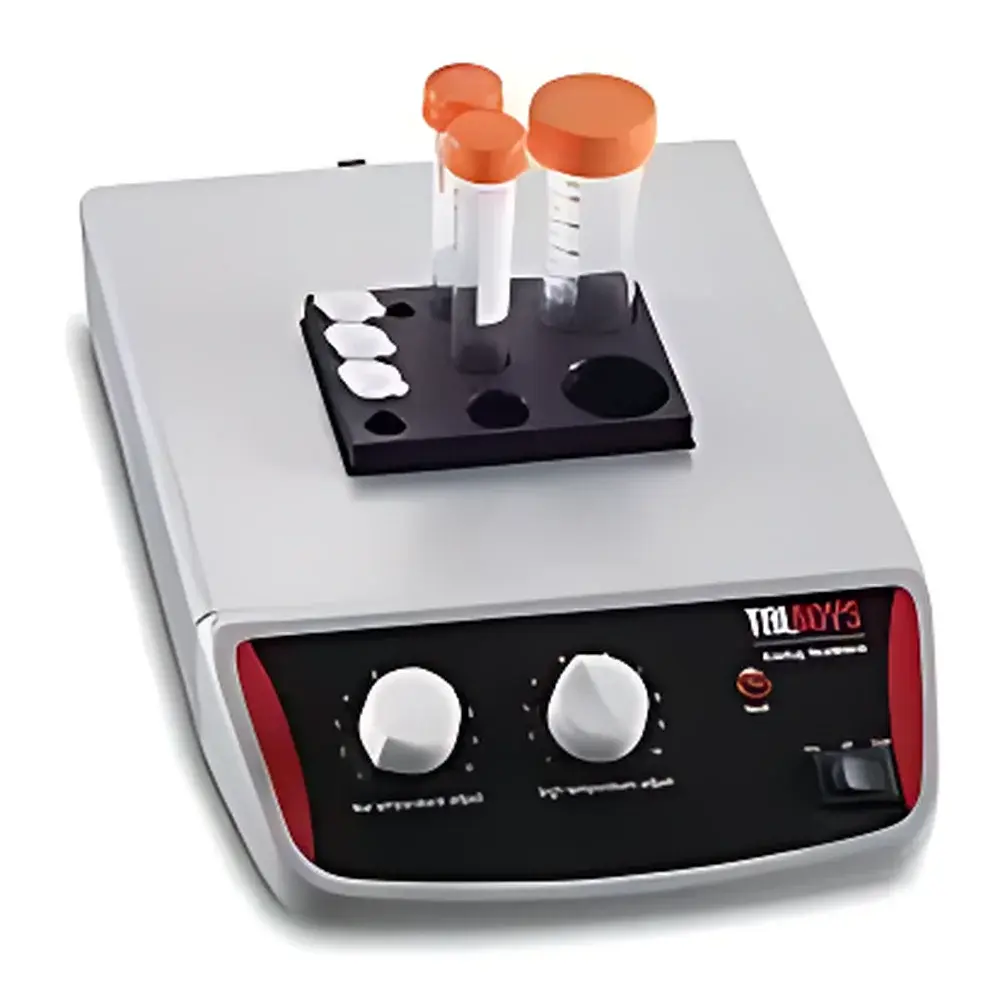
Supelco® 21 mm Heating Block for 3–5 mL Microreaction Vessels
| Brand | Supelco |
|---|---|
| Origin | USA |
| Model | 33316 |
| Number of Holes | 8 |
| Block Dimensions (L × W × H) | 95.3 mm × 73.7 mm × 50.8 mm |
| Hole Diameter × Depth | 21 mm × 30 mm |
| Compatible Vessel Capacity | 3–5 mL |
Overview
The Supelco® 21 mm Heating Block (Model 33316) is a precision-engineered aluminum thermal block designed for consistent, uniform heating of small-volume reaction vessels in analytical and synthetic chemistry workflows. Constructed from high-thermal-conductivity anodized aluminum, the block delivers rapid thermal equilibration and minimal temperature gradient across all eight wells—critical for reproducible kinetic studies, derivatization reactions, and sample preparation steps requiring controlled thermal activation. Unlike generic hot plates or water baths, this dedicated block integrates seamlessly with standard laboratory heating mantles, dry bath incubators, or programmable heating platforms operating within typical ambient-to-120 °C ranges. Its geometry and thermal mass are optimized to match the thermal profile of Supelco’s certified 3 mL and 5 mL screw-thread microreaction vials (e.g., catalog numbers 5182-0717, 5182-0718), ensuring mechanical stability and minimizing convective heat loss during extended incubations.
Key Features
- Eight precisely machined 21 mm-diameter × 30 mm-deep wells—dimensionally matched to Supelco microreaction vial outer diameter and length for full immersion and thermal contact.
- Anodized aluminum construction provides corrosion resistance, mechanical durability, and long-term dimensional stability under repeated thermal cycling.
- Compact footprint (95.3 × 73.7 × 50.8 mm) enables efficient benchtop use and compatibility with space-constrained heating modules and modular incubation systems.
- No electrical components or embedded sensors—designed as a passive thermal interface, supporting compliance with intrinsic safety requirements in solvent-rich environments.
- Traceable manufacturing origin (USA) and adherence to Supelco’s quality control standards for laboratory consumables and accessories.
Sample Compatibility & Compliance
This heating block is validated exclusively for use with Supelco 3 mL and 5 mL threaded reaction vials (polypropylene or glass variants). The 21 mm well diameter accommodates vials with nominal OD ±0.2 mm, while the 30 mm depth ensures ≥25 mm of vessel wall contact—sufficient for conductive heat transfer without compromising headspace integrity. It is not rated for pressure applications or autoclaving. While the block itself carries no regulatory certification, its design supports GLP-compliant sample preparation when used with validated heating instruments and documented SOPs. Laboratories performing USP , ICH Q3C, or EPA Method 502.2 derivatizations routinely deploy this block as part of auditable thermal conditioning steps.
Software & Data Management
As a passive hardware component, the 21 mm heating block does not incorporate firmware, connectivity, or data logging capabilities. Temperature control and monitoring must be managed externally via the host heating system (e.g., Thermo Scientific™ MyBlock™, Benchmark Scientific HB-2000, or similar). When integrated into regulated environments, users are responsible for instrument qualification (IQ/OQ/PQ), calibration traceability (NIST-traceable thermocouples or RTDs), and audit trail documentation per FDA 21 CFR Part 11 requirements. Supelco provides no proprietary software; however, block usage parameters—including setpoint, dwell time, and vessel type—are routinely captured within LIMS or ELN entries during sample workflow execution.
Applications
- Thermal derivatization of analytes prior to GC or GC-MS analysis (e.g., silylation, acylation, esterification).
- Controlled hydrolysis or enzymatic digestion in trace-level residue analysis (pesticides, pharmaceuticals, environmental contaminants).
- Accelerated solvent extraction (ASE) vial pre-conditioning and post-extraction concentration steps.
- Standard addition spiking protocols requiring identical thermal history across calibration and sample sets.
- Stability-indicating assays where thermal consistency directly impacts degradation kinetics and quantitation accuracy.
FAQ
Is this block compatible with non-Supelco vials?
It is dimensionally optimized for Supelco 3–5 mL reaction vials. Use with third-party vials requires verification of outer diameter (21.0 ± 0.2 mm) and total length (≤50 mm) to ensure proper fit and thermal coupling.
Can the block be sterilized in an autoclave?
No—autoclaving may compromise the anodized surface and alter thermal conductivity. Clean with isopropanol or mild detergent; air-dry thoroughly before reuse.
What is the maximum recommended operating temperature?
The aluminum substrate remains structurally stable up to 150 °C; however, prolonged exposure above 120 °C may accelerate oxidation and reduce long-term thermal repeatability. Consult your heating platform’s specifications for safe operational limits.
Does Supelco provide calibration certificates for this block?
No—calibration applies to the active heating instrument, not passive blocks. Users must validate temperature uniformity across all wells using calibrated probes per ISO/IEC 17025 or internal SOPs.
How should the block be mounted on a heating platform?
Secure placement on flat, level heating surfaces is essential. Avoid over-tightening clamps or applying lateral force; thermal expansion mismatches may cause micro-fractures in the anodized layer over time.



