
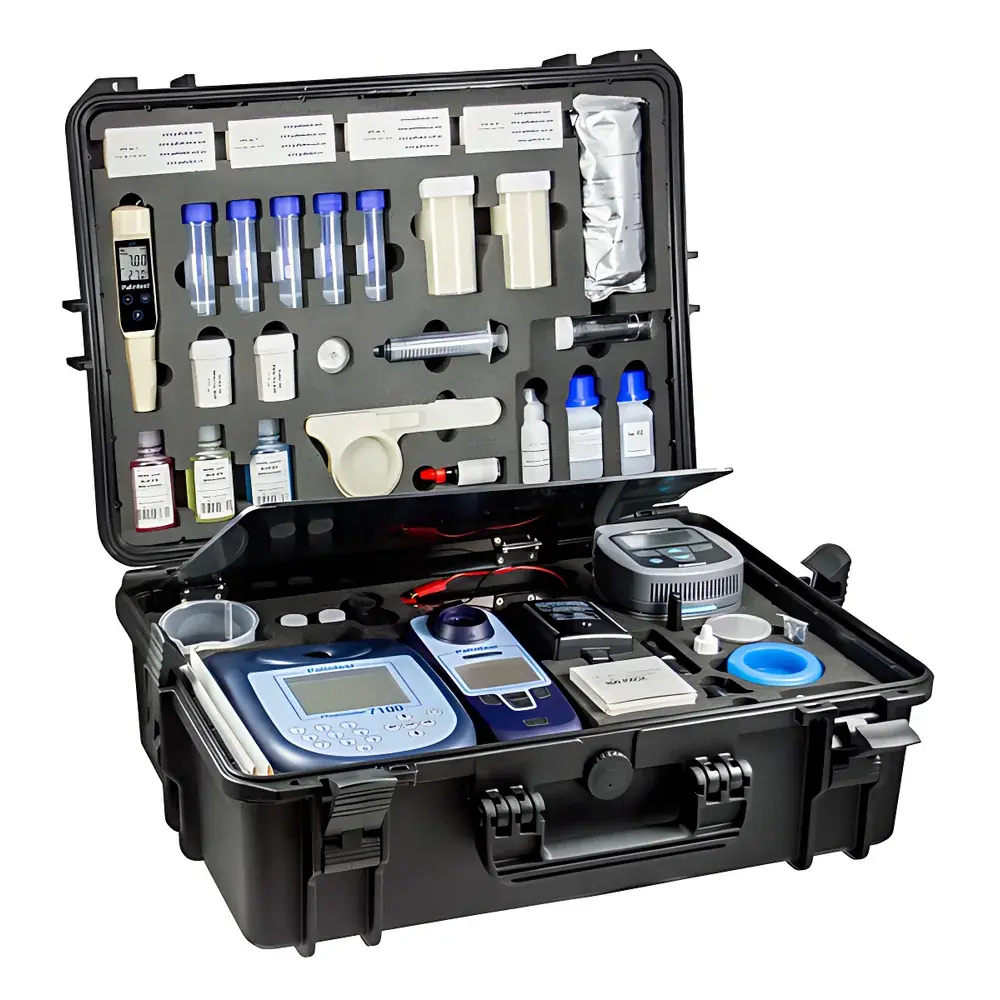
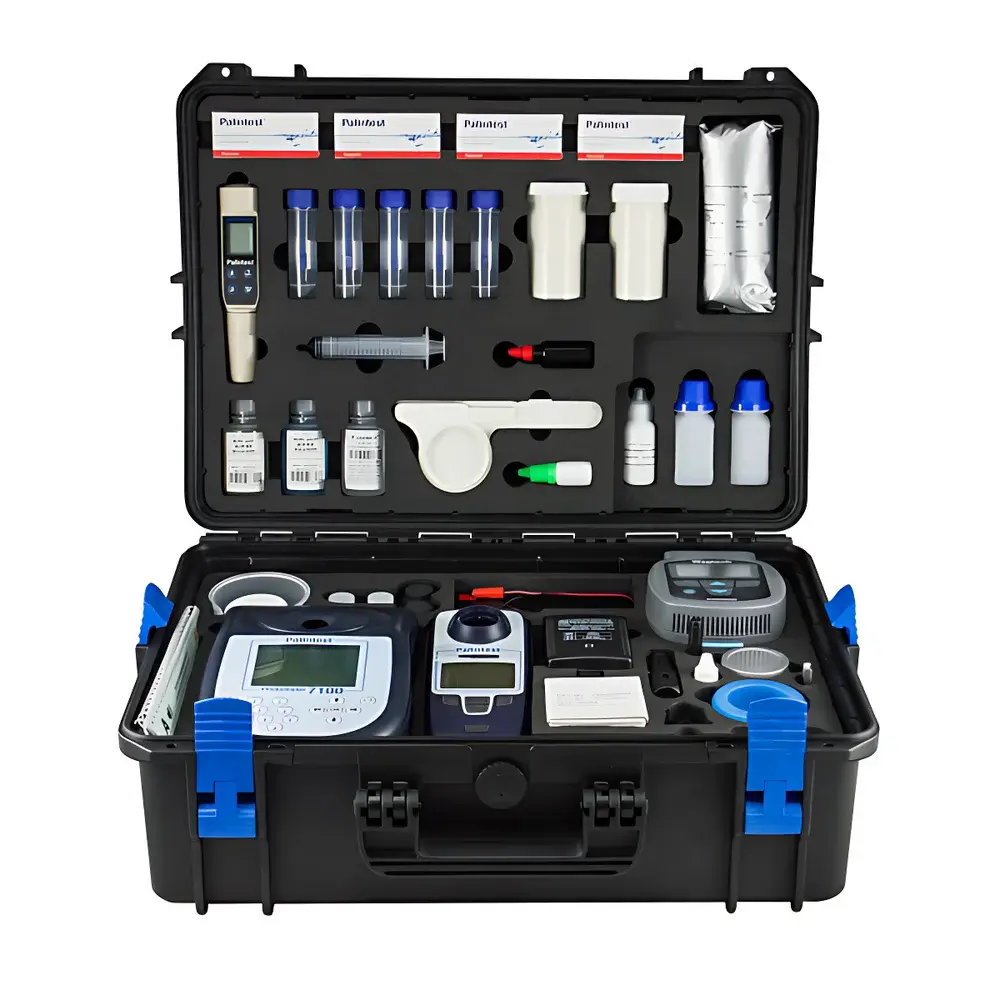
Palintest Potatech9 Standard Water Quality Analysis Laboratory
| Brand | Palintest |
|---|---|
| Origin | United Kingdom |
| Model | Potatech9 |
| Instrument Type | Portable/Handheld Water Quality Analyzer |
| Detection Parameters | Total Coliforms & Fecal Coliforms, Heterotrophic Plate Count (HPC), Free Chlorine, Chlorine Dioxide, Ozone, COD (Permanganate Index), Turbidity, Color, pH |
| Compliance | Designed to meet Chinese National Standards (e.g., GB/T 5750 series), ISO 9001-certified manufacturing, CE-marked for EU environmental instrumentation safety |
Overview
The Palintest Potatech9 Standard Water Quality Analysis Laboratory is a field-deployable, integrated analytical platform engineered for regulatory compliance and operational resilience in decentralized water supply systems. It implements standardized wet-chemistry and membrane filtration methodologies aligned with ISO 9308-1 (coliform enumeration), ISO 7899-2 (heterotrophic plate count), ISO 7027 (turbidity), ISO 8694 (colorimetric chlorine measurement), and GB/T 5750–2006 (Standard Methods for Examination of Drinking Water, China). Unlike benchtop spectrophotometers or standalone culture-based systems, the Potatech9 integrates microbiological incubation, photometric quantification, and physical parameter measurement into a single coordinated workflow—enabling full compliance with WHO Guidelines for Drinking-water Quality (4th ed.) and China’s “Thousand-Ton-Per-Day Rural Water Safety Monitoring Requirements”. Its architecture supports both fixed-laboratory operation and mobile deployment at distribution endpoints, with battery-powered modules enabling uninterrupted analysis during grid outages or remote site visits.
Key Features
- Modular tri-domain design: independent but interoperable microbiology, photometric, and physical measurement subsystems
- Pre-sterilized, lyophilized culture media in aluminum trays—validated for ≥24-month shelf life at ambient temperatures (15–30°C), eliminating cold-chain dependency
- Dual-mode incubation: programmable digital incubator (35 ± 0.5°C) for membrane filtration assays; ambient-temperature enzymatic color development for coliform detection
- 7100 Series Photometer with fixed-wavelength LED optics (430 nm, 520 nm, 610 nm) calibrated per ISO 8694; integrated遮光帽 (light-shield cap) ensures reproducible pathlength control in variable ambient lighting
- Portable turbidimeter compliant with ISO 7027: uses 90° scattered light detection with formazin-based 4-point calibration standards (0.02, 10, 100, 800 NTU)
- pH and temperature probe with NIST-traceable calibration solutions (pH 4.01, 7.00, 10.01) and automatic temperature compensation (ATC)
- No consumable-dependent electronics: all optical and electrochemical sensors are field-replaceable without recalibration
Sample Compatibility & Compliance
The Potatech9 accepts raw, filtered, chlorinated, and groundwater samples across turbidity ranges up to 1000 NTU (pre-dilution required >500 NTU). Membrane filtration compatibility includes 47-mm mixed cellulose ester (MCE) filters with 0.45 µm pore size—certified non-pyrogenic and low-binding. All reagent kits conform to ISO/IEC 17025:2017 reference material requirements and are supplied with lot-specific Certificate of Analysis (CoA) including stability data under accelerated aging (40°C/75% RH). The system meets WHO/UNICEF WASH Programme technical specifications for rural water quality surveillance and supports audit-ready documentation per GLP principles, including operator ID logging, timestamped result capture, and manual entry validation flags.
Software & Data Management
Data acquisition is managed via embedded firmware with onboard storage for ≥500 test records (timestamp, parameter, operator ID, sample ID, instrument serial number). USB-C export enables direct transfer to LIMS-compatible CSV or PDF reports. No proprietary cloud platform is required; exported files include metadata fields compatible with EPA STORET, WHO WaSHBoX, and China’s National Rural Drinking Water Information System (NRDWIS). Audit trails comply with FDA 21 CFR Part 11 requirements for electronic records when paired with user-defined password policies and role-based access controls (administrator/operator modes).
Applications
- Routine daily self-monitoring for rural water plants serving ≥10,000 persons (meeting China’s “9-item mandatory testing” requirement)
- Post-disaster rapid assessment of fecal contamination and disinfectant residual depletion
- Verification of point-of-use treatment device performance (e.g., ceramic filters, UV reactors, chlorination dosers)
- Field validation of centralized lab results during inter-laboratory comparison exercises
- Training laboratories for water utility technicians under national capacity-building programs (e.g., China MWR’s Rural Water Safety Training Framework)
FAQ
Does the Potatech9 require annual factory recalibration?
No—optical and electrochemical modules are factory-calibrated with NIST-traceable references and retain accuracy for 24 months under normal use. Field verification using included calibration standards is recommended before each daily session.
Can it quantify E. coli specifically, or only total/fecal coliforms?
It detects fecal coliforms via elevated-temperature (44.5°C) membrane filtration with selective mFC agar—consistent with ISO 9308-1 Annex B. E. coli confirmation requires subsequent IMViC testing, which is outside the scope of this platform.
Is the turbidity module compliant with ISO 7027 for drinking water applications?
Yes—the portable turbidimeter employs tungsten-halogen illumination and 90° scatter detection with certified formazin standards; measurement uncertainty is ±2% FS at 100 NTU per ISO 7027-1:2016.
What is the minimum detectable concentration for free chlorine using the DPD method?
0.02 mg/L (Cl₂), with linearity maintained from 0.02 to 5.00 mg/L using pre-filled DPD tablet reagents (Lot-controlled, expiry ≥24 months).







