
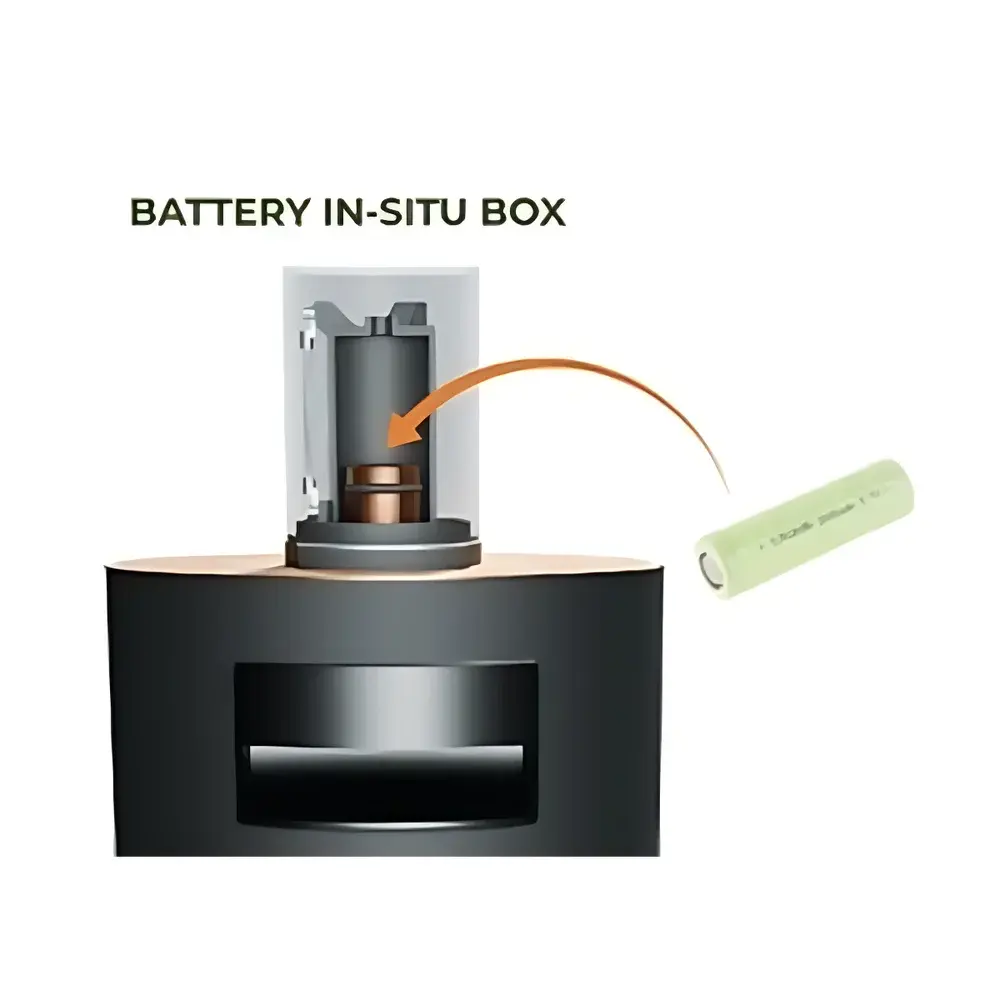
CactuX Battery BOX In-situ Electrochemical Cycling Platform for Micro-CT
| Brand | CactuX |
|---|---|
| Model | Battery BOX |
| Origin | Czech Republic |
| Temperature Range | –30 °C to +60 °C |
| Max Current | 30 A |
| Sample Compatibility | Cylindrical cells (bare, no plastic casing) |
| Dimensions (L×W×H) | 200 mm × 200 mm × 405 mm |
| Weight | 4.25 kg (excluding control unit) |
| Power Input | 230 V AC |
Overview
The CactuX Battery BOX is an engineered in-situ electrochemical testing platform designed specifically for integration with laboratory micro-focus X-ray computed tomography (micro-CT) systems. It enables real-time, non-destructive observation of internal structural evolution in battery cells during active electrochemical cycling under precisely controlled thermal conditions. Unlike conventional post-mortem analysis or ex-situ testing, the Battery BOX operates synchronously with CT acquisition—allowing dynamic correlation between electrical state (voltage, current, SOC), thermal boundary conditions, and 3D volumetric structural changes at micron-scale resolution. Its core architecture follows Couette-style thermal-electrochemical coupling principles, where temperature gradients and current flow are independently regulated yet spatially co-registered with the X-ray field of view. This platform supports fundamental research into degradation mechanisms—including electrode particle cracking, solid-electrolyte interphase (SEI) growth heterogeneity, electrolyte redistribution, and gas bubble formation—under realistic operational stressors.
Key Features
- Simultaneous CT imaging and galvanostatic/potentiostatic cycling: Enables time-resolved 4D (3D + time) reconstruction of internal morphology during charge/discharge sequences.
- Active thermal control from –30 °C to +60 °C with ±0.5 °C stability over 1 h, achieved via integrated Peltier-based cooling/heating modules and closed-loop PID regulation.
- High-current electrochemical interface supporting up to 30 A continuous bidirectional current, compatible with standard battery cyclers (e.g., BioLogic VMP-3, Arbin BT-2000) via isolated analog/digital I/O.
- Modular mechanical design: Interchangeable sample holders accommodate bare cylindrical cells (e.g., 18650, 21700, 26650), with optional fixtures for pouch or prismatic formats upon request.
- CT-compatible materials: All internal components—including electrodes, thermal plates, and shielding—are constructed from low-X-ray-absorption alloys (e.g., titanium, beryllium-copper) and ceramics to minimize beam hardening and scatter artifacts.
- EMI-suppressed signal routing: Shielded cabling, optical isolation, and differential voltage sensing ensure measurement integrity within high-voltage X-ray environments.
Sample Compatibility & Compliance
The Battery BOX is validated for use with commercially available lithium-ion and lithium-metal battery formats, including NMC, LFP, and silicon-anode chemistries. It complies with ISO/IEC 17025 requirements for test equipment traceability and meets mechanical safety standards per EN 61000-6-2 (immunity) and EN 61000-6-4 (emission). While not a medical device or production-line QA tool, its operational parameters align with common research-grade protocols referenced in ASTM D7281 (electrochemical impedance spectroscopy), IEC 62660-1 (performance testing), and US Department of Energy’s Battery Testing Manual guidelines. Data acquisition workflows support GLP-compliant metadata tagging—including timestamp synchronization between CT projections and electrochemical logs—to facilitate audit readiness in academic and industrial R&D settings.
Software & Data Management
The platform includes CactuX Control Suite—a cross-platform application (Windows/Linux) providing synchronized orchestration of thermal setpoints, current/voltage profiles, and CT scan triggers. It supports import of custom cycling protocols (.csv/.xlsx), real-time visualization of voltage/current/temperature trends alongside live CT preview frames, and export of time-stamped binary data streams compliant with HDF5 v1.12+ format. All raw electrochemical logs include embedded calibration coefficients and hardware identification tags. The software architecture conforms to FDA 21 CFR Part 11 principles through optional electronic signature modules, role-based access control, and immutable audit trails for parameter changes and session start/stop events. Exported datasets are structured to integrate natively with MATLAB, Python (via h5py), and commercial CT reconstruction pipelines (e.g., Thermo Scientific Avizo, Bruker SkyScan CTAn).
Applications
- Quantifying anisotropic electrode swelling during lithiation/delithiation across temperature gradients.
- Tracking electrolyte wetting dynamics and depletion zones in dry-room assembled cells.
- Correlating local current density hotspots (inferred from resistivity maps) with microcrack nucleation in cathode particles.
- Evaluating thermal runaway propagation pathways in multi-cell modules under localized heating.
- Validating physics-based battery models (e.g., Newman-type porous electrode theory) using experimentally derived 3D microstructural constraints.
- Supporting DOE and EU Battery 2030+ initiatives focused on next-generation solid-state and sodium-ion cell development.
FAQ
Is the Battery BOX compatible with synchrotron-based CT systems?
Yes—its compact footprint, low-Z material construction, and EMI-hardened electronics have been verified at beamlines such as TOMCAT (SLS, Switzerland) and ID19 (ESRF, France). Custom vacuum-compatible variants are available upon request.
Can it be used with commercial battery testers other than those listed in the documentation?
All analog I/O channels follow standard 0–10 V / 4–20 mA conventions; digital triggers use TTL-level signals. Integration with third-party cyclers requires verification of signal polarity and grounding topology, which CactuX engineering provides during pre-installation review.
Does the system include safety interlocks for thermal runaway scenarios?
The platform incorporates dual-redundant thermal fuses, real-time gas detection (optional NH₃/H₂ sensor module), and emergency shutdown via hardware latch triggered by external safety relays—fully configurable to site-specific lab safety protocols.
What level of spatial resolution can be maintained during active cycling?
Resolution is governed by the host CT system—not the Battery BOX. However, mechanical stability is maintained to <1 µm RMS vibration amplitude across the full temperature and current range, preserving sub-5 µm voxel fidelity typical of modern benchtop micro-CT scanners.
Is remote operation supported?
Yes—via secure SSH tunneling or VPN-configured RDP sessions. All control functions, including firmware updates and diagnostic logging, are accessible remotely without compromising data integrity or audit trail compliance.



