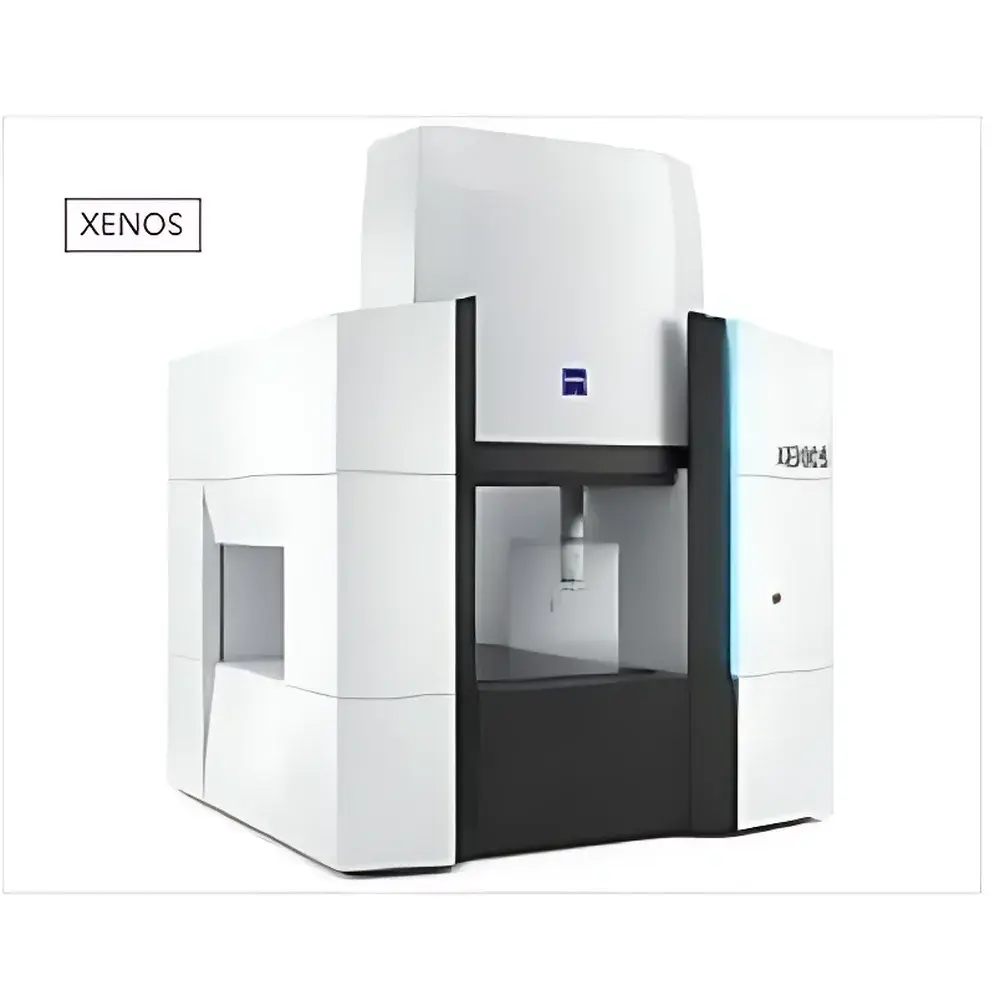
ZEISS XENOS Benchtop Coordinate Measuring Machine
| Brand | ZEISS |
|---|---|
| Origin | Germany |
| Model | XENOS |
| Configuration | Bridge-type |
| Operation Mode | Automatic |
| Orientation | Vertical |
| Measurement Volume (X×Y×Z) | 900 × 1500 × 700 mm |
| Length Measurement Error E₀ | (0.3 + L/1,000) µm |
| Standard Ambient Temperature Range | 18–26 °C |
Overview
The ZEISS XENOS Benchtop Coordinate Measuring Machine (CMM) is an ultra-high-precision metrology system engineered for applications demanding sub-micrometer geometric accuracy in research laboratories, aerospace component validation, optical assembly verification, and advanced manufacturing quality assurance. Built upon a fundamentally re-engineered mechanical architecture—distinct from conventional bridge CMMs—the XENOS employs a decoupled Y-axis motion concept: Y-guideways are mounted at the top of the side walls, while only the bridge moves along Y, eliminating platform inertia variations. This design ensures constant moving mass across the entire measurement volume, enabling high acceleration (≥0.8 m/s²), sustained scanning velocities up to 500 mm/s, and exceptional dynamic stability. All three axes utilize direct-drive linear motors—free of mechanical transmission elements—eliminating backlash, cogging, and shear-force-induced deviations. Coupled with ultra-high-resolution optical encoders (sub-100 nm interpolation resolution), the system achieves repeatable positioning accuracy below 100 nm and minimizes probe deflection hysteresis during complex surface tracing.
Key Features
- Innovative kinematic architecture: Fixed granite base with suspended Y-guideways and single-bridge Y-motion—reducing effective moving mass by >40% versus traditional moving-table bridges.
- Full-axis linear motor drive: Enables jerk-free acceleration profiles, nanometer-level trajectory fidelity, and zero mechanical wear over extended service life.
- SiC (silicon carbide) ceramic structural components: Used in critical kinematic elements including the bridge, Z-column, and probe mounting interface; offers 50% lower coefficient of thermal expansion vs. alumina ceramics, 30% higher stiffness, and 50% weight reduction vs. steel at double the specific rigidity.
- VAST gold active scanning probe: Optimized for metrological repeatability (MPEP ≤ 0.25 µm) and compatibility with probes up to 800 mm in length and 500 g total mass—including asymmetric configurations for deep cavity or narrow-feature access.
- Dual synchronous Y-axis linear drives with virtual center-of-mass control: Dynamically balances drive torque distribution based on real-time X-position feedback, suppressing yaw and pitch errors across full travel.
- Enhanced air-bearing system: Redesigned porous-air bearing pads with adaptive pressure regulation deliver improved load capacity, thermal drift resistance, and vibration damping—critical for low-noise probing at sub-µm levels.
- Integrated cable management and revised electronics layout: Minimizes electromagnetic interference and mechanical coupling between motion cables and sensitive metrology axes.
Sample Compatibility & Compliance
The XENOS accommodates workpieces up to 1,500 mm in length and 700 mm in height, supporting both single-part inspection and fixture-mounted multi-component assemblies. Its vertical configuration allows unobstructed access to complex geometries—including turbine blades, optical mounts, and precision molds—without repositioning constraints typical of horizontal-arm systems. The machine complies with ISO 10360-2 (CMM acceptance and reverification tests), ISO 15530-3 (calibration using calibrated artifacts), and supports traceable calibration per DKD-R 3-3 (German Calibration Service). Environmental operation adheres to ISO 230-2 (determining accuracy under defined thermal conditions) within 18–26 °C ambient, with optional active temperature stabilization modules available for Class 1 metrology labs.
Software & Data Management
Controlled via ZEISS CALYPSO software (v8.0+), the XENOS integrates seamlessly with industry-standard GD&T evaluation workflows—including ASME Y14.5 and ISO 1101 tolerancing frameworks. CALYPSO supports automated feature recognition, adaptive scanning path planning, and statistical process control (SPC) data export compliant with SPC-ML v2.0. Full audit trail functionality satisfies FDA 21 CFR Part 11 requirements, including electronic signatures, user-role-based access control, and immutable change logs. Measurement programs can be exported as XML-based portable templates for cross-site replication. Optional integration with ZEISS PiWeb reporting servers enables centralized database storage, trend analysis, and compliance-ready documentation packages aligned with ISO/IEC 17025 laboratory accreditation criteria.
Applications
- Aerospace: Verification of turbine blade airfoil profiles, wing spar hole patterns, and composite layup alignment per NAS970 and NADCAP AC7114 standards.
- Optics & Photonics: Metrology of aspheric lenses, beam splitters, and optomechanical mounts requiring form error < λ/20 PV and positional accuracy < 0.5 µm.
- Medical Device Manufacturing: Validation of orthopedic implant surfaces, microfluidic channel geometry, and laser-welded sensor housings per ISO 13485 QMS requirements.
- Research Metrology: Primary reference measurements for artifact calibration labs, inter-laboratory comparison studies, and development of new ISO 5725-compliant uncertainty budgets.
- Automotive Powertrain: Cylinder head port geometry, fuel injector nozzle orifice alignment, and gear tooth flank deviation mapping under ISO 1328-1.
FAQ
What environmental conditions are required for optimal performance?
The XENOS must operate within a thermally stable environment of 18–26 °C, with temperature gradients not exceeding 1 K/hour and humidity maintained between 40–60% RH. Active HVAC integration and granite base thermal mass buffering are recommended for Class 1 metrology environments.
Is the system compatible with non-contact optical sensors?
Yes—via optional ZEISS VAST XT extension module, the XENOS supports interchangeable sensor heads including the Zeiss OptoScan chromatic confocal sensor (resolution down to 10 nm vertical) and the Zeiss CT-Scan computed tomography add-on for internal feature metrology.
How is measurement uncertainty quantified and validated?
Uncertainty evaluation follows the GUM (JCGM 100:2008) framework, incorporating contributions from machine kinematics (E₀), probe hysteresis (MPEP), thermal drift (k·ΔT), and operator influence. Certificate of Conformance includes full MPE test reports per ISO 10360-2 Annex B.
Can the system be integrated into an Industry 4.0 production line?
Yes—via OPC UA server interface and RESTful API endpoints, the XENOS supports real-time data exchange with MES/SCADA platforms, automated pass/fail flagging, and predictive maintenance alerts based on drive current harmonics and air-bearing pressure trends.