
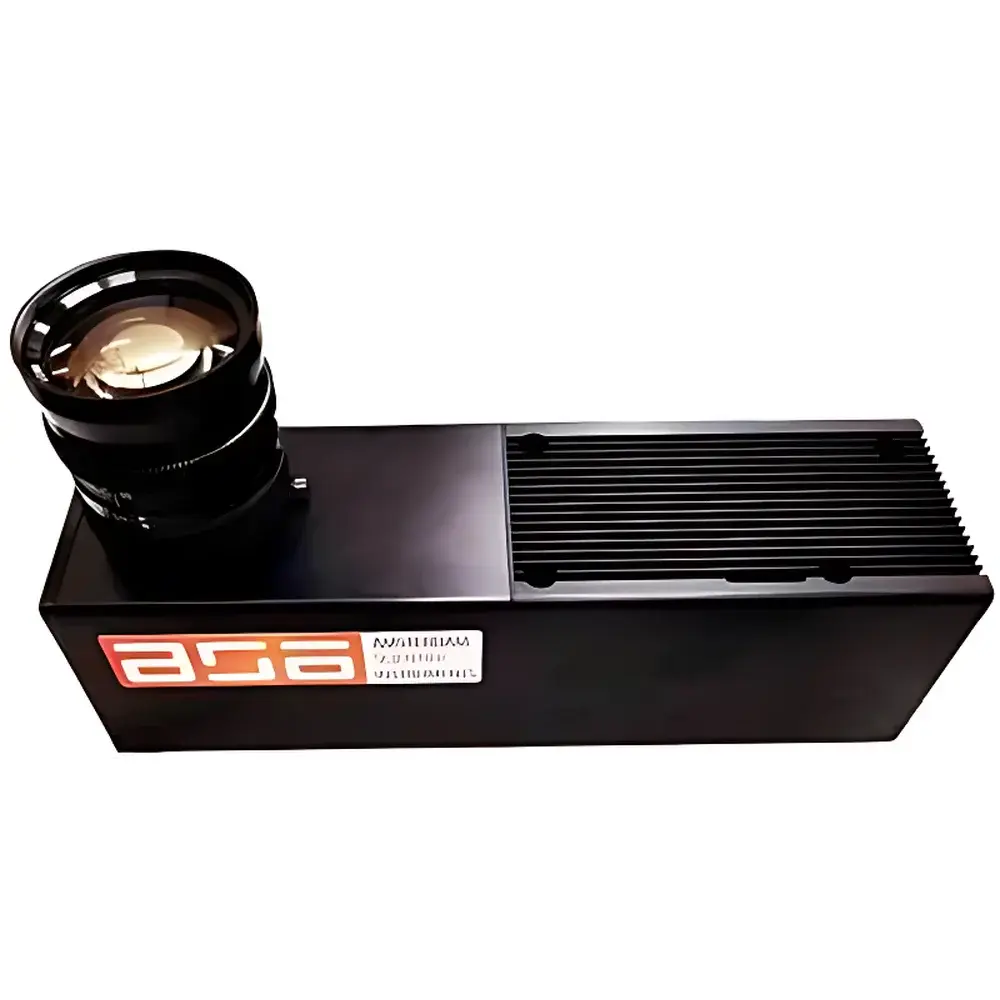
Amsterdam Scientific Instruments TPX3Cam High-Speed Optical Camera for Nanosecond Photon Timestamping
| Brand | Amsterdam Scientific Instruments (ASI) |
|---|---|
| Origin | Netherlands |
| Model | TPX3Cam |
| Effective Pixels | 256 × 256 |
| Pixel Size | 55 µm |
| Active Area | 14.1 × 14.1 mm² |
| Wavelength Range | 400–1000 nm |
| Time Resolution | 1.6 ns |
| Maximum Hit Rate | 80 Mhits/s |
| Frame Equivalent Rate | >500 MHz |
| Readout Dead Time | Zero (data-driven) |
| Operating Environment | External to Vacuum (optical coupling via phosphor screen) |
| Cooling | Air-cooled |
| Weight | 2.2 kg |
| Dimensions (L×W×H) | 28.5 × 80 × 90 cm³ |
| Threshold Channels | 1 |
| Shutter Control | External TTL-compatible |
Overview
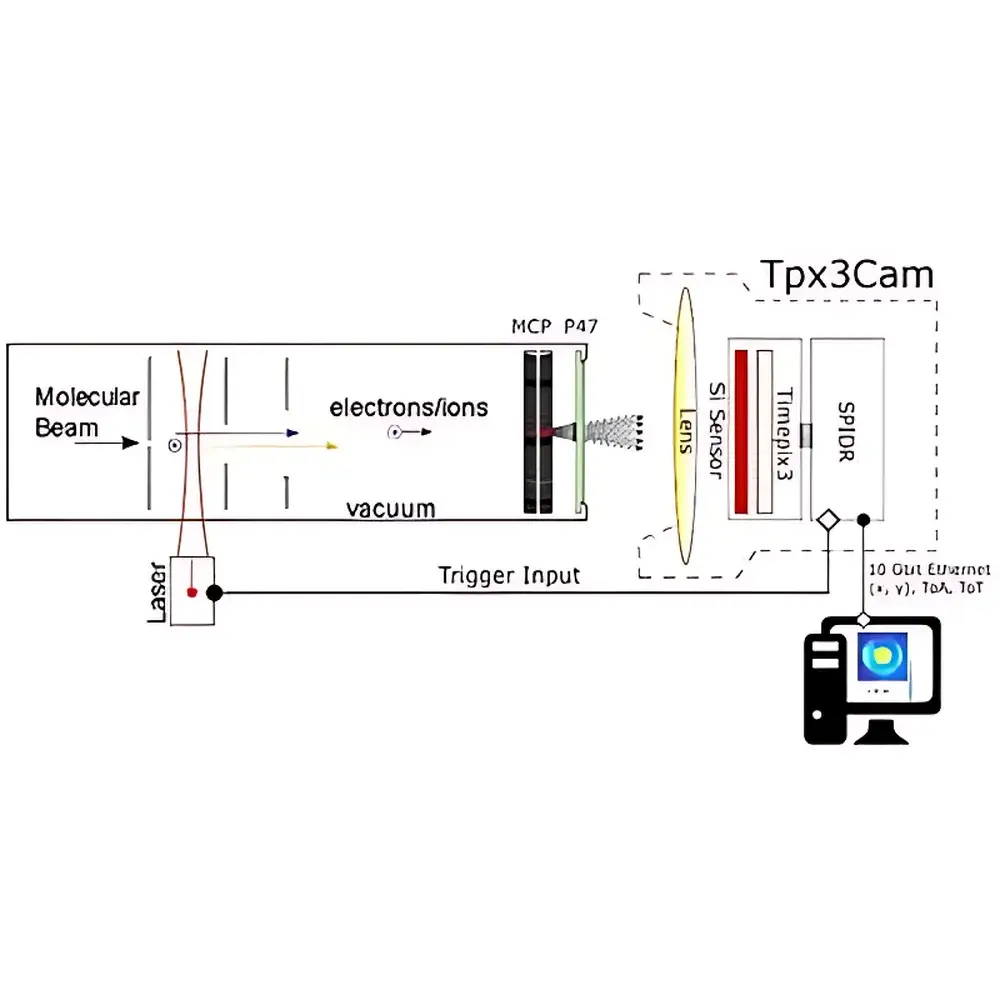
The Amsterdam Scientific Instruments TPX3Cam is a high-speed, time-resolved optical imaging camera engineered for nanosecond-scale photon timestamping in demanding scientific environments. Unlike conventional CCD or sCMOS cameras, the TPX3Cam integrates a custom silicon pixel sensor with the Timepix3 application-specific integrated circuit (ASIC), enabling simultaneous per-pixel measurement of time-of-arrival (ToA) and time-over-threshold (ToT). This architecture implements a massively parallel, event-driven digital converter array—where each of the 256 × 256 pixels functions as an independent, time-stamping photon counter. The system operates on the principle of time-resolved scintillation detection: when ions or electrons strike a microchannel plate (MCP) coupled to a fast-decay P47 phosphor screen, the resulting optical flash (400–1000 nm) is imaged through vacuum-compatible optics onto the TPX3Cam sensor. Critically, the camera operates outside the vacuum chamber, eliminating feedthrough complexity and enabling rapid integration into VMI (Velocity Map Imaging), TOF-MS (Time-of-Flight Mass Spectrometry), and free-electron laser (FEL) end stations.
Key Features
- Per-pixel nanosecond timing: 1.6 ns time resolution with full ToA/ToT readout across all 65,536 pixels
- Zero dead-time, data-driven acquisition: No global frame exposure; events are timestamped and streamed asynchronously at up to 80 million hits per second
- High quantum efficiency in visible–NIR range: Optimized for 400–1000 nm emission from fast phosphors (e.g., P47) and image intensifiers
- Vacuum-decoupled optical design: Enables robust operation in UHV environments without compromising sensor longevity or thermal stability
- Real-time covariance and coincidence analysis: Native support for multi-particle correlation studies via synchronized timestamp streams
- Compact, air-cooled form factor (28.5 × 80 × 90 cm³) with external TTL shutter control and 260 ps external trigger timestamping capability
Sample Compatibility & Compliance
The TPX3Cam is designed for compatibility with standard ultra-high-vacuum (UHV) imaging setups, including VMI spectrometers, reaction microscopes (ReMi), and FEL beamlines. It interfaces seamlessly with MCP–phosphor detection stacks using standard fused-silica or UV-grade quartz windows. The system meets mechanical and electrical requirements for integration into ISO-standard optical tables and synchrotron end stations (e.g., FLASH at DESY, Hamburg). While not certified for medical or industrial regulatory frameworks, its timestamping architecture supports traceable time-domain metrology compliant with ISO/IEC 17025 principles for research-grade instrumentation. Data provenance—including hardware timestamps, pixel-level gain calibration, and trigger synchronization metadata—is preserved in raw HDF5 output files, facilitating GLP-aligned experimental documentation.
Software & Data Management
Acquisition and analysis are supported by ASI’s open-source PyTPX3 toolkit and the commercial SPIDR software suite. Both provide real-time visualization of ToA histograms, ToT-intensity maps, and 3D event clouds (x, y, t). Raw data streams conform to HDF5 v1.10+ with embedded NeXus-compatible metadata schemas, ensuring interoperability with Python-based scientific stacks (NumPy, SciPy, scikit-image) and MATLAB toolchains. Timestamped event lists include precise synchronization markers for external triggers (e.g., laser pulses, RF gates), enabling post-acquisition alignment with sub-nanosecond jitter. All software modules support audit-trail logging per FDA 21 CFR Part 11 Annex 11 guidelines for regulated research environments requiring electronic record integrity.
Applications
- Velocity map imaging (VMI) of electrons and fragment ions in strong-field ionization experiments
- Multi-hit time-of-flight mass spectrometry with momentum reconstruction of correlated ion pairs
- Wide-field time-correlated single-photon counting (TCSPC) when coupled with Photonis Cricket2 image intensifiers
- Phosphorescence lifetime imaging (PLIM) in materials science and biological fluorescence assays
- Ultrafast beam diagnostics at synchrotrons and X-ray free-electron lasers (XFELs)
- Coincidence spectroscopy in cold-target recoil ion momentum spectroscopy (COLTRIMS) setups
FAQ
Does the TPX3Cam require vacuum-compatible mounting?
No—the camera is designed for external optical coupling. Only the phosphor screen and MCP assembly reside inside vacuum; the TPX3Cam mounts outside behind a viewport.
Can it resolve overlapping photon events within the same pixel?
Yes—each pixel has an internal 1.6 ns time-resolution timer and a 14-bit ToT counter, enabling pile-up discrimination up to ~1 µs inter-event spacing.
Is calibration data provided for quantitative intensity and timing accuracy?
Yes—factory calibration includes pixel-wise gain, offset, and time-walk correction tables, delivered with each unit in standardized HDF5 format.
What software licenses are included with purchase?
PyTPX3 (open-source, MIT license) is included; SPIDR requires a separate annual maintenance subscription for updates and technical support.
How is synchronization achieved with external pulsed sources such as femtosecond lasers?
Via a dedicated LEMO input accepting TTL/NIM signals with 260 ps timestamp precision relative to internal clock, fully integrated into event metadata.




