
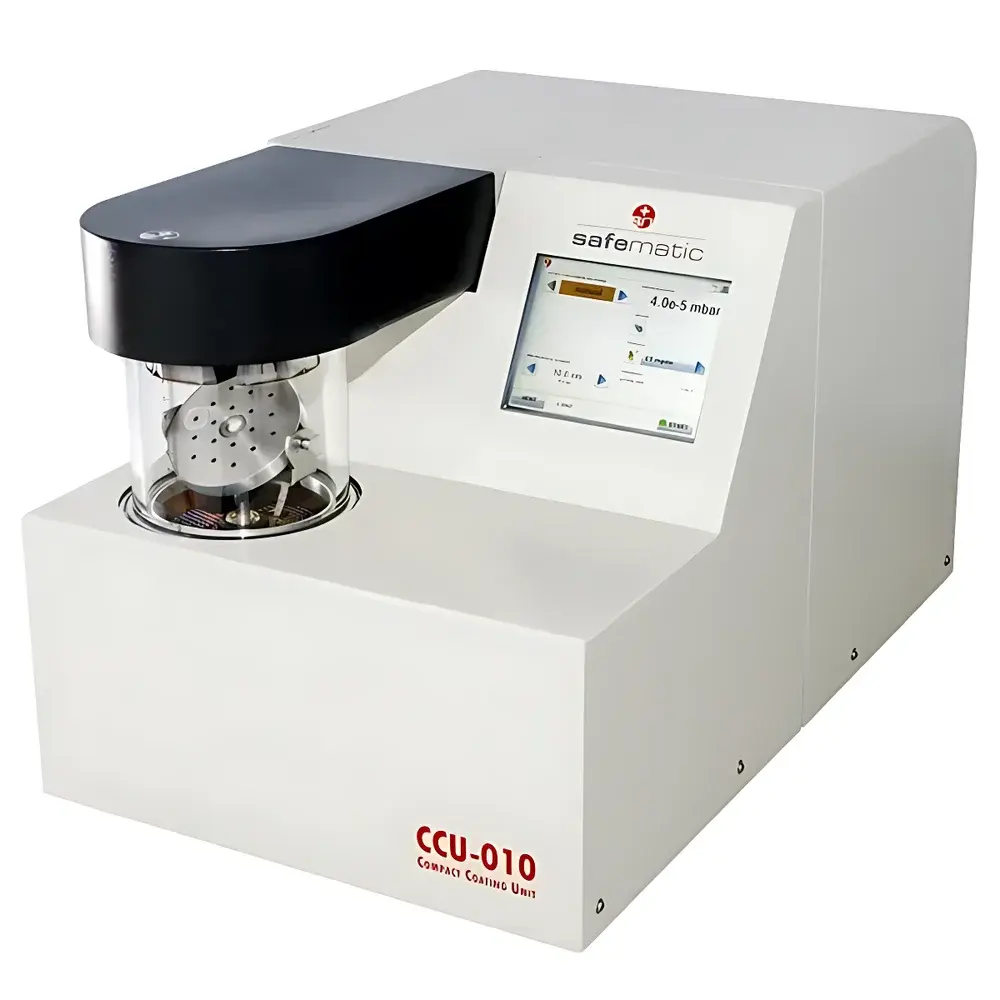
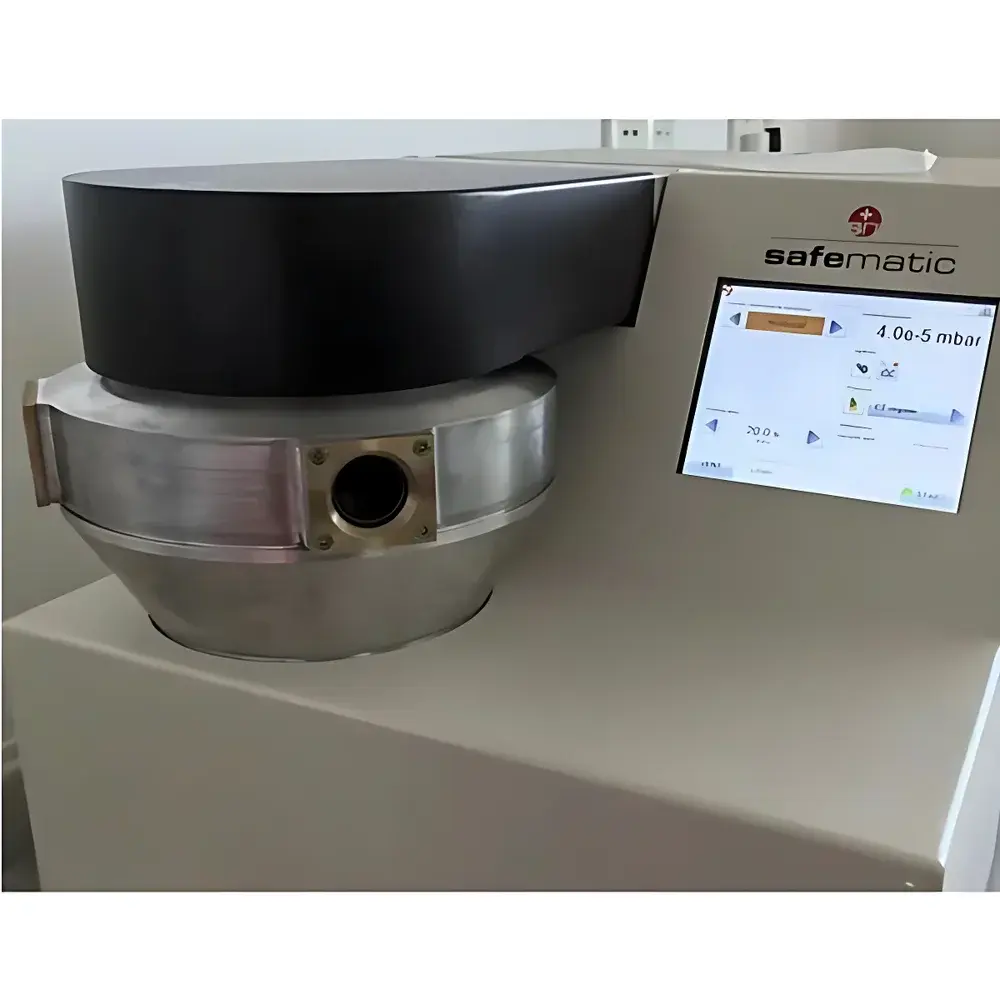
Safematic CCU-010 LV_CT Thermal Evaporation Carbon Coater
| Brand | Safematic |
|---|---|
| Origin | Switzerland |
| Model | CCU-010 LV_CT |
| Vacuum Type | Low-Vacuum Thermal Evaporation System |
| Coating Method | Resistive Thermal Evaporation (Carbon Rope Feed) |
| Plasma Treatment | Optional Integrated Glow Discharge (GD-010) and Plasma Etching (ET-010) Modules |
| Thickness Monitoring | Dual-Position Quartz Crystal Microbalance (QCM) |
| Control Interface | TFT Touchscreen + Windows-Based Remote Software (RC-010) |
| Sample Stage | Ø ≥60 mm, Height-Adjustable & Tilt-Compatible |
| Compliance | Designed for SEM/EDS Sample Preparation per ISO 13822, ASTM E1558, and GLP-Compliant Workflow Support |
Overview
The Safematic CCU-010 LV_CT is a compact, modular low-vacuum thermal evaporation carbon coater engineered specifically for high-fidelity sample preparation in scanning electron microscopy (SEM), energy-dispersive X-ray spectroscopy (EDS), and related surface analysis workflows. It operates on the principle of resistive thermal evaporation—where high-purity carbon rope is heated under controlled vacuum conditions to generate a directional vapor flux that condenses as a uniform, conductive amorphous carbon film on non-conductive or beam-sensitive specimens. Unlike sputter-based systems, this method avoids ion bombardment damage and minimizes substrate heating, making it ideal for delicate biological, polymeric, or hydrated samples requiring ultra-thin (<5 nm), low-contamination carbon coatings. The system’s fine vacuum architecture (base pressure ≤5 × 10⁻² mbar, typical operating range 1–5 × 10⁻² mbar) balances rapid pump-down time with stable evaporation kinetics—achieved through optimized chamber geometry, low-outgassing materials (e.g., electropolished stainless steel, ceramic insulators), and dual standard KF-40 vacuum flanges for seamless integration with auxiliary gas lines or external plasma sources.
Key Features
- Proprietary auto-feed carbon rope module (CT-010): Enables up to 30+ consecutive carbon depositions per vacuum cycle without manual intervention—reducing operator dependency and cross-contamination risk.
- Plug-and-play thermal evaporation head: Interchangeable with optional magnetron sputtering (CCU-010 LV_MS) or hybrid sputter/carbon (CCU-010 LV_SC) modules—supporting future platform expansion without hardware replacement.
- Dual-position quartz crystal microbalance (QCM): Independently calibrated sensors at center and edge positions accommodate variable sample geometries (e.g., bulk mounts, stubs, TEM grids) while maintaining ±0.1 nm thickness resolution for films ranging from 1 nm to 50 nm.
- Intelligent power control: Integrates pulsed evaporation, programmable shutter delay (post-degassing), and real-time QCM feedback to suppress arcing and ensure lateral uniformity—critical for quantitative EDS quantification.
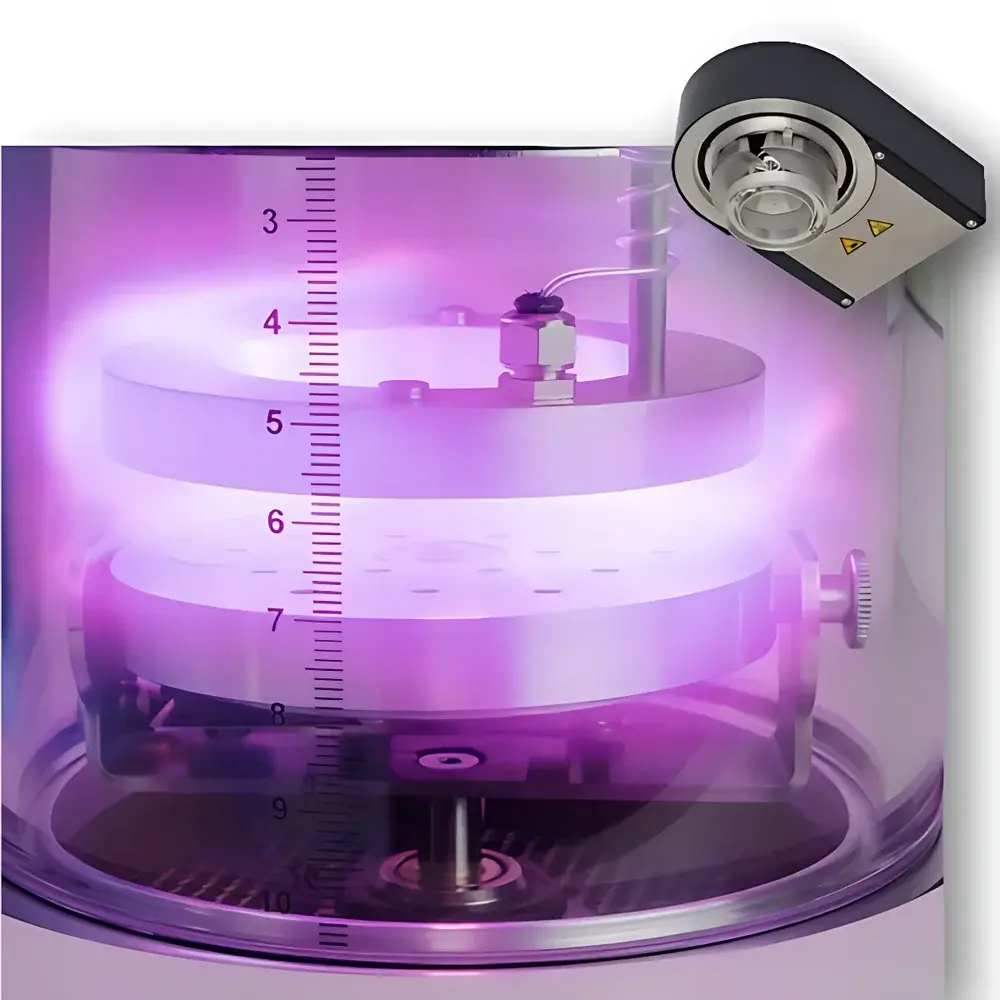
- Integrated plasma functionality: Optional GD-010 glow discharge unit enables hydrophilization of carbon films using air, Ar, or O₂; ET-010 plasma etch module supports pre-coating surface cleaning or post-coating functionalization—all performed in situ without venting.
- TFT touchscreen interface with recipe-based operation: Stores up to 99 user-defined protocols (evaporation rate, duration, tilt angle, plasma parameters); includes automatic safety interlocks and power-fail vacuum dump to protect turbomolecular pump integrity.
Sample Compatibility & Compliance
The CCU-010 LV_CT accommodates standard SEM stubs (Ø ≤32 mm), TEM grids (3.05 mm), and custom substrates up to Ø60 mm via its height-adjustable, tilt-capable stage. Optional rotating, planetary, or microscope slide holders extend utility to multi-sample throughput or anisotropic coating requirements. All wetted components comply with RoHS and REACH directives. The system supports audit-ready documentation workflows aligned with ISO/IEC 17025, FDA 21 CFR Part 11 (via RC-010 software logging), and GLP/GMP environments—featuring timestamped parameter logs, electronic signatures, and exportable Excel/PNG reports. Vacuum performance meets ASTM E1558 guidelines for carbon coating reproducibility in microanalysis laboratories.
Software & Data Management
The RC-010 Windows-based remote control software provides full instrument supervision—including real-time QCM thickness curves, live vacuum trace monitoring, and synchronized plasma event logging. Users create, version-control, and archive deposition recipes with metadata tagging (operator ID, date, sample ID). All data exports retain SI-unit consistency (nm, nm/s, mbar) and support CSV/Excel for LIMS integration. Audit trails record every parameter change, emergency stop, or vacuum breach—enabling full traceability per ISO 13822 Annex B requirements for coated reference material certification.
Applications
- Conductive carbon coating of insulating specimens prior to SEM imaging and EDS elemental mapping.
- Preparation of TEM support films with tunable thickness for low-dose cryo-EM workflows.
- In-situ surface activation of carbon layers via GD-010 for improved antibody binding in immunogold labeling.
- Controlled plasma etching (ET-010) to remove organic contaminants from semiconductor wafers before metallization.
- Routine maintenance of carbon evaporation sources in central facility labs—leveraging CT-010’s extended service interval and tool-free cartridge replacement.
FAQ
What vacuum level is required for stable carbon evaporation?
Stable thermal evaporation of carbon rope requires a base pressure ≤5 × 10⁻² mbar; the CCU-010 LV_CT achieves this in <90 seconds using its optimized dual-stage pumping architecture.
Can the same chamber be used for both carbon evaporation and sputter coating?
Yes—the CCU-010 LV platform supports hot-swappable modules: CT-010 (carbon), MS-010 (magnetron sputtering), or SC-010 (dual-mode), all sharing identical mounting interfaces and vacuum seals.
Is the QCM thickness monitor calibrated traceably to NIST standards?
Each QCM sensor ships with individual calibration certificate referencing ISO 14644-1 cleanroom-grade quartz crystal standards; field recalibration is supported via Safematic’s certified service program.
Does the system meet regulatory requirements for pharmaceutical QA labs?
When configured with RC-010 software and enabled audit-trail mode, the CCU-010 LV_CT satisfies FDA 21 CFR Part 11 and EU Annex 11 data integrity criteria for GMP-compliant sample prep documentation.
How is contamination minimized during multi-user operation?
Modular head design isolates carbon residue within CT-010; plasma modules operate independently; and the chamber’s smooth, crevice-free interior enables validated cleaning per ISO 14644-1 Class 5 protocols.



