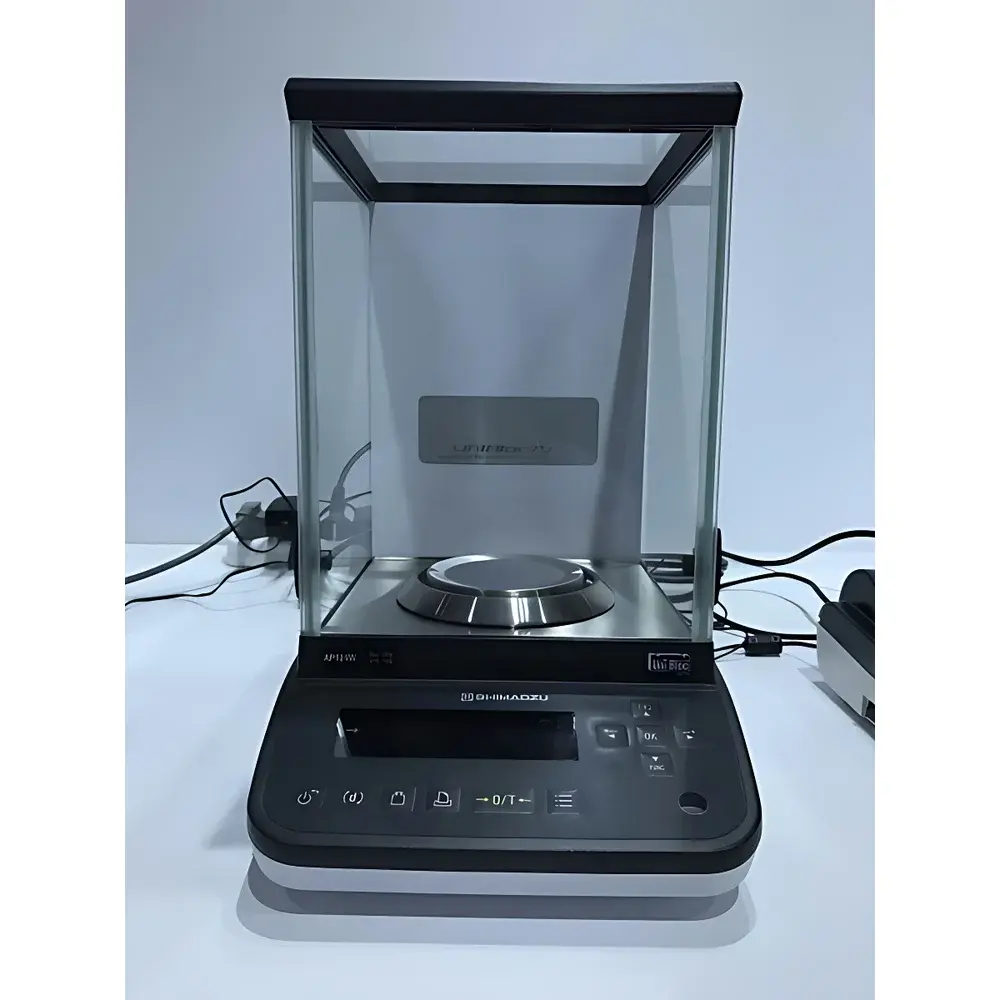
Shimadzu AP135W Ultra-Micro Balance
| Brand | Shimadzu |
|---|---|
| Origin | Japan |
| Model | AP135W |
| Instrument Type | Ultra-Micro Balance |
| Maximum Capacity | 135 g |
| Readability | 0.01 mg (10 µg) |
| Repeatability | 0.05 mg |
| Calibration | Internal |
| Compliance | ISO/IEC 17025, USP <41>, ASTM E898, GLP/GMP-ready |
| Connectivity | USB interface for data export and peripheral integration |
| Operating Environment | 18–26°C, 30–70% RH (non-condensing) |
Overview
The Shimadzu AP135W Ultra-Micro Balance is an advanced analytical weighing instrument engineered for laboratories requiring high-precision mass determination in low-mass regimes—particularly where sample availability is constrained or regulatory traceability is mandatory. Operating on electromagnetic force compensation (EMFC) principle, the AP135W delivers stable, drift-compensated measurements with a readability of 0.01 mg (10 µg) across its 135 g maximum capacity. Its monolithic sensor architecture, combined with active temperature stabilization and real-time air buoyancy compensation, ensures metrological integrity under routine lab conditions. Designed for compliance-critical environments—including pharmaceutical QC, reference standard preparation, and nanomaterial formulation—the AP135W meets foundational requirements of USP for balance performance verification and supports full audit trail generation per FDA 21 CFR Part 11 when paired with compliant software.
Key Features
- Integrated Electrostatic Neutralization: Built-in ionizer module eliminates electrostatic interference during ultra-low-mass weighing (<1 mg), activated/deactivated directly via front-panel controls—no external accessories required.
- Accelerated Stabilization Algorithm: Proprietary damping logic reduces settling time by up to 40% compared to prior-generation Shimadzu microbalances, enabling consistent measurement repeatability within 1.2 seconds at full readability.
- Regulatory-Ready Data Handling: Auto-generates timestamped, user-attributed weight records with digital signature support; configurable print templates comply with ISO/IEC 17025 reporting requirements and internal SOPs.
- Application-Specific Workflows: Pre-programmed modes include buffer solution preparation (mass/volume ratio calculation), sample concentration adjustment (target % w/w or molarity), and multi-component formulation (stepwise addition with tolerance alerts).
- User Access Management: Role-based authentication (administrator/operator/auditor) with password protection, session timeout, and activity logging—fully aligned with GLP and GMP personnel accountability standards.
- Minimum Sample Alert System: Configurable threshold warning triggers visual and audible alerts when placed mass falls below user-defined limits—critical for preserving precious reference materials or clinical trial samples.
- USB-C Expansion Port: Enables direct connection to PCs for raw data streaming (CSV/Excel), firmware updates, and integration with LIMS or ELN platforms without proprietary dongles.
Sample Compatibility & Compliance
The AP135W accommodates standard analytical crucibles, vials, and tare containers (up to Ø90 mm base diameter). Its draft shield design conforms to OIML R 76-1 Class I requirements for environmental isolation, while the internal calibration mass (certified to ±0.005 mg uncertainty) is traceable to NMIJ/JCSS standards. All operational parameters—including linearity, eccentricity, and repeatability—are verifiable using Shimadzu’s certified test weights (Class E2, 10 mg–100 g). The balance satisfies ASTM E898 for laboratory balance qualification and supports IQ/OQ/PQ documentation packages for regulated facility validation.
Software & Data Management
Data export is natively supported via USB mass storage mode—no drivers required. Weight logs include metadata: operator ID, timestamp (ISO 8601), environmental readings (optional external sensor input), tare history, and calibration event stamps. When used with Shimadzu’s LabSolutions Balance Module (sold separately), the AP135W enables electronic signatures, electronic audit trails, and automated report generation compliant with 21 CFR Part 11 Subpart C. Raw data files are stored in open-format CSV with UTF-8 encoding, ensuring long-term archival integrity and third-party analysis compatibility.
Applications
- Preparation of certified reference materials (CRMs) and primary standards in metrology labs
- Weighing of cytotoxic compounds and radiolabeled tracers in oncology research
- Formulation of lyophilized biologics where batch-to-batch mass consistency is critical
- Gravimetric calibration of pipettes and volumetric glassware per ISO 8655
- Quality control of catalyst powders and nanocatalyst dispersions in materials science
- Stoichiometric reagent dispensing for high-throughput synthesis workflows
FAQ
What is the minimum weighable mass for reliable results on the AP135W?
The minimum sample mass is determined by the 2 × SD rule per USP . With a repeatability of 0.05 mg, the recommended minimum is 100 mg for routine use—but method-specific validation may extend down to 20 mg under controlled conditions.
Does the AP135W support external temperature/humidity sensors?
Yes—via optional analog input module (Shimadzu part #AP-ENV-01), enabling real-time environmental correction of mass values per ISO 9001 Annex B.
Can calibration certificates be issued with NIST-traceable documentation?
Shimadzu provides JCSS-accredited calibration certificates upon request; NIST-traceable equivalents are available through authorized third-party calibration providers accredited to ISO/IEC 17025.
Is the internal calibration mass user-replaceable?
No—the calibration mass is hermetically sealed within the sensor housing and serviced only by Shimadzu-certified technicians during scheduled maintenance.
How does the AP135W handle static-prone samples like polymers or dried proteins?
The integrated ionizer operates continuously during weighing cycles, reducing surface charge to <±50 V within 0.8 s—verified per IEC 61340-5-1 electrostatic discharge testing protocol.