
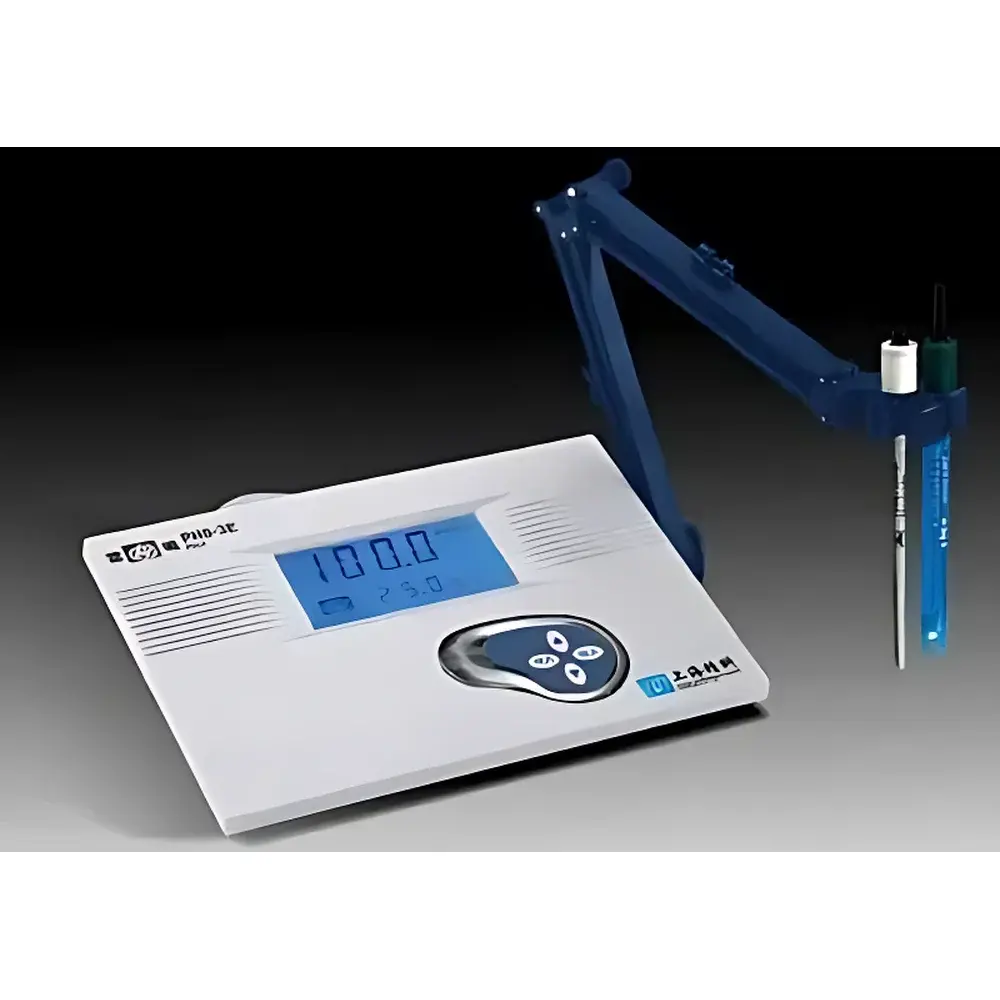
Leici PHS-3E Digital pH Meter
| Brand | Leici |
|---|---|
| Model | PHS-3E |
| Instrument Class | 0.01 |
| pH Range | (-2.00 to 18.00) pH |
| mV Range | ±1999 mV |
| Temperature Range | (0.0 to 99.9) °C |
| pH Resolution | 0.01 pH |
| mV Resolution | 1 mV |
| Temperature Resolution | 0.1 °C |
| pH Accuracy | ±0.01 pH ±1 digit |
| mV Accuracy | ±1 mV ±1 digit |
| Temperature Accuracy | ±0.3 °C ±1 digit |
| Input Impedance | 1 × 10¹² Ω |
| Stability | ±0.01 pH ±1 digit / 3 h |
| Temp. Compensation Range | (0.0 to 99.9) °C |
| Sample Temp. Limit | (0 to 60) °C |
| Electrode Compatibility | E-201-C pH combination electrode, T-818-B-6 temperature sensor |
Overview
The Leici PHS-3E Digital pH Meter is a benchtop electrochemical instrument engineered for precision pH and redox potential (mV) measurement in routine laboratory, quality control, and educational environments. It operates on the principle of potentiometric measurement using a glass pH electrode and reference junction system, generating a Nernstian voltage response proportional to hydrogen ion activity in aqueous solutions. Designed to meet ISO 8655 and IUPAC guidelines for pH metrology, the PHS-3E delivers class 0.01 performance—suitable for applications requiring trace-level acidity/alkalinity quantification, buffer verification, and comparative titration endpoint monitoring. Its dual-display architecture simultaneously presents either pH/temperature or mV/temperature values, enabling real-time correlation between electrochemical potential and thermal state—a critical requirement for thermally sensitive samples such as biological buffers, pharmaceutical formulations, and electroplating baths.
Key Features
- High-contrast blue-backlit LCD with dual-line numeric display ensures legibility under varied ambient lighting conditions, including low-intensity lab settings.
- Manual and automatic temperature compensation (ATC) functionality supports accurate pH reporting across the full operational range of 0.0–99.9 °C, minimizing thermal drift errors per ASTM D1293 and ISO 10523 protocols.
- Two-point calibration routine (using standard pH 4.01 and 7.00 or 7.00 and 10.01 buffers) enables linear slope validation and offset correction, ensuring long-term measurement fidelity.
- Front-panel electrode interface features recessed electrical connectors conforming to DIN 19262 specifications, reducing electrolyte creep risk and enhancing corrosion resistance during extended use with aggressive media.
- Robust housing design incorporates an industrial-grade ABS polymer chassis with patented planar front panel geometry (Chinese Design Patent ZL 200430036029.2), optimized for ergonomic operation and cleanability.
- Input impedance exceeds 1 × 10¹² Ω, minimizing loading effects on high-impedance pH electrodes and preserving signal integrity during low-conductivity sample analysis (e.g., deionized water, ethanol-water mixtures).
Sample Compatibility & Compliance
The PHS-3E is validated for aqueous and mildly conductive non-aqueous solutions within a temperature envelope of 0–60 °C. It is compatible with Leici’s E-201-C pH combination electrode (Ag/AgCl reference, low-resistance glass membrane) and the T-818-B-6 Pt1000 temperature sensor, both certified to GB/T 11165–2022 (Chinese national standard equivalent to ISO 7888). While not designed for sterilizable or intrinsically safe hazardous-area deployment, the meter complies with electromagnetic compatibility requirements per GB/T 18268.1–2010 (IEC 61326-1) and electrical safety per GB 4793.1–2007 (IEC 61010-1). Its measurement uncertainty budget aligns with GLP documentation practices, supporting audit-ready data generation when paired with calibrated reference standards traceable to NIM (National Institute of Metrology, China).
Software & Data Management
The PHS-3E operates as a standalone instrument without embedded data logging or USB connectivity. All measurements are displayed in real time and intended for manual transcription or external recording via laboratory notebooks or LIMS-integrated workflows. For regulatory environments governed by FDA 21 CFR Part 11 or EU Annex 11, users must implement procedural controls—including defined calibration logs, electrode maintenance records, and environmental monitoring—to ensure data integrity. The instrument’s stability specification (±0.01 pH ±1 digit over 3 hours) facilitates scheduled recalibration intervals consistent with ISO/IEC 17025 clause 7.7 requirements for measurement equipment management.
Applications
- Academic teaching labs: Demonstrating Nernst equation principles, buffer capacity analysis, and acid-base titration curve construction.
- Food & beverage QC: Monitoring pH stability in dairy products, fermented beverages, and canned goods per AOAC 973.41 and Codex Alimentarius standards.
- Environmental testing: Field-deployable verification of surface water, wastewater effluent, and soil extract pH prior to ICP-MS or HPLC analysis.
- Pharmaceutical manufacturing: In-process control of dissolution media (USP ) and cleaning validation rinse water (FDA Guidance for Industry, 2022).
- Electrochemistry education: mV mode supports redox couple characterization, standard hydrogen electrode (SHE) referencing, and corrosion potential screening.
FAQ
What electrode types are supported by the PHS-3E?
The meter is optimized for use with the Leici E-201-C pH combination electrode and T-818-B-6 temperature sensor. Other DIN-compatible electrodes with BNC or screw-terminal interfaces may function but require empirical validation of slope and asymmetry potential.
Does the PHS-3E support automatic calibration recognition (ARC)?
No. Calibration is fully manual; users must enter known buffer pH values during setup. ARC functionality is absent per design specification.
Can the PHS-3E measure pH in non-aqueous solvents?
It may provide relative readings in mixed solvents (e.g., methanol-water), but accuracy is not guaranteed due to altered liquid junction potentials and glass membrane hydration dynamics. Refer to ISO 10523 Annex B for guidance on non-aqueous pH estimation limitations.
Is the instrument suitable for GMP-regulated environments?
Yes—as a Class 0.01 general-purpose meter—but requires documented procedures for calibration, maintenance, and operator training to satisfy ALCOA+ data integrity criteria.
What is the recommended recalibration frequency?
Per ISO/IEC 17025, recalibration should occur before each analytical batch, after electrode replacement, following exposure to extreme pH or temperature, or at least every 2 hours during continuous operation.



