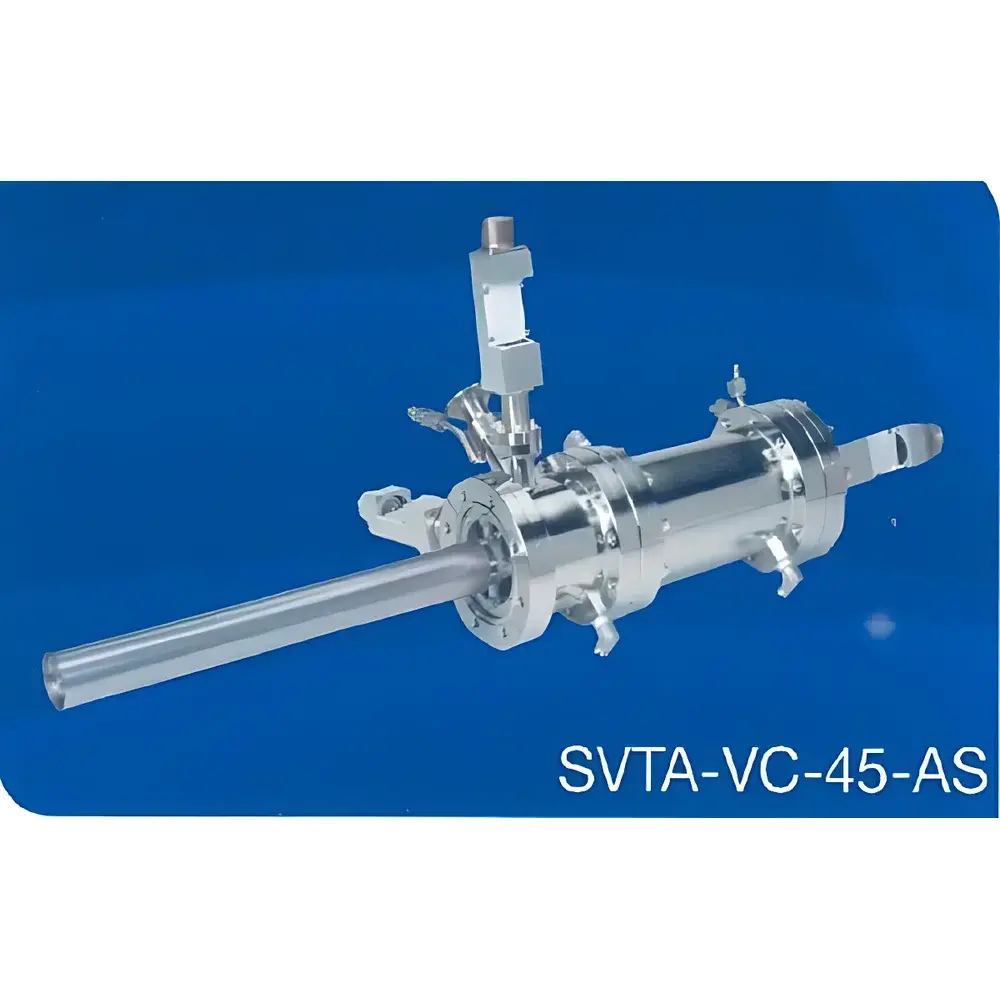
SVT Associates SVTA-VC-45 Valve-Controlled Cracking Source
| Brand | SVT Associates |
|---|---|
| Origin | USA |
| Model | SVTA-VC-45 |
| Heating Zones | As (2-zone), P/Sb/Te/Se/S (3-zone) |
| Cooling | Integrated water-cooled jackets for evaporator body, valve, cracking tube, and PBN crucible |
| Control Options | Manual needle valve (standard), computer-controlled ACM valve (optional, SVTA-VC-ACM) |
| Software Integration | Compatible with RoboMBE® |
| Crucible Materials | High-purity PBN, molybdenum, or tantalum |
| Vacuum Compatibility | UHV (≤1×10⁻¹⁰ Torr) |
| Source Capacities | 200 cm³ or 500 cm³ |
| Compliance | Designed for GLP/GMP-aligned MBE process environments |
Overview
The SVT Associates SVTA-VC-45 Valve-Controlled Cracking Source is a precision-engineered effusion cell system designed specifically for molecular beam epitaxy (MBE) and other ultra-high vacuum (UHV) thin-film growth applications. It enables controlled thermal decomposition of solid Group V precursors—including arsenic (As), phosphorus (P), antimony (Sb), tellurium (Te), selenium (Se), and sulfur (S)—into reactive diatomic or polyatomic molecular beams (e.g., As₂, P₂) essential for stoichiometric III–V and II–VI compound semiconductor synthesis. Unlike conventional effusion cells, the SVTA-VC-45 integrates spatially separated, independently regulated heating zones with active water cooling to decouple precursor storage, thermal activation, and beam generation. This architecture ensures stable, reproducible beam fluxes while minimizing thermal drift, backstreaming, and residual oxide formation—critical parameters in high-yield MBE reactor operation.
Key Features
- Modular multi-zone thermal design: As sources feature two independent heating zones (bulk evaporation + high-temperature cracking); P, Sb, Te, Se, and S sources utilize three thermally isolated zones enabling in-situ red-to-white phosphorus conversion and repeatable cycling.
- Full water-cooling integration: Jackets circulate deionized water across the evaporator body, needle valve housing, high-purity pyrolytic boron nitride (PBN) cracking tube, and crucible support—maintaining thermal stability below 60 °C at ambient surfaces and suppressing condensation-induced beam instability.
- UHV-compatible construction: All wetted components are fabricated from high-purity PBN, molybdenum, or tantalum; all seals employ metal gaskets (ConFlat®); outgassing rates meet ≤1×10⁻¹² Torr·L/s/cm² after bakeout.
- Beam flux control architecture: Standard manual needle valve provides fine-tuned mechanical adjustment; optional SVTA-VC-ACM computer-controlled actuator enables sub-second response time, programmable ramp profiles, and closed-loop feedback integration via RS-485 or Ethernet/IP.
- Pre-characterized delivery: Each unit undergoes full UHV testing pre-shipment—including beam flux mapping (quadrupole mass spectrometry), temperature calibration (Type K thermocouples traceable to NIST), and leak integrity verification (helium mass spectrometry).
Sample Compatibility & Compliance
The SVTA-VC-45 supports elemental Group V precursors in solid form only, with verified compatibility for high-purity arsenic (99.9999%), red phosphorus (99.999%), antimony (99.9999%), tellurium (99.999%), selenium (99.999%), and sulfur (99.999%). All internal surfaces are passivated to prevent catalytic decomposition or intermetallic diffusion. The source complies with standard UHV material compatibility protocols per ASTM F1473 and ISO 14644-1 Class 1 cleanroom assembly practices. Its design supports audit readiness for GLP and GMP environments, including full traceability of calibration records, material certifications (CoA), and test reports—all delivered with shipment.
Software & Data Management
The optional SVTA-VC-ACM actuator integrates natively with RoboMBE® software (v5.2+), allowing synchronized beam modulation during layer-by-layer growth sequences. Valve position, temperature setpoints, and real-time thermocouple readings are logged with timestamped metadata into SQLite-based process databases compliant with FDA 21 CFR Part 11 requirements (electronic signatures, audit trails, data immutability). Remote monitoring via OPC UA or Modbus TCP enables centralized control within Fab-wide SCADA systems. No proprietary drivers or runtime dependencies are required—communication uses open, documented ASCII command sets.
Applications
- Growth of lattice-matched and strained III–V heterostructures (e.g., GaAs, InP, AlGaAs, InGaAs) requiring precise As₂/P₂ flux ratios.
- Low-temperature MBE of narrow-bandgap materials (InSb, GaSb) where Sb beam stability directly impacts interface abruptness.
- Chalcogenide thin-film synthesis (CdTe, ZnSe, PbS) demanding ultra-low oxygen/hydrocarbon background and repeatable Te/Se flux.
- Research-scale development of 2D layered semiconductors (e.g., In₂Se₃, Sb₂Te₃) where controlled S/Se cracking kinetics influence crystallinity.
- Process qualification and transfer between R&D and pilot-line MBE tools using identical source calibration protocols.
FAQ
What vacuum level is required for optimal SVTA-VC-45 operation?
UHV conditions ≤1×10⁻¹⁰ Torr are recommended for long-term stability and minimal oxide contamination during arsenic or phosphorus cracking.
Can the same SVTA-VC-45 housing be reconfigured for different Group V elements?
Yes—crucibles and cracking tubes are swappable; however, thermal profiles and cooling configurations must be validated per element due to differing vapor pressures and decomposition kinetics.
Is the SVTA-VC-ACM valve compatible with non-RoboMBE control platforms?
Yes—its RS-485 interface supports custom LabVIEW, Python (PySerial), or PLC-based controllers using documented ASCII command syntax.
How often does the PBN cracking tube require replacement?
Under typical GaAs growth conditions (As beam equivalent pressure ~1×10⁻⁷ Torr), service life exceeds 1,200 operational hours before measurable flux decay (>5%) occurs.
Does SVT provide beam flux calibration certificates with each unit?
Yes—each shipped SVTA-VC-45 includes a NIST-traceable flux vs. temperature curve measured in situ using a calibrated quartz crystal microbalance (QCM) and quadrupole mass spectrometer.
Related Products