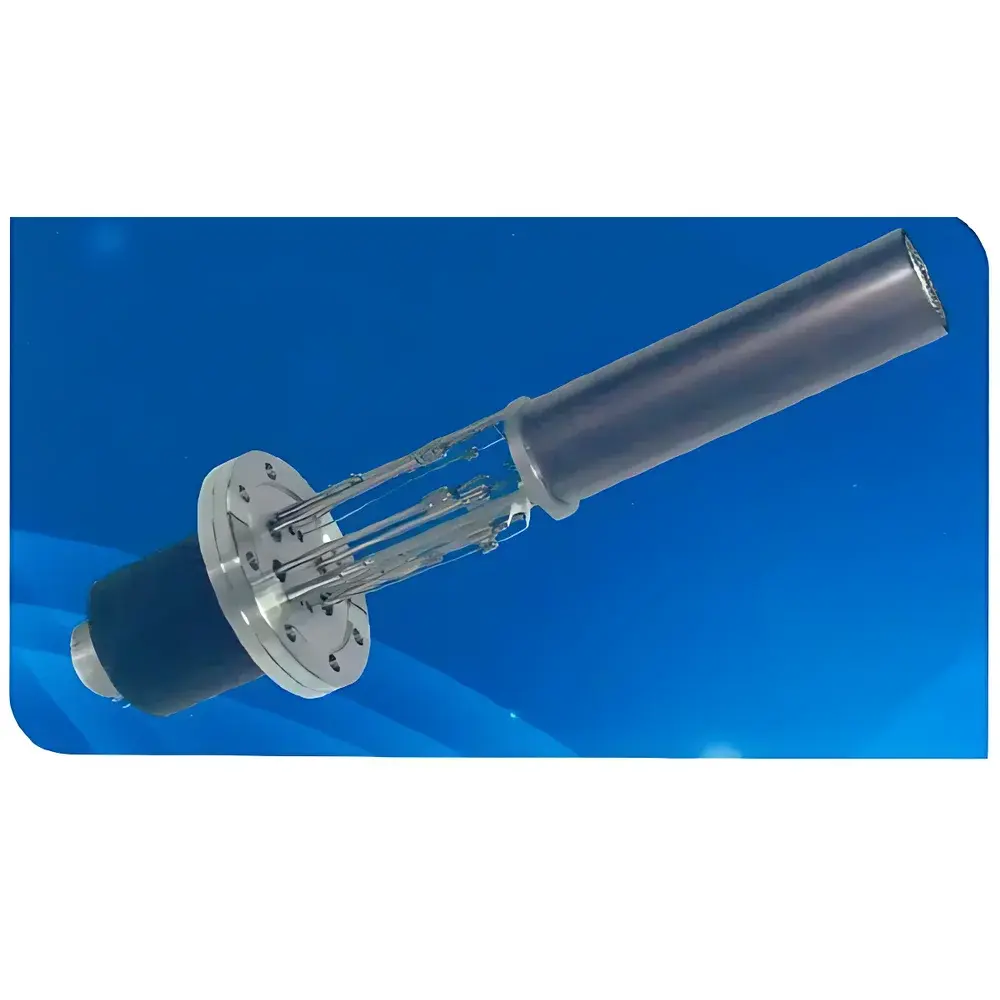
SVT Associates SVT-DF Dual-Filament Molecular Beam Epitaxy Effusion Cell
| Brand | SVT Associates |
|---|---|
| Origin | USA |
| Model | SVT-DF |
| Interface | 4.5″ or larger Conflat (CF) flange |
| Temperature Range | 0 °C to 1,400 °C |
| Power Rating | 600 W / 1 kW |
| Temperature Stability | ±0.1 °C |
| Temperature Reproducibility | ±0.1 °C |
| Thermocouple Type | Type C (Type D optional) |
| Crucible Capacities | 16 cc, 20 cc, 22 cc, 40 cc, 60 cc, 85 cc, 150 cc |
| Standard Length | 12″ (304.8 mm) |
| Flange Options | 2.75″ or 4.5″ OD CF |
| Filament Connector | Amphenol ring-type |
| Thermocouple Connector | Omega subminiature |
Overview
The SVT Associates SVT-DF Dual-Filament Molecular Beam Epitaxy (MBE) Effusion Cell is a precision-engineered thermal evaporation source designed for high-purity, stoichiometric growth of III–V and II–VI compound semiconductors—including Ga, In, Al, Sb, and Bi—in ultra-high vacuum (UHV) MBE systems. Unlike single-filament effusion cells, the SVT-DF integrates two independently controlled tungsten or molybdenum filament assemblies, enabling differential heating of crucible zones or simultaneous evaporation from two distinct material charges. This architecture supports advanced growth strategies such as shuttered co-evaporation, gradient doping, and in-situ compositional tuning—critical for fabricating quantum wells, superlattices, and heterostructures with atomic-layer control. The cell operates via resistive heating of the filament(s), which thermally transfers energy to the crucible, maintaining stable vapor pressure profiles under UHV conditions (typically <1×10⁻¹⁰ Torr). Its robust stainless-steel body, all-metal Conflat sealing, and integrated C-type thermocouple provide long-term thermal integrity and compatibility with standard MBE chamber integration protocols.
Key Features
- Dual independent filament system with separate power leads and temperature feedback loops—enabling asymmetric heating profiles and real-time flux modulation.
- High-precision temperature control with stability and reproducibility of ±0.1 °C over the full operating range (0–1,400 °C), verified via NIST-traceable calibration prior to shipment.
- Modular crucible design supporting multiple volumetric configurations (16–150 cc), including conical-wall variants optimized for improved thermal uniformity and reduced axial temperature gradients.
- Standardized 4.5″ outer diameter Conflat (CF) flange interface—with optional 2.75″ or 6.0″ variants—ensuring mechanical and vacuum compatibility across major MBE platforms (Riber, Veeco, SPECS, DCA).
- UHV-rated electrical feedthroughs: Amphenol ring-type connectors for filaments and Omega subminiature connectors for thermocouples—minimizing outgassing and thermal leakage.
- Pre-characterized performance data provided with each unit, including measured evaporation rates for Ga and In at defined setpoints, beam homogeneity maps, and leak-check certification.
Sample Compatibility & Compliance
The SVT-DF is engineered for use with elemental and alloy precursors requiring precise thermal management, including but not limited to Ga, In, Al, Sb, Bi, Cd, Zn, Se, Te, and As4. It complies with standard UHV material compatibility requirements per ASTM E595 and ISO 15528 for outgassing performance. All wetted components are electropolished 316L stainless steel or oxygen-free high-conductivity (OFHC) copper; no organics or elastomers contact the beam path. The cell meets mechanical interface specifications outlined in the European Vacuum Society (EVS) Technical Recommendation TR-004 for MBE source integration and conforms to ASME B31.3 process piping standards for thermal cycling durability. Optional documentation packages support GLP/GMP-compliant installation qualification (IQ) and operational qualification (OQ) protocols.
Software & Data Management
While the SVT-DF is a hardware-only analog device, it is fully compatible with industry-standard MBE process controllers—including those from Lake Shore Cryotronics (Model 336, 350), Eurotherm (Series 3500), and custom LabVIEW- or Python-based DAQ systems—via standard 0–10 V analog inputs and thermocouple signal outputs. Digital communication (RS-232/485 or Ethernet) can be added via external signal conditioners supporting Modbus RTU/TCP. All delivered units include traceable calibration certificates with raw thermocouple voltage vs. temperature curves, and optional audit trails for temperature setpoint history are supported when integrated with FDA 21 CFR Part 11–compliant supervisory control systems.
Applications
- Growth of GaAs, InP, GaN, and InGaAs heterostructures for high-electron-mobility transistors (HEMTs) and photonic integrated circuits (PICs).
- Atomic-layer deposition of InSb and InAs quantum dots for mid-infrared detectors and spintronic devices.
- Co-evaporation of Ga and Sb to synthesize GaSb-based type-II superlattices for thermophotovoltaic applications.
- In-situ monitoring of flux transients during shutter sequence optimization using residual gas analyzers (RGAs) or quartz crystal microbalances (QCMs).
- Multi-source MBE runs where independent control of group-III and group-V fluxes is required without cross-contamination.
FAQ
Is the SVT-DF compatible with non-SVT MBE chambers?
Yes—the 4.5″ CF flange, standard electrical interfaces, and UHV-compatible materials ensure seamless integration with Riber, Veeco, SPECS, and other third-party MBE systems.
Can the dual filaments be operated at different temperatures simultaneously?
Yes—each filament has an independent power supply input and dedicated thermocouple feedback loop, allowing independent setpoint control within the 0–1,400 °C range.
What crucible geometries improve flux uniformity?
Conical-wall crucibles (16 cc, 22 cc, and 150 cc variants) reduce radial thermal gradients and yield more symmetric angular flux distributions compared to cylindrical designs.
Does SVT Associates provide evaporation rate data for specific materials?
Yes—each shipped unit includes empirically measured Ga and In evaporation rates at 50 °C intervals between 700 °C and 1,200 °C, referenced to a 10⁻⁹ Torr background pressure.
Is retrofitting existing single-filament sources with the SVT-DF feasible?
Yes—mechanical mounting dimensions and flange bolt patterns are backward-compatible with legacy SVT effusion cell mounts; only electrical rewiring and controller configuration updates are required.