
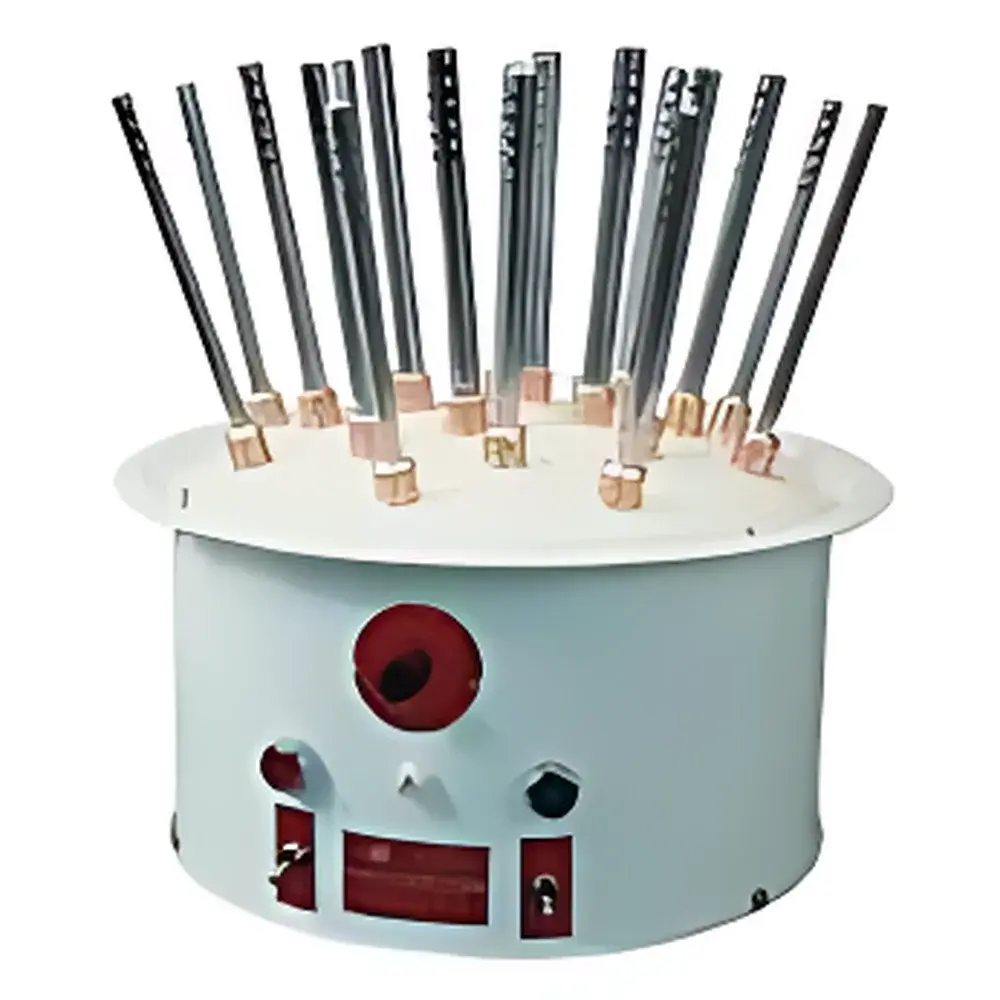
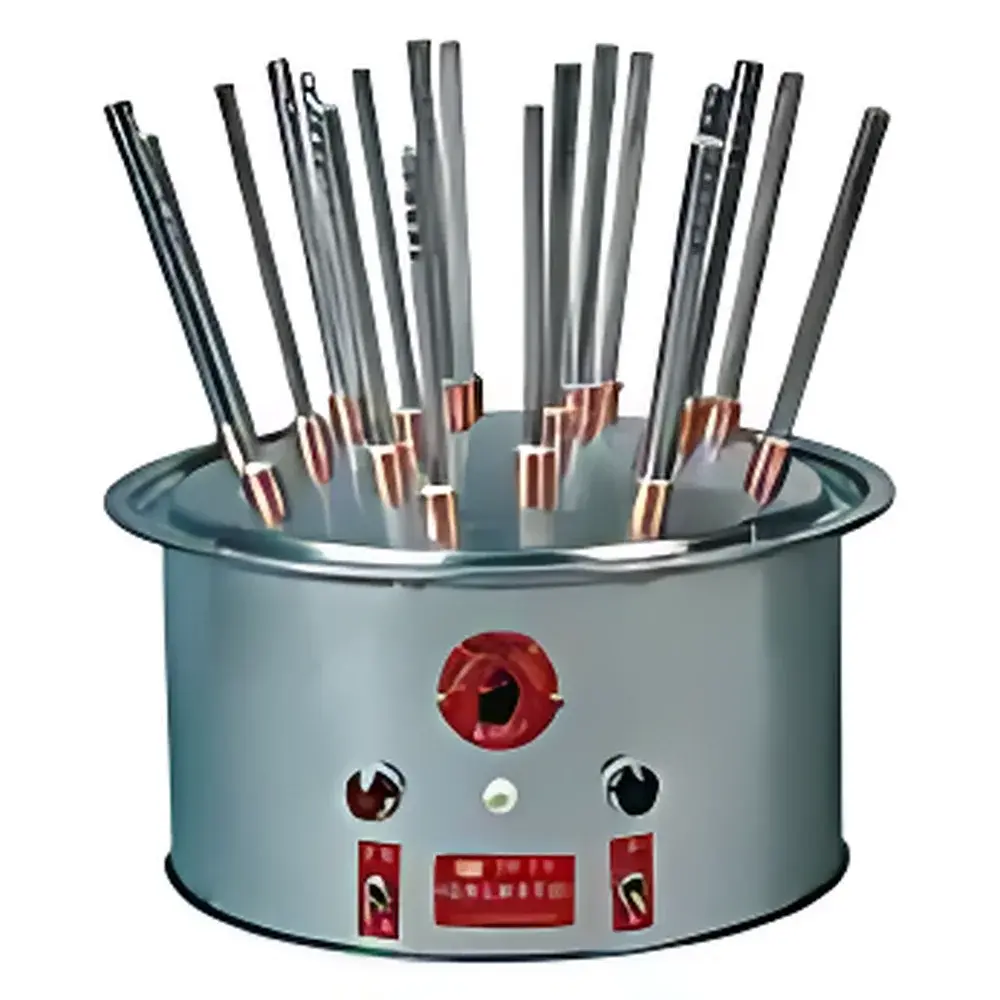
Truelab C12/C20/C30 Benchtop Air-Jet Glassware Dryer
| Brand | Truelab |
|---|---|
| Origin | Shanghai, China |
| Model | C12 / C20 / C30 |
| Power | 800 W |
| Voltage/Frequency | 220 V / 50 Hz |
| Temperature Range | 40–120 °C |
| Temperature Accuracy | ±5 °C |
| Number of Air Jets | 12 / 20 / 30 |
| Jet Length | 170 mm / 220 mm (adjustable) |
| Dimensions (W × H) | 400 × 40 mm |
| Weight | 7–8 kg |
| Housing Material | Stainless Steel (Type C) |
| Compliance | CE-marked for laboratory use under IEC 61010-1 |
Overview
The Truelab C12/C20/C30 Benchtop Air-Jet Glassware Dryer is an engineered solution for rapid, residue-free drying of rinsed glassware in analytical, quality control, and research laboratories. Unlike conventional oven-based or passive air-drying methods, this system employs precisely directed, temperature-controlled laminar airflow through individual stainless-steel nozzles to accelerate solvent evaporation from flasks, burettes, pipettes, volumetric cylinders, and other standard lab glassware. The dryer operates on the principle of convective heat transfer with forced air circulation—optimized for thermal efficiency and minimal thermal stress on delicate instruments. Designed for routine post-wash processing in GLP-compliant environments, it supports standardized workflows where reproducible drying conditions are critical for trace analysis, titration preparation, and sample integrity preservation.
Key Features
- Stainless-steel housing (Type C design) ensures corrosion resistance, mechanical durability, and compatibility with high-humidity or solvent-rich lab environments.
- Three scalable configurations—C12 (12 nozzles), C20 (20 nozzles), and C30 (30 nozzles)—allow flexible throughput matching to lab volume and spatial constraints.
- Precise dual-range thermostatic control (40–120 °C) enables selection of low-temperature drying for heat-sensitive items (e.g., calibrated volumetric ware) or higher-temperature cycles for rapid removal of water, acetone, or ethanol residues.
- ±5 °C temperature accuracy across the operating range ensures consistency between drying batches—critical for method validation and audit readiness.
- Adjustable nozzle length (170 mm / 220 mm) accommodates varying glassware heights without repositioning; each jet delivers uniform airflow velocity and thermal profile.
- Compact footprint (400 × 40 mm) permits integration into fume hood sashes, prep benches, or adjacent to wash stations—minimizing workflow interruption.
- 800 W power rating balances energy efficiency with drying speed; typical cycle times range from 3–8 minutes depending on glassware type, initial moisture load, and selected temperature setpoint.
Sample Compatibility & Compliance
The dryer accepts all common borosilicate glassware with standard neck diameters (10–35 mm), including Erlenmeyer flasks (50–1000 mL), graduated cylinders (10–500 mL), burettes (25–50 mL), volumetric flasks (10–1000 mL), and test tubes. Nozzle alignment fixtures ensure stable positioning without clamps or adapters. Units comply with IEC 61010-1:2010 for electrical safety in laboratory equipment and meet RoHS Directive 2011/65/EU for hazardous substance restrictions. While not FDA 21 CFR Part 11–certified (as it performs no data acquisition), its operational parameters support documentation in SOPs aligned with ISO/IEC 17025 and USP Analytical Instrument Qualification protocols.
Software & Data Management
This is a manually operated, analog-control instrument with no embedded microprocessor or digital interface. Temperature setpoint and on/off functions are managed via a calibrated rotary thermostat and illuminated power switch. As such, it requires no software installation, firmware updates, or cybersecurity configuration. All operational parameters—including set temperature, duration, and nozzle usage—are recorded manually in lab notebooks or integrated LIMS systems as part of standard drying SOPs. Its simplicity eliminates validation overhead associated with electronic logging, making it suitable for regulated environments where deterministic, non-software-dependent processes are preferred.
Applications
- Routine drying of volumetric and analytical glassware prior to calibration verification or quantitative analysis.
- Post-rinse conditioning in pharmaceutical QC labs adhering to USP and EU GMP Annex 15 requirements.
- High-turnover drying in teaching laboratories where student-accessible, low-maintenance equipment is prioritized.
- Preparation of trace-metal analysis vessels requiring particulate-free, low-temperature drying to avoid surface oxidation or contamination.
- Integration into automated wash-dry-fill workflows when paired with programmable labware washers (e.g., Miele LabWash series) via timed relay interfaces.
FAQ
What is the maximum recommended operating temperature for calibrated glassware?
For Class A volumetric flasks and burettes, we recommend ≤60 °C to prevent thermal expansion-induced calibration drift.
Can the dryer be used for plastic or PTFE labware?
No—only borosilicate glassware is supported. Polymers may deform or off-gas at temperatures above 40 °C.
Is airflow rate adjustable per nozzle?
No—airflow is fixed and balanced across all nozzles via internal manifold design to ensure uniform drying performance.
Does the unit include overheat protection?
Yes—a redundant bimetallic thermal cutoff interrupts power if internal housing temperature exceeds 130 °C.
What maintenance is required?
Monthly inspection of nozzle orifices for dust or residue buildup; cleaning with lint-free swabs and isopropanol; annual verification of thermostat calibration using a NIST-traceable thermometer.



