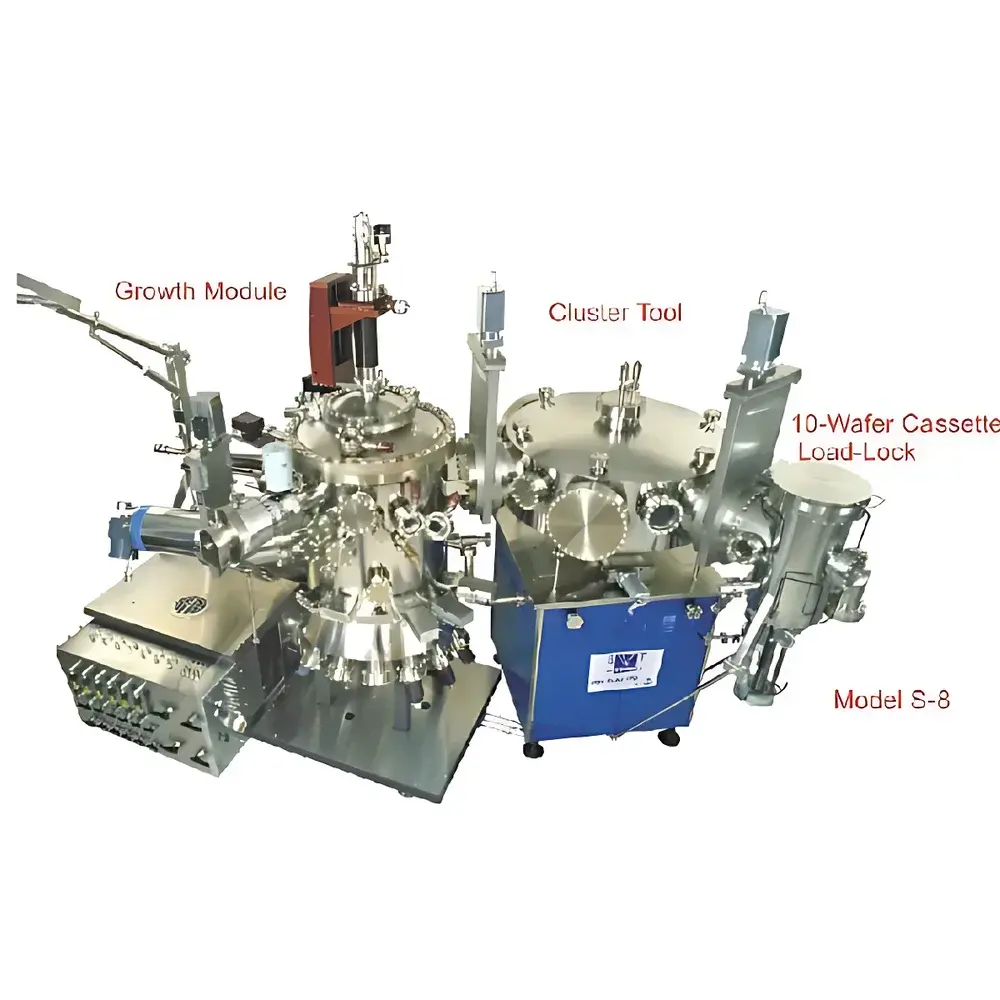
SVT Associates SVTA-CLM-6 / SVTA-CLM-4 Central Transfer Chamber (RDC / Cluster Tool)
| Brand | SVT Associates |
|---|---|
| Origin | USA |
| Model | SVTA-CLM-6, SVTA-CLM-4 |
| Maximum Substrate Size | 200 mm (SVTA-CLM-6), 125 mm (SVTA-CLM-4) |
| Port Configuration | Six 305 mm (12″) CF flanges + one 152 mm (6″) CF viewport + one 70 mm (2.75″) CF ion gauge port (SVTA-CLM-6) |
| Vacuum Compatibility | UHV-capable (≤1×10⁻⁹ Torr base pressure with appropriate pumping) |
| Structural Material | 304 or 316 stainless steel, electropolished interior |
| Flange Standard | ConFlat (CF), ISO-K and ISO-F variants available upon request |
Overview
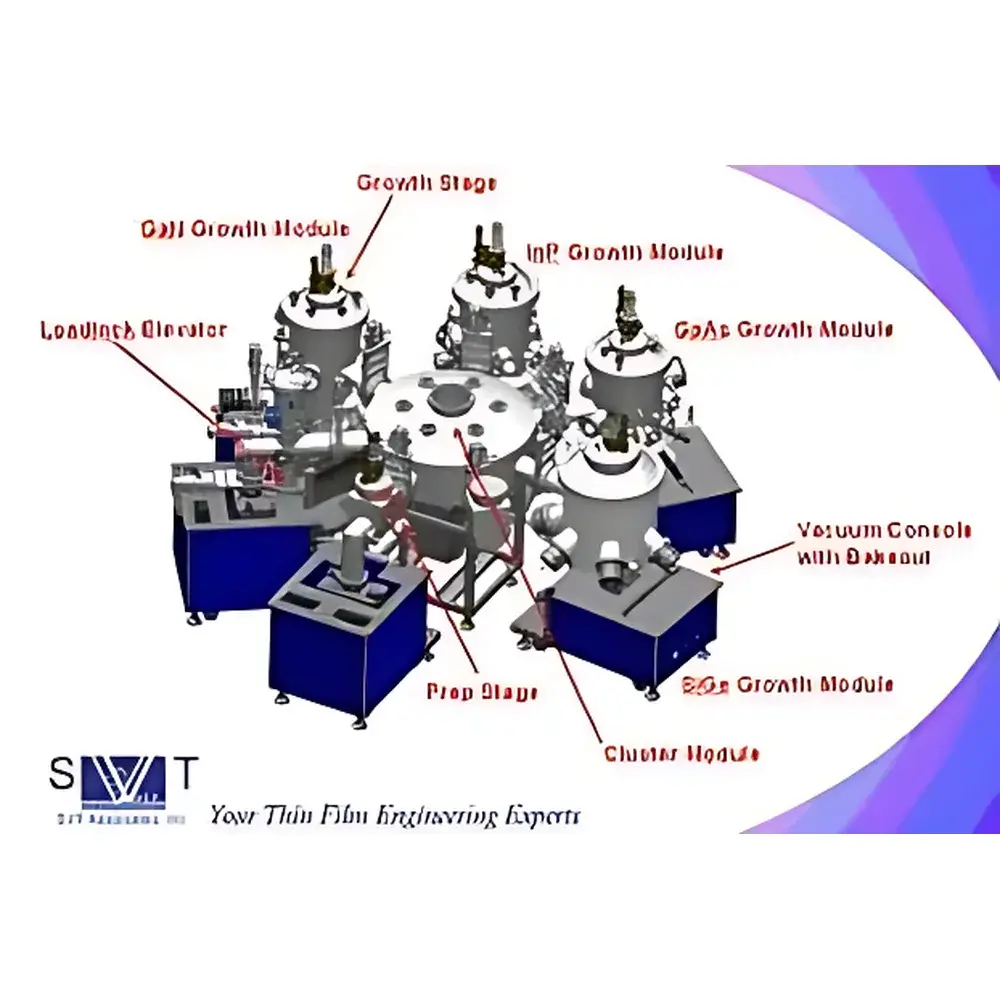
The SVT Associates SVTA-CLM-6 and SVTA-CLM-4 Central Transfer Chambers (CTCs) serve as the mechanical and vacuum-integrated core of modular ultra-high vacuum (UHV) cluster tool systems used in semiconductor process development, thin-film research, and epitaxial growth applications. Engineered for structural rigidity, thermal stability, and leak-tight integrity, these chambers function as robotic sample-handling hubs—enabling deterministic, contamination-minimized transport of wafers between interconnected process modules (e.g., MBE, sputtering, ALD, annealing, surface analysis) without breaking vacuum. The CTC operates on the principle of coordinated motion control: a linear or theta-phi manipulator arm, housed within the central chamber, interfaces with load-lock entry ports and module-specific docking stations to achieve repeatable positioning (±5 µm typical repeatability) under UHV conditions. This architecture eliminates air exposure during multi-step fabrication sequences, preserving surface stoichiometry and interfacial cleanliness critical for heterostructure growth, quantum well engineering, and low-defect-density device prototyping.
Key Features
- Modular UHV-compatible design with electropolished 304/316 stainless steel construction and all-metal seals (copper gaskets)
- Dual configuration options: SVTA-CLM-6 supports up to 200 mm (8″) substrates with six 305 mm (12″) CF process ports, while SVTA-CLM-4 accommodates up to 125 mm (5″) wafers with four 203 mm (8″) CF ports
- Integrated high-transmission viewport (152 mm CF on CLM-6; 114 mm CF on CLM-4) enabling real-time optical monitoring of robot trajectory and substrate alignment
- Dedicated 70 mm (2.75″) CF port for ionization gauge mounting—compatible with Bayard-Alpert or extractor-type gauges for accurate pressure verification across 1×10⁻¹⁰ to 1×10⁻³ Torr range
- Standardized CF flange interface ensures seamless integration with legacy and next-generation UHV components (pumps, valves, feedthroughs) compliant with ASTM F2590 and ISO 2861 standards
- Optional motorized linear stage, end-effector tooling (edge-grip or paddle-style), and bake-out capability (up to 150 °C) for extended UHV conditioning
Sample Compatibility & Compliance
The SVTA-CLM series accommodates standard silicon, GaAs, InP, sapphire, and SiC substrates ranging from 50 mm to 200 mm in diameter. Substrate handling is optimized for flat, notch, or orientation flat configurations per SEMI MF1217 specifications. All wetted surfaces meet ASTM A276 Type 316L requirements for low outgassing and corrosion resistance. Vacuum integrity complies with ISO 14644-1 Class 4 (cleanroom-compatible assembly) and supports GLP/GMP-aligned workflows when integrated with audit-trail-capable motion controllers and pressure logging systems. The chamber design facilitates qualification per SEMI S2/S8 safety and ergonomics guidelines and is compatible with ISO/IEC 17025-accredited calibration protocols for robotic positioning accuracy.
Software & Data Management
While the CTC itself is hardware-centric, its operation is fully programmable via RS-232, Ethernet/IP, or EtherCAT interfaces compatible with industry-standard automation platforms—including Brooks Automation GEM/SECS, Applied Materials Endura Control Framework, and custom LabVIEW or Python-based sequencers. Motion profiles, vacuum interlocks, and port access permissions are configurable through XML-based recipe files supporting version control and change management. When deployed in FDA-regulated environments (e.g., compound semiconductor photonics for medical lasers), the system supports 21 CFR Part 11-compliant electronic signatures and audit trails when paired with validated supervisory software (e.g., EPICS IOC with Archiver Appliance or DeltaV DCS integration).
Applications
- Multi-step epitaxial growth of III–V and II–VI compound semiconductors (e.g., InGaAs/InP heterojunctions for photodetectors)
- In-situ surface characterization coupling XPS, AES, or LEED modules with growth chambers
- Atomic-layer-controlled metallization processes requiring sequential Ti/TiN/W deposition without oxidation
- Development of van der Waals heterostructures using 2D material transfer modules
- Process window optimization for high-k dielectric ALD where ambient exposure degrades interface trap density (Dit)
- Academic and industrial R&D of topological insulators and magnetic skyrmion devices requiring pristine interfacial control
FAQ
What vacuum level can the SVTA-CLM chamber maintain after bake-out?
With a properly configured turbomolecular pump stack and cryo- or ion-pumping supplement, the chamber achieves ≤1×10⁻⁹ Torr base pressure following a 12-hour 120 °C bake-out.
Is robotic arm integration included or optional?
The chamber structure and port layout are designed for third-party UHV-compatible manipulators (e.g., MBraun, Kurt J. Lesker, or INFICON OEM arms); arm selection, installation, and commissioning are performed by the end-user or system integrator.
Can the CLM-6 be retrofitted with additional ports post-delivery?
No—port locations are precision-machined and electron-beam welded during fabrication; modifications would compromise UHV integrity and invalidate ASME BPVC Section VIII Div. 1 certification.
Does SVT provide vacuum compatibility documentation for audit purposes?
Yes—certified material test reports (CMTRs), helium leak test records (≤1×10⁻¹⁰ std cm³/s), and CF flange surface finish verification (≤0.8 µm Ra) are supplied with each unit.
Are ISO-K or ISO-F flange variants available?
Yes—custom flange types, including ISO-K blind, ISO-F gate valve, and DN40/DN63 quick-release variants, are available under engineering change order (ECO) with lead-time adjustment.