
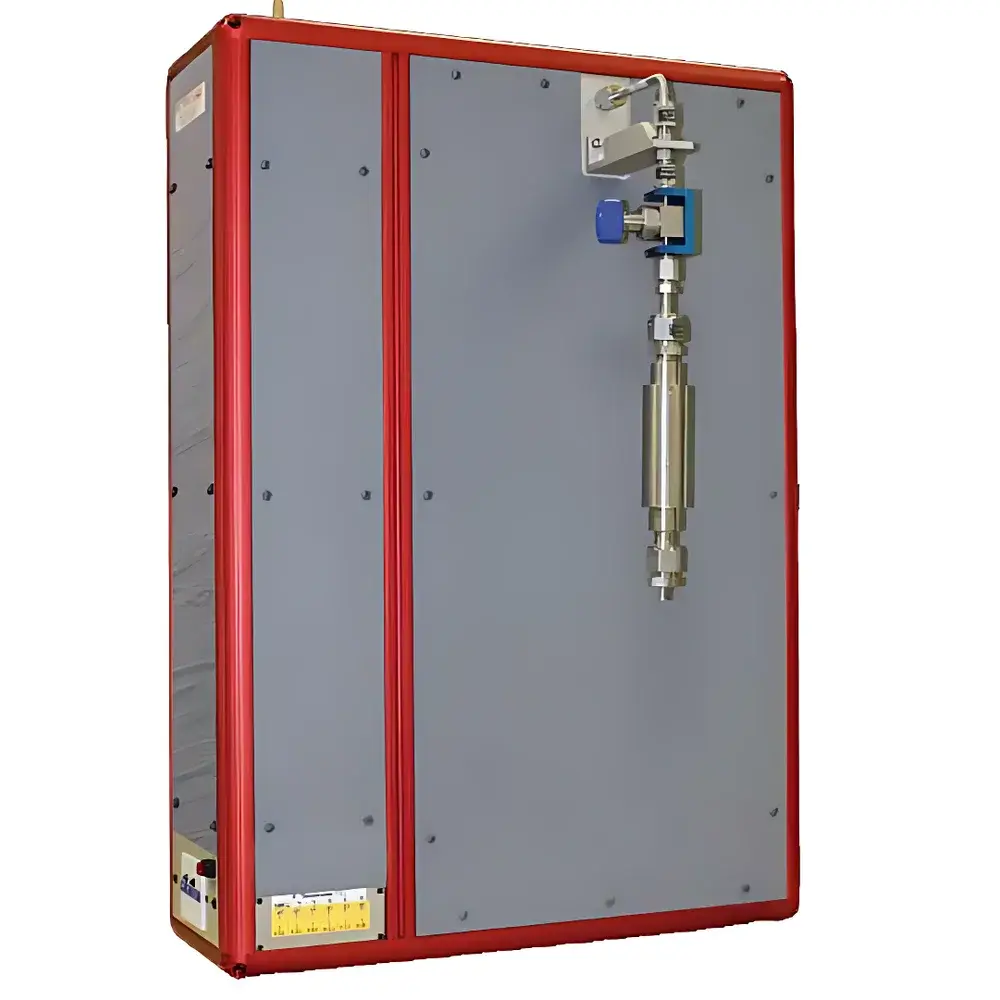
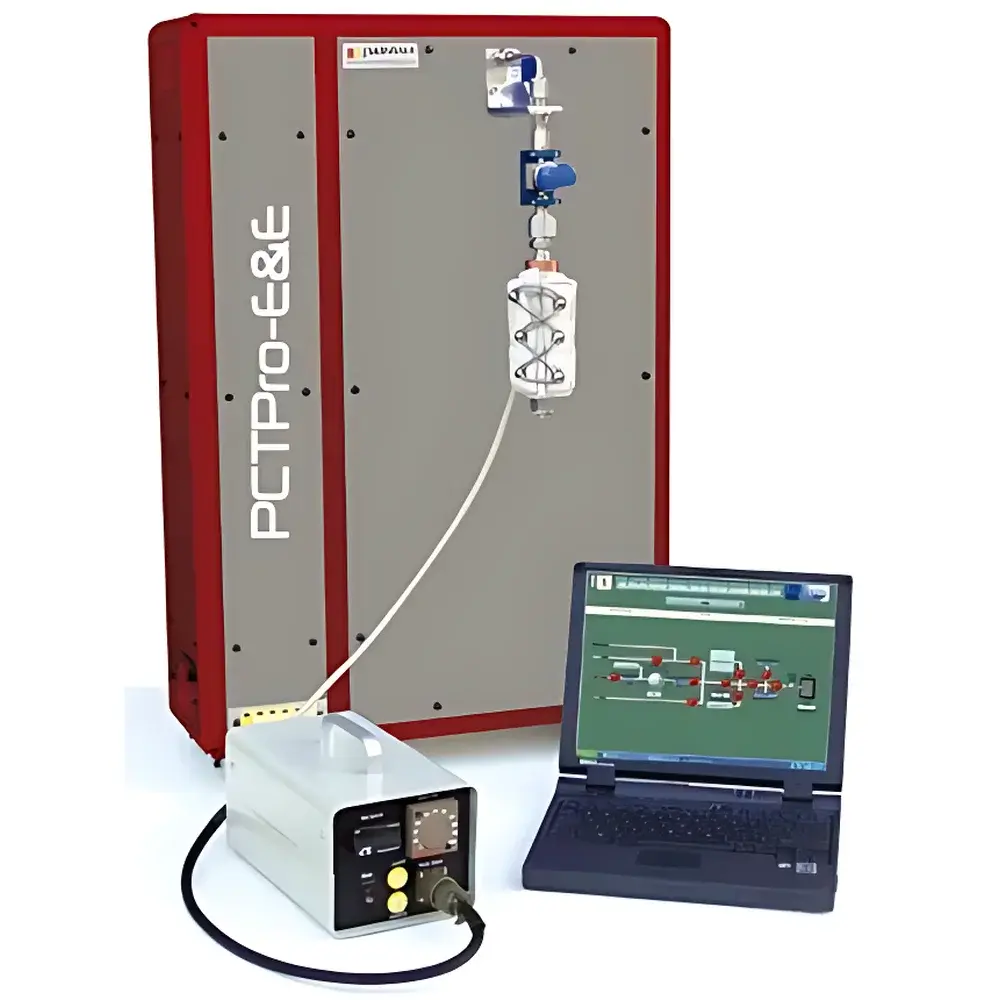
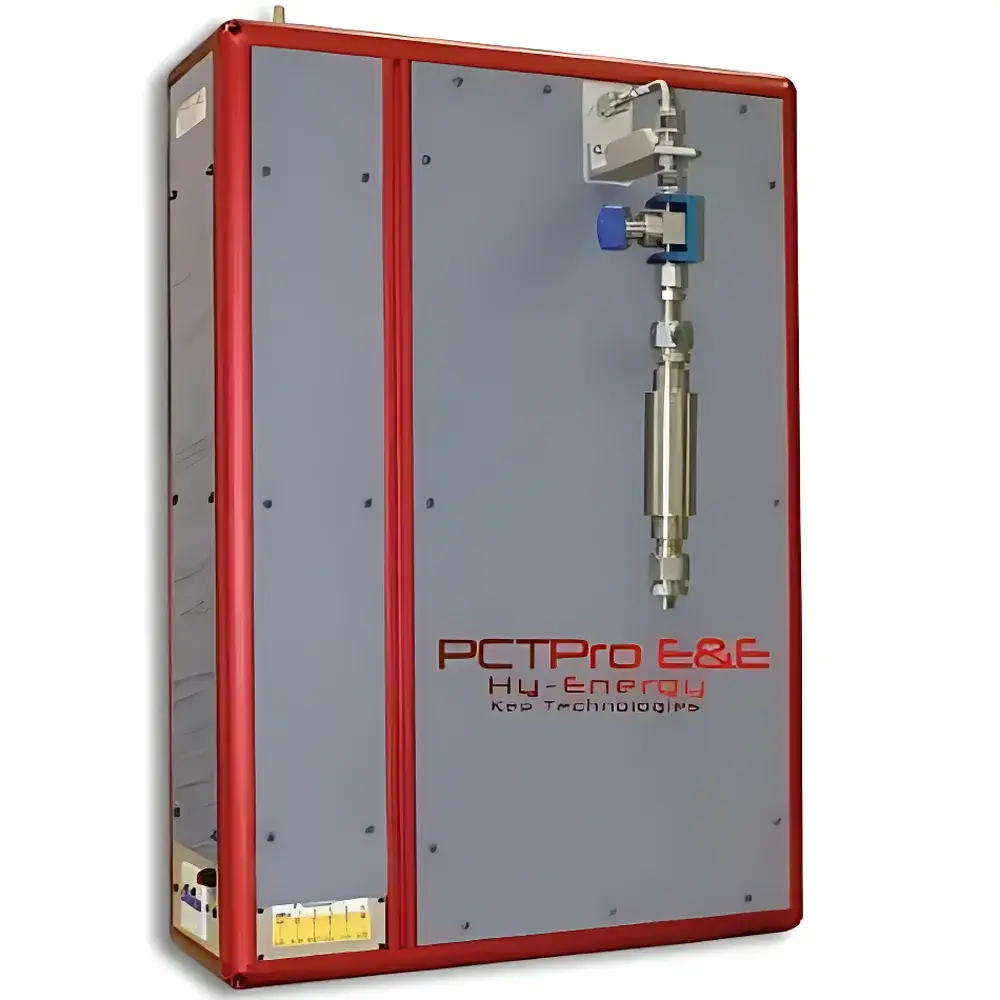
SETARAM PCT Pro E&E High-Pressure Gas Sorption Analyzer
| Brand | SETARAM |
|---|---|
| Origin | USA |
| Model | PCT Pro E&E |
| Instrument Type | Physical & Chemical Sorption Analyzer |
| Temperature Range | –269 °C to 500 °C |
| Pressure Range | Vacuum to 200 bar |
| Pressure Accuracy | ±1% FS |
| Detection Limit | 3 µg (equivalent to 0.3 wt% gas uptake on 1 mg sample) |
| Integrated Pressure Sensors | 4 (auto-switching dual-range) |
| Gas Compatibility | H₂, CO₂, CH₄, NH₃ |
| Sample Cell Options | 6 types (standard, high-temp, liquid, thin-film, cryogenic, micro-dosing) |
| Safety Systems | Combustible gas detection, multi-point T/P monitoring, inert-gas purged transfer pathway |
| Software Platform | LabVIEW-based with real-time data acquisition, automated sequence execution, and audit-trail-capable operation |
Overview
The SETARAM PCT Pro E&E is a fully automated, Sieverts-type high-pressure gas sorption analyzer engineered for quantitative thermodynamic and kinetic characterization of solid materials under controlled temperature and pressure conditions. Based on volumetric–manometric principles, it measures reversible gas uptake and release by monitoring pressure differentials across calibrated reference and sample volumes while maintaining strict mass balance. Its operational envelope spans cryogenic temperatures (down to 0.4 K via liquid helium cooling) to 500 °C and pressures from full vacuum to 200 bar—enabling rigorous evaluation of physisorption, chemisorption, and interstitial hydride formation mechanisms. Designed originally by Hy-Energy (acquired by SETARAM in 2012), the system meets the stringent reproducibility and traceability requirements of academic research labs, national metrology institutes, and industrial R&D centers developing hydrogen storage media, carbon capture sorbents, catalytic formulations, and pharmaceutical excipients.
Key Features
- Ultra-broad operating range: –269 °C to 500 °C with programmable ramp rates and isothermal stability ≤ ±0.1 °C; vacuum to 200 bar with PID-controlled pressure regulation supporting constant-P, constant-ΔP, and frequency-modulated ΔP modes.
- Four integrated pressure transducers with auto-switching logic ensure optimal signal-to-noise ratio across the full pressure span; accuracy certified to ±1% full scale per ISO 6789-2.
- Detection limit of 3 µg enables high-sensitivity quantification of low-uptake systems—e.g., metal–organic frameworks (MOFs) at sub-ambient H₂ pressures or amine-functionalized silicas under dilute CO₂ streams.
- Six interchangeable sample cells accommodate diverse physical forms: standard stainless-steel vessels (1–5 cm³), high-temperature Inconel cells (rated to 800 °C), hermetically sealed liquid-compatible chambers, thin-film holders for electrode studies, cryogenic cells with integrated radiation shields, and micro-dosing units for <10 mg samples.
- 13 pre-validated LabVIEW sequences automate sample degassing, thermal equilibration, gas dosing, equilibrium validation, and desorption ramping—fully compliant with ASTM D7845 (hydrogen storage materials) and ISO 15901-2 (pore size distribution by gas adsorption).
- Integrated safety architecture includes combustible gas sensors (H₂, CH₄), redundant pressure relief valves, real-time thermal runaway detection, and inert-gas-purged sample transfer pathways meeting OSHA 1910.120 and IEC 61508 SIL2 requirements.
Sample Compatibility & Compliance
The PCT Pro E&E supports heterogeneous solid-phase materials across energy, environmental, and life sciences domains—including metal hydrides (e.g., MgH₂, NaAlH₄), porous carbons, zeolites, MOFs, covalent organic frameworks (COFs), supported catalysts (Pt/Al₂O₃, Ni/MgO), active pharmaceutical ingredients (APIs), and polymer barrier films. Its modular cell design permits direct coupling to complementary in situ characterization tools: high-pressure mass spectrometry (HP-MS), Fourier-transform infrared spectroscopy (HP-FTIR), and synchrotron X-ray diffraction (HP-XRD) via standardized flange interfaces (CF-63 or KF-40). All hardware and software functions adhere to GLP/GMP documentation standards, with optional 21 CFR Part 11-compliant electronic signatures, audit trails, and user-access-level controls available through validated firmware extensions.
Software & Data Management
Control and analysis are executed via a native LabVIEW-based platform featuring deterministic real-time scheduling, synchronized multi-channel acquisition (T, P, flow, valve status), and embedded thermodynamic modeling engines (van’t Hoff, Langmuir, Dual-site Langmuir, Redlich–Peterson). Raw data are stored in HDF5 format with metadata embedding (instrument ID, operator, calibration certificates, environmental logs). Export options include ASTM E2936-compliant .csv, ISO-standardized .cif for crystallographic correlation, and MATLAB-compatible .mat files. Batch processing workflows support automated baseline correction, dead-volume calibration, and isosteric heat calculation using the Clausius–Clapeyron method. Audit logs record all parameter modifications, sequence executions, and calibration events with timestamped user attribution—fully traceable for regulatory submissions.
Applications
- Hydrogen storage capacity mapping for light-metal hydrides and complex hydrides under DOE Hydrogen Program targets (e.g., ≥ 5 wt% reversible uptake at ≤ 100 °C / 100 bar).
- CO₂ capture screening of amine-grafted mesoporous silicas and functionalized polymers under simulated flue-gas conditions (0.1–15 bar, 25–75 °C).
- Catalyst poisoning resistance assessment via cyclic H₂/CO co-adsorption on Pt–Ru bimetallics under industrially relevant partial pressures.
- Moisture-induced structural degradation kinetics of pharmaceutical hydrates monitored via stepwise water vapor dosing at 25 °C and 10–90% RH equivalents.
- Pore-filling thermodynamics of CH₄ in activated carbons for ANG (adsorbed natural gas) vehicle tank certification per SAE J2579.
FAQ
What gas purity levels are required for reliable PCT measurements?
High-purity gases (≥ 99.999% for H₂, CO₂, CH₄; ≥ 99.99% for NH₃) are recommended to avoid catalytic surface contamination and ensure stoichiometric uptake fidelity. Optional inline purifiers (oxygen/moisture traps) are available.
Can the system perform simultaneous TGA–PCT coupling?
Yes—the external sample chamber allows integration with commercial TGA units via temperature-synchronized communication protocols (RS-485 or Ethernet/IP), enabling concurrent mass loss and gas uptake tracking.
Is remote operation supported for unattended overnight runs?
Fully supported via secure SSH tunneling and VNC-enabled GUI access; all sequences include automatic error recovery, emergency venting, and email/SMS alerting upon completion or fault condition.
How is dead volume calibrated, and how often is recalibration needed?
Dead volume is determined using helium expansion method per ISO 15901-1; recalibration is recommended after cell replacement, major maintenance, or every 6 months under continuous use—with NIST-traceable pressure and temperature references.
Does the system comply with ISO/IEC 17025 for accredited testing laboratories?
Yes—when operated with documented SOPs, certified reference materials (e.g., SRM 2975 for carbon black surface area), and annual third-party metrological verification, the PCT Pro E&E satisfies clause 6.4.10 (equipment validation) and 7.7 (result reporting) of ISO/IEC 17025:2017.



