
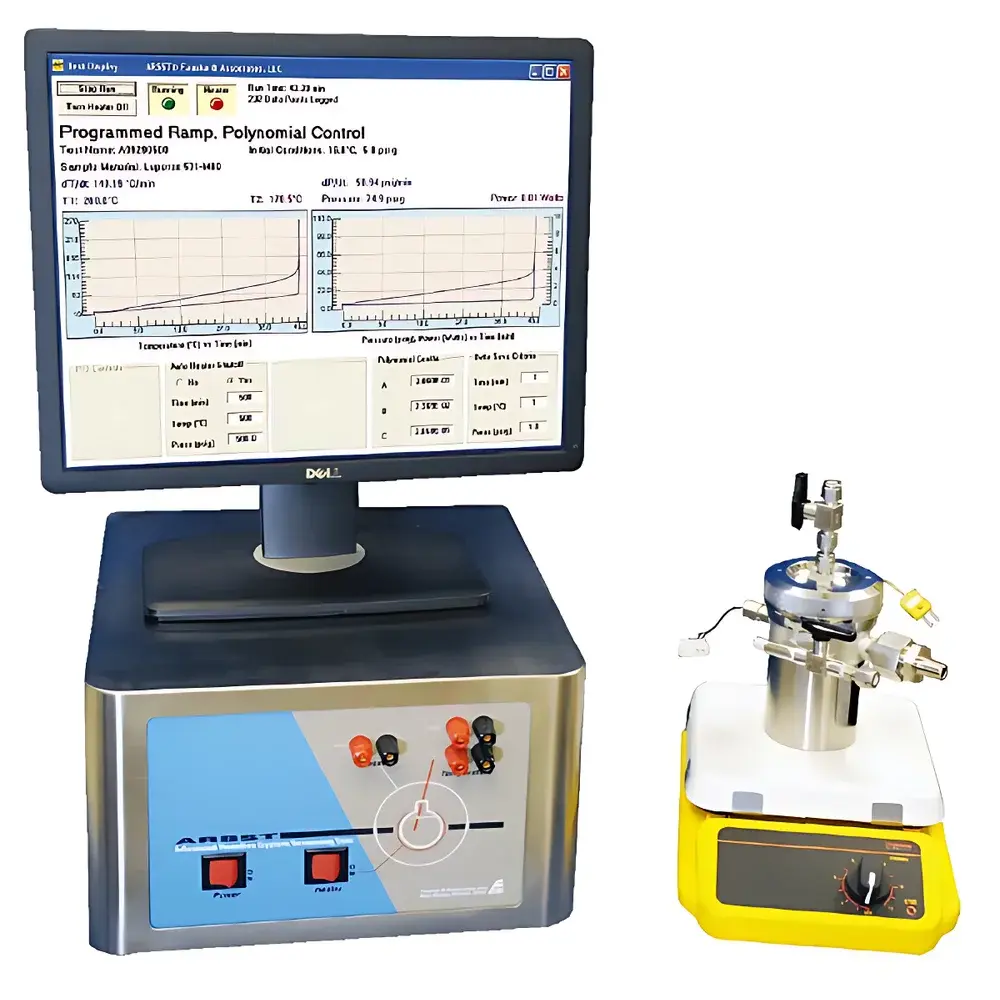
Fauske ARSST Advanced Reactive Systems Screening Tool
| Brand | Fauske |
|---|---|
| Origin | USA |
| Instrument Type | Adiabatic Reaction Calorimeter |
| Measurement Mode | Adiabatic Calorimetry |
| Model | ARSST |
| Compliance Basis | DIERS-validated two-phase flow methodology (OSHA-recognized “Exemplary Engineering Practice”) |
| Sample Volume | 5–10 g in 10 mL lightweight quartz test cell |
| Pressure Vessel Capacity | 350 mL rated pressure vessel |
| Operating Modes | Scanning & Isothermal |
| Optional Accessories | High-pressure test cells, Flow-Regime Evaluation Detector (FRED™) |
Overview
The Fauske ARSST Advanced Reactive Systems Screening Tool is a low-thermal-inertia adiabatic calorimeter engineered for rapid, reliable acquisition of critical thermal runaway data under near-adiabatic conditions. It implements the DIERS (Design Institute for Emergency Relief Systems) two-phase flow methodology—formally recognized by OSHA as “Exemplary Engineering Practice”—to minimize heat loss and deliver high-fidelity reaction enthalpy, temperature rise rate (dT/dt), pressure rise rate (dP/dt), and adiabatic temperature rise (ΔTad) measurements. Unlike conventional differential scanning or heat-flux calorimeters, the ARSST operates by actively compensating for thermal inertia through real-time power adjustment to the band heater surrounding the quartz test cell, thereby maintaining near-zero temperature gradient between sample and vessel wall. This architecture enables direct scalability of laboratory-derived kinetic and thermodynamic parameters to pilot- and production-scale process safety design—including relief system sizing, quench tank specification, and thermal stability assessment per CCPS, NFPA 49, and EU ATEX Directive requirements.
Key Features
- Low-thermal-inertia quartz test cell (10 mL volume, 5–10 g sample mass) ensures minimal lag in thermal response and high reproducibility across repeated runs
- Integrated band heater with programmable temperature ramping (scanning mode) and precise isothermal hold capability
- 350 mL ASME-coded pressure vessel with inert gas backpressure control for volatile sample containment during open-cell testing
- Modular design supports optional high-pressure test cells (up to 200 bar) and FRED™ (Flow-Regime Evaluation Detector) for foam/non-foam discrimination in vapor-phase evolution
- Intuitive touchscreen interface with preconfigured test templates aligned with ASTM E1981, ISO 8064, and CCPS Guidelines for Runaway Reaction Hazard Assessment
- No consumable sensors—reusable thermocouples, heaters, and sealing components reduce long-term operational cost
Sample Compatibility & Compliance
The ARSST accommodates a broad spectrum of chemistries, including energetic materials, nitration mixtures, polymerization systems, pharmaceutical intermediates, and battery electrolyte formulations. Its open-cell configuration allows direct measurement of vapor pressure development and phase behavior, while closed-cell operation supports self-pressurizing reactions. All hardware and firmware comply with IEC 61511 (functional safety of SIS), FDA 21 CFR Part 11 (electronic records/records integrity), and GLP audit requirements. Test reports include full traceability of calibration certificates (NIST-traceable thermocouples), raw time-series data (dT/dt, dP/dt, T, P), and derived safety parameters—fully exportable for integration into PHA (Process Hazard Analysis) documentation and Layer of Protection Analysis (LOPA).
Software & Data Management
ARSST Control Software provides real-time visualization of thermal and pressure transients, automated calculation of key safety indices—including Time to Maximum Rate (TMR), Self-Accelerating Decomposition Temperature (SADT), onset temperature (Tonset), and adiabatic time-to-explosion (texp)—and seamless export to CSV, PDF, and XML formats. Audit trails record all user actions, parameter changes, and calibration events with timestamped digital signatures. The software supports multi-user role-based access control and integrates with enterprise LIMS and MES platforms via OPC UA and RESTful API interfaces. Raw datasets retain full resolution (≥10 Hz sampling) for post-test reanalysis using third-party kinetic modeling tools (e.g., Chemkin, Thermo-Calc, or Kinetics Simulator).
Applications
- Thermal stability screening of new synthetic routes and existing manufacturing processes
- Determination of safe operating limits (SOL), maximum process temperature (MPT), and emergency quench criteria
- Relief system design per DIERS methodology: vent area calculation, two-phase flow modeling, and rupture disk sizing
- Characterization of decomposition kinetics for UN transport classification (e.g., Class 1 explosives, Class 4.1 flammable solids)
- Supporting Process Safety Management (PSM) compliance under OSHA 1910.119 and EPA RMP Rule 40 CFR Part 68
- Validation of computational thermal hazard models (e.g., TSS, SACHE, or DSC-based extrapolation)
FAQ
What distinguishes ARSST from other adiabatic calorimeters such as Phi-TEC or VSP2?
The ARSST employs a unique low-mass quartz cell and active band-heater compensation to achieve superior thermal inertia correction (φ factor ≈ 1.05–1.15), enabling faster test turnaround (typically <4 hours per run) without sacrificing data fidelity for early-stage hazard identification.
Can ARSST data be used directly for full-scale relief valve sizing?
Yes—when operated per DIERS protocols and validated against benchmark systems (e.g., cumene hydroperoxide), ARSST-derived dT/dt and dP/dt values are accepted by regulatory authorities and insurance underwriters for vent sizing calculations in batch and semi-batch reactors.
Is FRED™ required for standard ARSST operation?
No—FRED™ is an optional add-on module used specifically to characterize foaming tendency and two-phase flow regimes during venting; standard ARSST operation does not require it.
How often must the quartz test cell be replaced?
Quartz cells exhibit excellent chemical resistance and mechanical stability; typical service life exceeds 200 runs when handling non-hydrofluoric acid chemistries and proper cleaning protocols are followed.
Does FAI provide method validation support for GMP-regulated environments?
Yes—FAI offers IQ/OQ documentation packages, on-site installation qualification, and protocol development assistance aligned with USP , ASTM E2550, and ICH Q5C guidelines.



