
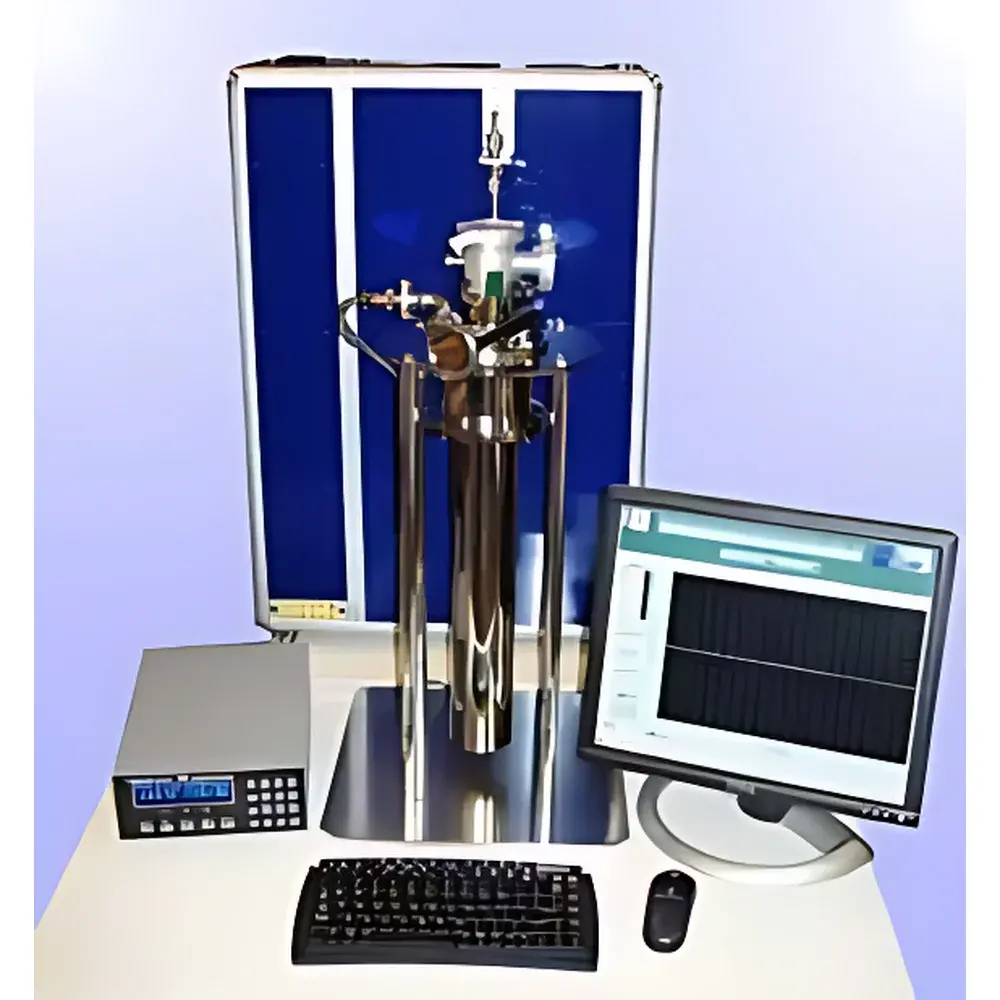
SETARAM CryoPro-2009 Low-Temperature Gas Adsorption Measurement System
| Brand | SETARAM |
|---|---|
| Origin | USA |
| Model | CryoPro-2009 |
| Operating Temperature Range | –269 °C to 100 °C |
| Pressure Range | Vacuum to 200 bar (3000 psi / 100 psi dual-range transducers) |
| Cooling Medium | Liquid Helium or Liquid Nitrogen |
| Construction Material | 316 Stainless Steel |
| Sealing Method | Metal-Gasketed Arc-Welded Joints |
| Control System | LabVIEW-Based Automated Platform |
| Safety Features | Integrated Hydrogen Leak Detection and Flame Suppression System |
| Compliance | Designed for GLP/GMP-aligned workflows with full audit trail capability |
Overview
The SETARAM CryoPro-2009 is a high-precision, cryogenic gas adsorption measurement system engineered as a modular low-temperature sample chamber for integration with the PCTPro-2000 pressure-composition-temperature (PCT) analyzer. It operates on the principle of volumetric gas adsorption analysis under precisely controlled thermal and pressure conditions, enabling quantitative determination of gas uptake, desorption kinetics, and cyclic stability in solid sorbents—particularly critical for hydrogen storage material development. Its operational range extends from liquid helium temperatures (4.2 K, –268.95 °C) to 100 °C, supporting fundamental research into physisorption thermodynamics, enthalpy–entropy compensation, and kinetic barrier analysis across multiple gas–solid interfaces. The system is not a standalone analyzer but a purpose-built cryogenic extension module that transforms the PCTPro-2000 into a low-temperature-capable platform compliant with ISO 15901-2 (physisorption), ASTM D7252 (hydrogen storage capacity), and USP (sorption characterization of pharmaceutical excipients).
Key Features
- Ultra-low temperature operation down to 4.2 K (–269 °C) using liquid helium or liquid nitrogen cryogens, with extended hold times enabled by high-efficiency Dewar geometry and vacuum-jacketed thermal insulation
- Dual-range pressure transduction (0–100 psi and 0–3000 psi) with automatic sensor switching to maintain ±0.05% FS accuracy across the full 0–200 bar operating envelope
- Direct-in-situ sample temperature monitoring via calibrated Pt-100 sensors embedded in the sample holder, eliminating thermal lag and enabling real-time PID feedback control
- Hermetic sealing architecture based on arc-welded 316 stainless steel construction and metal C-ring gaskets, achieving leak rates <1×10⁻⁹ mbar·L/s (He) per ASTM E493
- Integrated hydrogen-specific safety subsystem including catalytic bead sensors (detection limit: 10 ppm H2), automatic purge sequencing, and flame arrestor valves compliant with NFPA 55 and IEC 60079-29-1
- LabVIEW-based automation framework supporting fully programmable temperature ramps, pressure steps, dwell times, and cycle repetition—with timestamped metadata logging at 10 Hz resolution
Sample Compatibility & Compliance
The CryoPro-2009 accommodates powdered, pelletized, or monolithic sorbent samples (typical mass range: 0.1–5 g) within a standardized Swagelok-compatible sample cup. It supports inert gas purging (Ar, He), reactive gas handling (H2, D2, CO2, CH4), and multi-step adsorption–desorption protocols under isothermal or isobaric conditions. All hardware and software components are designed for traceability and regulatory alignment: electronic logs include user authentication, parameter change history, and digital signatures; data export formats (CSV, TDMS) support FDA 21 CFR Part 11 compliance when deployed with validated IT infrastructure. The system meets ISO/IEC 17025 requirements for calibration traceability (NIST-traceable pressure and temperature standards) and is routinely deployed in DOE-funded hydrogen materials centers and EU Horizon 2020 Clean Hydrogen JU projects.
Software & Data Management
Control and analysis are executed through a dedicated LabVIEW application featuring three operational modes: (1) Static PCT acquisition (isothermal pressure sweeps), (2) Dynamic kinetic profiling (time-resolved uptake at fixed P/T), and (3) Cyclic endurance testing (repeated adsorption–desorption sequences with configurable aging parameters). Raw data—including absolute pressure, differential pressure, thermocouple readings, valve states, and time stamps—are written to binary TDMS files with embedded metadata headers. Post-acquisition processing includes Langmuir/BET surface area estimation (per ISO 9277), Dubinin–Astakhov pore energy distribution modeling, and Arrhenius activation energy extraction from multi-temperature kinetic datasets. Export options include PDF reports with embedded uncertainty propagation (based on transducer calibration certificates and temperature drift corrections) and XML schemas compatible with LIMS integration.
Applications
- Hydrogen storage material screening (MOFs, carbon nanotubes, complex hydrides) across 77 K–298 K isotherms
- CO2 capture sorbent evaluation under sub-ambient flue-gas conditions (0–50 °C, 0.1–1 bar)
- Quantitative assessment of thermal hysteresis and cycling degradation in metal–organic frameworks
- Calorimetric coupling studies (when interfaced with SETARAM Sensys Evo microcalorimeter)
- Validation of molecular simulation outputs (GCMC, DFT) against experimental low-T adsorption isotherms
- Pharmaceutical solid-state stability testing involving moisture or solvent vapor sorption at controlled RH and T
FAQ
Is the CryoPro-2009 compatible with non-SETARAM PCT systems?
No—it is mechanically, electrically, and pneumatically engineered exclusively for seamless integration with the PCTPro-2000 platform, including proprietary valve manifolds and communication protocols.
What is the typical hold time at 4.2 K using liquid helium?
With a standard 10-L Dewar and optimized thermal shielding, continuous operation at 4.2 K exceeds 18 hours; hold time scales linearly with Dewar volume and inversely with ambient heat load.
Can the system perform simultaneous temperature and pressure ramping?
Yes—the LabVIEW controller supports coupled ramping profiles (e.g., linear dT/dt + exponential dP/dt) with user-defined constraints on maximum heating/cooling rates and pressure slew limits.
How is calibration traceability maintained for pressure and temperature sensors?
Each transducer and RTD is supplied with NIST-traceable calibration certificates; field verification is supported via integrated reference ports and external dead-weight testers.
Does the software support automated reporting for regulatory submissions?
Yes—PDF report templates include mandatory elements for GLP audits: instrument ID, analyst signature fields, raw data appendices, and version-controlled method definitions with revision timestamps.



