
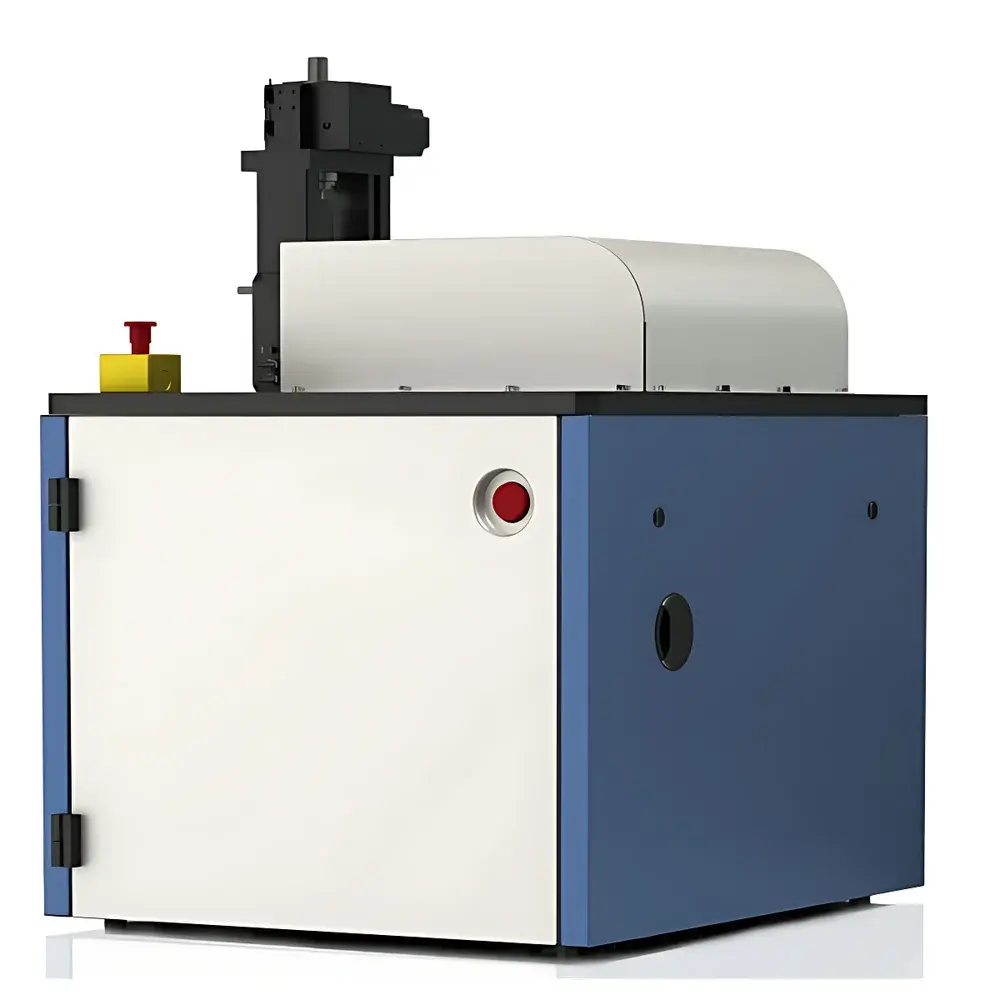
Rtec MPT-3000 Micro-Pitting Tribological Tester
| Brand | Rtec |
|---|---|
| Origin | Switzerland |
| Model | MPT-3000 |
| Maximum Friction Force | 8000 N |
| Friction Force Resolution | 0.15 N |
| Maximum Test Temperature | 150 °C |
Overview
The Rtec MPT-3000 Micro-Pitting Tribological Tester is a high-precision, open-architecture rolling contact fatigue testing system engineered for fundamental and applied research into surface-initiated failure mechanisms—particularly micro-pitting, scuffing, wear, and traction behavior under controlled combinations of rolling, sliding, and mixed lubrication regimes. Based on the well-established three-roller (or three-disk) configuration, the MPT-3000 replicates the kinematics and stress states found in critical tribological interfaces such as gear teeth flanks, bearing raceways, and cam-follower contacts. Its design adheres to principles defined in ASTM D5183 (Standard Test Method for Determining the Coefficient of Friction of Lubricants Using the Four-Ball Machine), ISO 14635-1 (Gears — FZG test procedures), and relevant sections of DIN 51354 and JIS B 1192, enabling direct correlation with industry-standard durability assessments. The system operates on a closed-loop servo-controlled architecture that maintains strict fidelity across force, speed, temperature, and environmental parameters—essential for generating reproducible, traceable, and statistically valid datasets required in R&D, formulation validation, and material qualification workflows.
Key Features
- Multi-axis active feedback control: Independent servo-driven control of rotational speed (0.1–5000 rpm), normal load (up to 8000 N, resolution ±0.15 N), and thermal environment (−20 °C to +150 °C, stability ±0.5 °C)
- Dual-mode operation: Configurable for dry, boundary, mixed, or full-film lubricated conditions; compatible with oil baths, mist lubrication, and sealed chamber setups
- Real-time multi-sensor acquisition: Integrated high-resolution dynamic torque sensor (patented), broadband acoustic emission (AE) sensor (100 kHz–1 MHz bandwidth), and optional in-situ profilometry or optical displacement modules
- Logic-based test termination: Programmable stop triggers using Boolean combinations of sensor thresholds—e.g., “terminate when friction coefficient increases by ≥30% from baseline” or “upon detection of AE burst amplitude exceeding 75 dB RMS”
- High-fidelity data acquisition: 200 kHz sampling rate across 16 synchronized analog channels; low-noise signal conditioning; hardware timestamping compliant with IEEE 1588 Precision Time Protocol (PTP)
Sample Compatibility & Compliance
The MPT-3000 accommodates cylindrical rollers (Ø3–25 mm), flat disks (Ø20–100 mm), and custom fixtures for coated substrates, polymer composites, or thin-film specimens. Sample mounting follows standardized ISO 14635-1 geometry conventions but supports non-standard configurations via modular tooling plates. All mechanical and thermal subsystems are CE-marked and comply with IEC 61000-6-2 (EMC immunity) and IEC 61000-6-4 (EMC emissions). Data integrity protocols—including audit trails, user access levels, electronic signatures, and raw-data immutability—support compliance with FDA 21 CFR Part 11 and EU Annex 11 requirements when operated within validated laboratory environments under GLP or GMP frameworks.
Software & Data Management
The MPT-3000 is operated via Tribos™ v5.x, a Windows-based platform supporting script-driven test sequencing (TCL/Python API integration available), real-time waveform visualization, and automated post-processing routines including friction coefficient evolution, AE event counting, and spectral energy distribution analysis. All acquired data are stored in HDF5 format with embedded metadata (test parameters, calibration certificates, operator ID, timestamps). Export options include ASCII (.txt), CSV, MATLAB (.mat), and universal binary formats compatible with third-party statistical packages (JMP, Minitab, Python Pandas). Software updates are delivered through secure HTTPS channels with SHA-256 signature verification.
Applications
- Aerospace: Gear oil performance screening under extreme pressure and thermal cycling
- Railway systems: Wheel-rail interface modeling and lubricant film breakdown analysis
- Electric drivetrains: E-fluid compatibility testing for high-speed e-motor bearings and reduction gears
- Lubricant development: Base stock and additive package evaluation per OEM specifications (e.g., GM dexos®, Ford WSS-M2C945-A, VW TL 52182)
- Surface engineering: DLC, nitrided, and PVD-coated component lifetime prediction
- Renewable energy: Wind turbine gearbox contact fatigue assessment under variable loading profiles
FAQ
What types of rolling-sliding ratios can the MPT-3000 achieve?
The system supports continuous adjustment of slide-to-roll ratio (SRR) from −100% (pure sliding) to +100% (pure rolling), with typical operational range spanning −5% to +20% for micro-pitting studies.
Is the MPT-3000 compatible with vacuum or inert gas environments?
Yes—optional vacuum chamber and purge gas adapters (N₂, Ar) are available for oxidation-sensitive materials and high-temperature dry tests.
Can raw sensor data be accessed for custom algorithm development?
Yes—HDF5 files contain unprocessed, time-aligned channel data with full scaling coefficients and calibration history embedded.
Does the system support ASTM or ISO standard test methods out-of-the-box?
Pre-configured test templates are provided for ASTM D5183, ISO 14635-1, and DIN 51354-2; users may modify or extend these per internal SOP requirements.
What maintenance intervals are recommended for long-term metrological stability?
Annual recalibration of force and torque sensors is advised; thermal chamber validation should be performed quarterly using NIST-traceable PT100 probes.



