
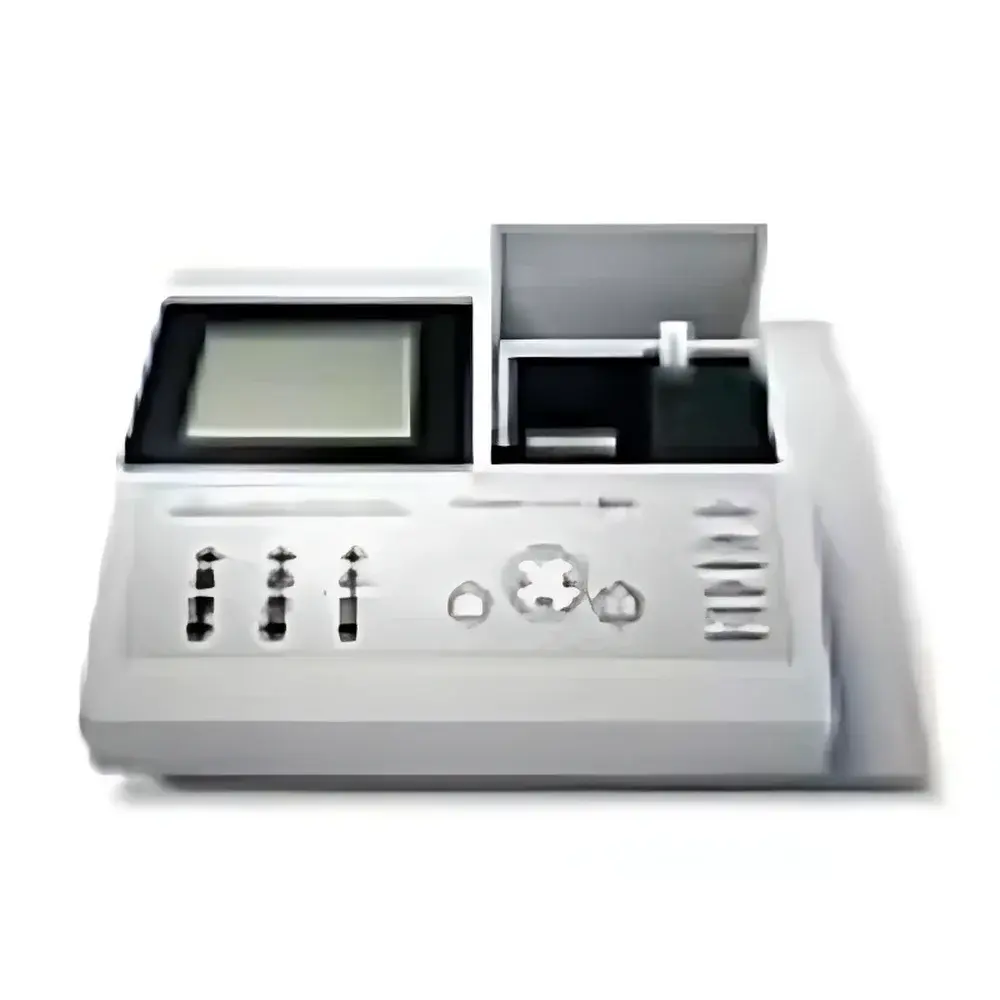
Merck Spectroquant® Pharo100 Visible-Spectrum Multi-Parameter Water Quality Analyzer
| Brand | Merck |
|---|---|
| Origin | Germany |
| Manufacturer Type | Original Equipment Manufacturer (OEM) |
| Product Category | Imported Instrument |
| Model | Pharo100 |
| Price | Upon Request |
| Wavelength Range | 320–1100 nm |
| Light Source | Tungsten Halogen Lamp |
| Optical Design | Stabilized Single-Beam |
| Spectral Bandwidth | 4 nm |
| Wavelength Resolution | 1 nm |
| Wavelength Accuracy | ±1 nm |
| Absorbance Range | ±3.3 A |
| Absorbance Resolution | 0.001 A |
| Absorbance Accuracy | ±0.003 A (for A < 0.600 A) |
| Cuvette Types | 16 mm round, and 10/20/50 mm square (auto-recognized) |
| Measurement Modes | Concentration, Absorbance, Transmittance, Multi-Wavelength, Full Spectrum Scan, Kinetics |
| AQA Levels | AQA1 (PhotoCheck/CertiPUR® wavelength verification), AQA2 (CombiCheck/CertiPUR® system verification), AQA3 (MatrixCheck interference assessment) |
| Data Storage | 1000 measurement results |
| Interfaces | 1× USB-A, 1× USB-B, 1× RS-232 |
| Compliance | DIN, USEPA, GLP-compliant audit trail, 21 CFR Part 11 ready (with optional software configuration) |
Overview
The Merck Spectroquant® Pharo100 Visible-Spectrum Multi-Parameter Water Quality Analyzer is a benchtop single-beam spectrophotometer engineered for precision, traceability, and regulatory compliance in environmental and municipal water laboratories. Operating across a wavelength range of 320–1100 nm, the instrument employs a stabilized tungsten halogen lamp and fixed 4 nm spectral bandwidth optics to deliver reproducible absorbance measurements up to ±3.3 A with 0.001 A resolution. Its core measurement principle is based on Beer–Lambert law–governed UV-Vis absorption spectroscopy, optimized for routine analysis of aqueous matrices—including drinking water, surface water, wastewater, and industrial effluents. Unlike general-purpose spectrophotometers, the Pharo100 integrates application-specific firmware, factory-calibrated methods, and embedded analytical quality assurance (AQA) protocols—making it a purpose-built platform for accredited water testing laboratories requiring ISO/IEC 17025–aligned workflows.
Key Features
- Automated barcode recognition for all Spectroquant® pre-filled test vials and economical reagent packs—eliminating manual method selection and minimizing operator error.
- Intelligent cuvette detection: automatic identification and calibration adjustment for 16 mm round, and 10/20/50 mm square cells—ensuring optimal pathlength selection and dynamic range adaptation per assay.
- Three-tier AQA framework: AQA1 verifies wavelength accuracy via PhotoCheck or CertiPUR® UV/VIS standards; AQA2 validates full-system performance using CombiCheck reference solutions; AQA3 performs matrix interference screening via MatrixCheck functionality—each logged with timestamped audit records.
- Built-in library of ≥170 certified methods covering >50 water quality parameters (e.g., nitrate, phosphate, COD, ammonia, iron, manganese, chlorine species), compliant with DIN 38404, DIN EN ISO 15309, and U.S. EPA-approved procedures.
- GLP-ready operation: All measurements include auto-recorded metadata (date/time, operator ID, cuvette ID, method version, AQA status); optional software enables 21 CFR Part 11–compliant electronic signatures and audit trail export.
- Expandable method capacity: Supports up to 100 user-defined programs and 20 custom kinetic or spectral scan protocols—enabling method development beyond standardized assays.
Sample Compatibility & Compliance
The Pharo100 accommodates standard aqueous samples without pretreatment for most Spectroquant® colorimetric assays. It accepts clarified, filtered, or centrifuged samples per method requirements—compatible with turbidity levels within specified limits (e.g., <5 NTU for orthophosphate analysis). The instrument meets IP31 ingress protection rating and includes spill-containment design features for accidental overflow or cuvette breakage. Regulatory alignment extends across multiple frameworks: its embedded methods are validated per DIN and USEPA guidelines; data integrity architecture supports GLP documentation practices; and with Spectroquant® LabStation software, full 21 CFR Part 11 compliance—including role-based access control, electronic signatures, and immutable audit logs—is achievable. Routine calibration verification satisfies ISO/IEC 17025 clause 6.4.10 (monitoring of equipment performance).
Software & Data Management
Data handling is managed through an integrated 4 MB internal memory—storing up to 1000 individual test results alongside high-resolution spectral and kinetic datasets (e.g., 100 full-scan spectra from 300–900 nm or 400 kinetic traces with 150 timepoints each). All data are exportable via USB-A port to FAT32-formatted drives in CSV or XML formats compatible with LIMS integration. Firmware and method updates are delivered free-of-charge via USB stick or PC-connected USB-B interface—ensuring long-term method currency without hardware obsolescence. Language support includes English, German, Spanish, French, Italian, and Simplified Chinese—facilitating multinational lab deployment. Optional Spectroquant® LabStation software provides advanced reporting, trend analysis, uncertainty estimation per GUM principles, and automated certificate generation aligned with ISO/IEC 17025 Annex A.3.
Applications
- Routine compliance monitoring for potable water per WHO/EU Drinking Water Directive parameters (e.g., nitrate, fluoride, residual chlorine).
- Wastewater treatment plant process control: BOD/COD surrogate quantification, nutrient removal efficiency tracking (N/P/K), and disinfection by-product precursor screening.
- Environmental field lab support: Rapid on-site analysis when paired with optional battery pack or vehicle power adapter—retaining full method fidelity and AQA traceability.
- Research-grade absorbance profiling: Full-spectrum scanning for unknown chromophore identification; multi-wavelength kinetics for reaction rate determination (e.g., persulfate oxidation, Fenton chemistry).
- Method validation and verification studies: Inter-laboratory comparison exercises, spike recovery assessments, and matrix-matched calibration curve development.
FAQ
Does the Pharo100 require annual recalibration by a certified service provider?
While no mandatory annual recalibration is stipulated, Merck recommends biannual verification using CertiPUR® UV/VIS standards or PhotoCheck kits—documented as part of internal QA/QC procedures per ISO/IEC 17025.
Can the instrument be used for UV-range measurements below 320 nm?
No—the Pharo100 is strictly a visible-light spectrophotometer (320–1100 nm). For UV-capable analysis (190–1100 nm), the Pharo300 model with deuterium/tungsten dual source is required.
Is method validation data available for each built-in parameter?
Yes—Merck provides full validation reports (precision, accuracy, LOD/LOQ, linearity, robustness) upon request for all DIN- and USEPA-listed methods, supporting laboratory accreditation documentation.
How is data security maintained during USB transfer?
Data exports are unencrypted CSV/XML files; however, Spectroquant® LabStation supports AES-256 encryption for exported audit trails and signed PDF reports when configured for 21 CFR Part 11 environments.
What is the expected lifetime of the tungsten halogen lamp?
Rated at ≥2,000 hours under typical usage (10–15 measurements/day); lamp replacement is user-performed with calibration retention—no optical realignment required.







