
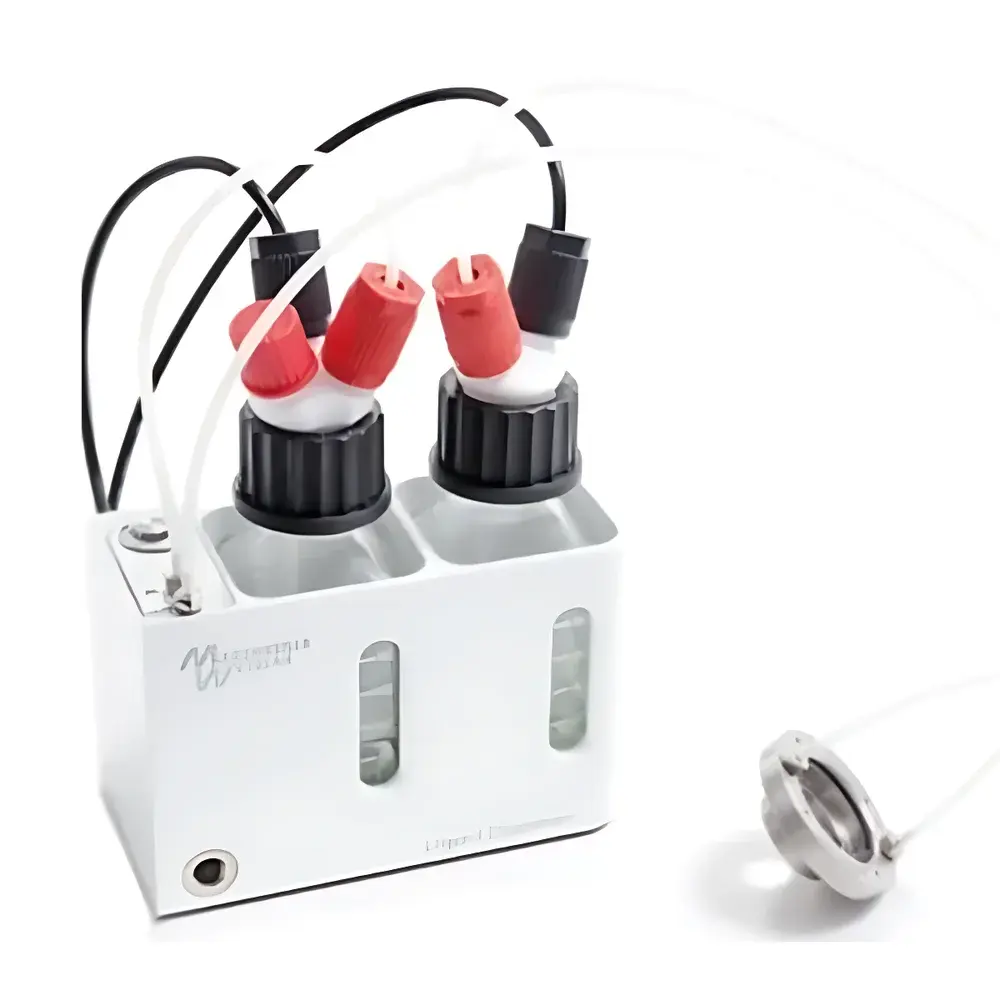
Marzhauser Liquid Dispenser for Objective Immersion
| Key | Brand: Marzhauser |
|---|---|
| Origin | Germany |
| Model | Liquid Dispenser |
| Delivery Principle | Pressure-driven dispensing |
| Volume Control | Time-programmable |
| Max Reservoir Capacity | 100 mL (interchangeable borosilicate glass reservoir) |
| Fluid Path Material | Chemically inert PTFE capillary tubing |
| Compatibility | Custom lens adapters for oil-immersion and water-immersion objectives |
| Actuation Modes | Manual, USB 2.0 (Type-B), TTL trigger, TANGO controller interface (5-pin female), remote control port (7-pin female) |
| Weight | 1.5 kg |
Overview
The Marzhauser Liquid Dispenser for Objective Immersion is an engineered fluid management system designed specifically to maintain stable, contamination-free immersion media between high-NA microscope objectives and biological specimens during long-term live-cell imaging. It operates on a pressure-driven delivery principle, enabling precise, repeatable, and particle-free dispensing and aspiration of immersion liquids—including immersion oil, deionized water, or buffered aqueous solutions—without introducing mechanical shear, air bubbles, or fluorescent background artifacts. Unlike syringe-based or peristaltic alternatives, this dispenser utilizes a fully inert fluid path composed exclusively of PTFE capillary tubing and borosilicate glass reservoirs, ensuring chemical compatibility with aggressive solvents and stringent optical clarity requirements. Its architecture supports continuous replenishment and recirculation of immersion medium, minimizing thermal drift and refractive index fluctuations critical for confocal, TIRF, and super-resolution microscopy workflows.
Key Features
- Chemically resistant fluid path: PTFE capillary tubing eliminates leaching, autofluorescence, and adsorption—essential for low-background fluorescence and UV-transmission applications.
- Interchangeable 100 mL borosilicate glass reservoir: Autoclavable, optically transparent, and compatible with sterile filtration; enables rapid media exchange without system disassembly.
- Multi-mode actuation: Supports manual operation via integrated control dial, computer-based control via USB 2.0 (Type-B), hardware-triggered dispensing via TTL input, and integration into automated platforms using the TANGO controller (5-pin female interface) or custom remote control signals (7-pin female port).
- Programmable time-controlled dispensing: Enables precise volume delivery based on user-defined duration and pressure settings—ideal for maintaining constant meniscus height during extended acquisitions.
- Recirculation capability: Integrated dual-channel valve architecture permits closed-loop liquid recirculation, reducing evaporation-induced refractive index drift and minimizing media consumption in multi-hour experiments.
- Lens-agnostic mounting: Modular adapter system accommodates standard RMS, M25×0.75, and custom-threaded objective housings—validated for use with 60× and 100× oil- and water-dipping objectives from Nikon, Olympus, Zeiss, and Leica.
Sample Compatibility & Compliance
The dispenser is routinely deployed in GLP-compliant live-cell imaging facilities where material biocompatibility and process traceability are mandatory. All wetted components—including PTFE tubing, glass reservoirs, and stainless-steel fittings—meet USP Class VI and ISO 10993-5 cytotoxicity standards. The absence of elastomeric seals or lubricants prevents hydrocarbon contamination and ensures compatibility with lipid bilayer studies and microfluidic co-cultures. While not a medical device, its design adheres to core principles of ISO 13485-aligned manufacturing controls, and its digital interfaces support audit-ready operation logs when paired with compliant acquisition software (e.g., Micro-Manager, NIS-Elements, or ZEN Blue with appropriate plugin configuration).
Software & Data Management
No proprietary software is bundled; instead, the device exposes standardized HID-class USB communication and TTL-level digital I/O, allowing seamless integration into existing laboratory automation frameworks. Developers may access low-level control via open-source Python libraries (e.g., PySerial) or LabVIEW VIs using documented command protocols. For regulated environments, timestamped dispensing events can be logged alongside microscope metadata—enabling full traceability under FDA 21 CFR Part 11 when implemented with electronic signature-capable acquisition platforms. Firmware updates are delivered via signed HEX files through Marzhauser’s authorized service channels.
Applications
- Sustained water-immersion imaging of brain slices, organoids, or zebrafish embryos over >12-hour time-lapse sessions.
- High-NA oil-immersion STED or SIM acquisition requiring stable refractive index and zero particulate interference.
- Correlative light-electron microscopy (CLEM) sample preparation workflows where immersion medium purity directly impacts resin infiltration quality.
- Automated screening platforms integrating objective-switching routines with synchronized liquid replenishment across multiple magnifications.
- Environmental microscopy setups monitoring microbial biofilms under controlled hydration conditions.
FAQ
Can this dispenser be used with glycerol-based immersion media?
Yes—provided the glycerol solution is filtered (0.22 µm) and free of suspended particulates, the PTFE fluid path remains chemically stable up to 80% (v/v) glycerol in aqueous buffer.
Is the glass reservoir certified for sterile use?
The borosilicate reservoir is autoclavable (121°C, 20 min) and compatible with ethylene oxide sterilization; validation data sheets are available upon request from Marzhauser technical support.
Does the system support bidirectional flow (dispense + aspirate) within a single sequence?
Yes—its dual-solenoid valve architecture enables programmable alternating dispensing and aspiration cycles, essential for dynamic meniscus maintenance during focus drift compensation.
What is the minimum dispensing volume resolution?
Resolution is time- and pressure-dependent; typical reproducibility is ±1.2% CV for 500 ms pulses at nominal pressure—calibration curves are provided per unit serial number.
Is firmware customization available for OEM integration?
Marzhauser offers limited firmware adaptation services under NDA for qualified industrial partners deploying the dispenser in diagnostic or analytical instrumentation platforms.





