
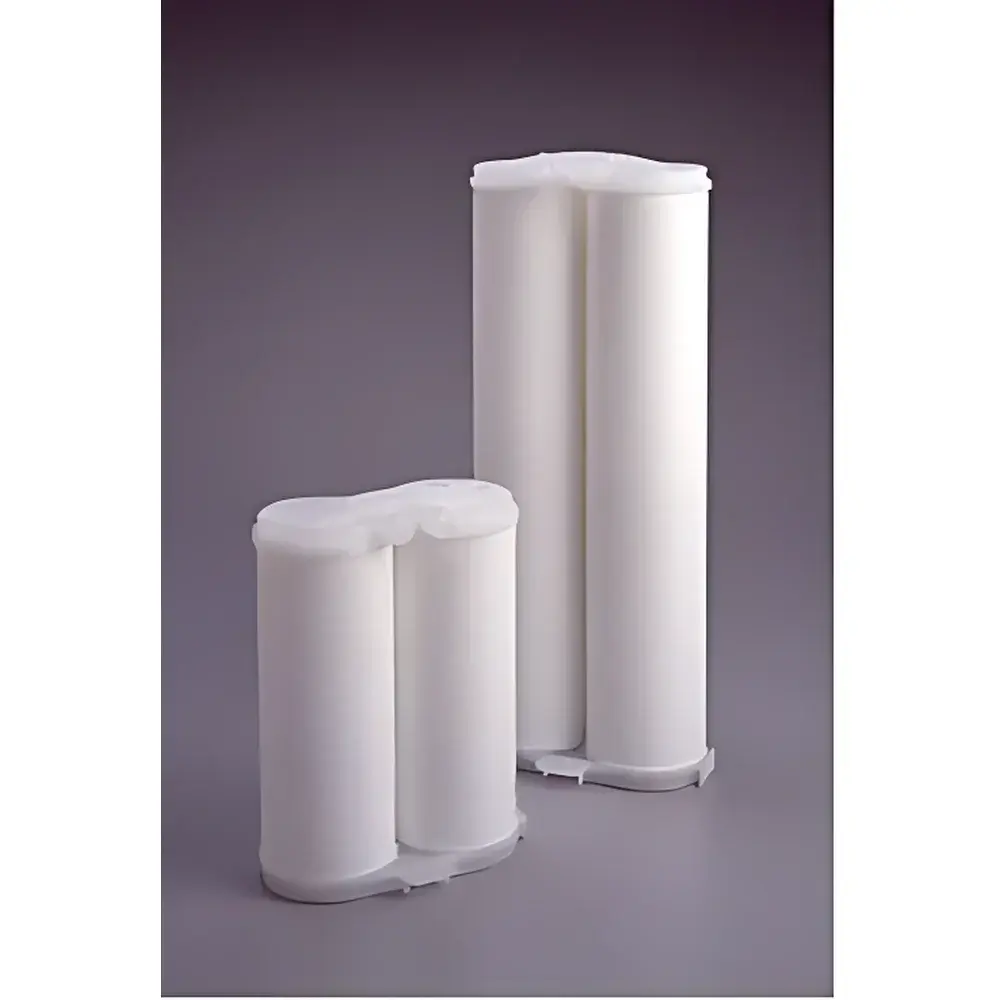
Milli-Q Progard Pre-Treatment Cartridge
| Brand | Milli-Q |
|---|---|
| Origin | France |
| Manufacturer | Merck KGaA |
| Product Type | Imported Pre-Filter Cartridge for Ultra-Pure Water Systems |
| Model | Milli-Q Progard |
| Feed Water Compatibility | Municipal Tap Water |
| Resistivity of Treated Water | ≥5 MΩ·cm @ 25°C |
| Heavy Metals & Soluble Silica | <0.1 ppb |
| Total Organic Carbon (TOC) | <5 ppb |
| Microbial Count / Endotoxins | <0.001 EU/mL |
| Particles (>0.1 µm) | <1 particle/mL |
| Recommended Service Life | 6–12 months or up to 30,000 L throughput |
Overview
The Milli-Q Progard Pre-Treatment Cartridge is a certified OEM consumable engineered for integration into Merck’s Milli-Q Elix, RiOs, Integral, and AFS ultra-pure water systems. Designed as the primary pre-filtration stage, it conditions incoming municipal tap water prior to reverse osmosis (RO) and subsequent polishing stages. Its function is not standalone purification but rather robust feedwater conditioning—removing chlorine, hardness ions, particulates, and organic contaminants that would otherwise foul or degrade downstream RO membranes and ion exchange resins. The cartridge operates on multi-modal adsorption, catalytic dechlorination, and ion exchange principles, ensuring consistent feed quality essential for maintaining system longevity, reproducible resistivity ≥5 MΩ·cm, TOC <5 ppb, and endotoxin levels below 0.001 EU/mL in final ultrapure water output.
Key Features
- Activated carbon impregnated with silver nanoparticles to inhibit bacterial colonization and mitigate biofilm formation—critical for minimizing microbial breakthrough and secondary contamination.
- High-molecular-weight low-leaching polymer matrix optimized for adsorption of humic substances, pesticides, and other large organic molecules without introducing extractables into the water stream.
- Catalytic dechlorination media that rapidly converts free chlorine (Cl₂) and chloramines into chloride ions, protecting RO membranes from oxidative degradation.
- Integrated cation exchange resin targeting Ca²⁺ and Mg²⁺ removal—reducing scaling potential and extending RO membrane service intervals.
- Sub-micron depth filtration layer retaining particles >0.1 µm, including colloidal silica and suspended solids, thereby safeguarding downstream components.
- Embedded RFID chip enabling automatic recognition by compatible Milli-Q platforms—validating cartridge authenticity, tracking installation date, and logging usage metrics for preventive maintenance scheduling.
Sample Compatibility & Compliance
The Progard cartridge is validated exclusively for use with Merck Milli-Q Elix (Type II water), RiOs (Type III water), Integral (dual-grade Type I/III), and AFS series systems. It complies with ISO 3696:1987 (Water for analytical laboratory use) and supports adherence to ASTM D1193-20 (Standard Specification for Reagent Water), CLSI EP23-A guidelines for water quality in clinical laboratories, and Good Manufacturing Practice (GMP) requirements for pharmaceutical water systems. While the cartridge itself is not a final-point purification device, its performance directly influences conformance with USP Purified Water and WFI specifications when deployed within validated Milli-Q architectures.
Software & Data Management
When installed in RFID-enabled Milli-Q platforms (e.g., Integral, Elix 300+), the Progard cartridge interfaces with the system’s embedded firmware to log installation timestamp, cumulative volume processed, and remaining service life estimate. This data integrates into the instrument’s audit trail—supporting compliance with FDA 21 CFR Part 11 requirements where electronic records are subject to regulatory review. No external software is required; all diagnostics and alerts appear via the front-panel LCD interface or Merck’s LabManager™ cloud-based monitoring platform (optional subscription). Usage history is exportable in CSV format for internal QA documentation and periodic review per GLP/GMP protocols.
Applications
The Progard cartridge serves as foundational protection across diverse laboratory workflows requiring stable, low-fouling feedwater: routine buffer preparation for HPLC and LC-MS mobile phases; diluent generation for ICP-MS and AA spectroscopy; reagent formulation in molecular biology (e.g., PCR, cell culture media); and calibration standard preparation in environmental and clinical testing labs. Its consistent performance ensures minimal variation in RO rejection rates and reduces unplanned downtime due to membrane replacement—particularly valuable in high-throughput core facilities and regulated manufacturing environments where water system uptime directly impacts assay reproducibility and batch release timelines.
FAQ
What is the maximum recommended throughput for a Progard cartridge?
The cartridge is rated for up to 30,000 liters of municipal tap water under typical European/US feedwater conditions (hardness ≤200 mg/L as CaCO₃, free chlorine ≤2 mg/L, TOC ≤3 mg/L). Actual service life depends on local water quality and daily usage patterns.
Can Progard cartridges be used interchangeably across all Milli-Q models?
No. Physical dimensions, flow path design, and RFID coding vary between Progard 1, 2, 3, S2, TS2, T3, NP2, and TNP2 variants. Only cartridges explicitly listed in the system’s user manual for a given model should be installed.
Does the silver-impregnated carbon pose any risk of metal leaching into purified water?
Independent validation per ISO 10993-12 confirms silver leaching is below detection limits (<0.005 ppb) under normal operating conditions, well within WHO and EU drinking water guideline thresholds.
Is end-user replacement supported without service technician intervention?
Yes—cartridge replacement is a tool-free, front-access procedure guided by on-screen prompts. However, post-replacement system recalibration and performance verification (e.g., resistivity, TOC) are mandatory before resuming critical applications.
How does Progard contribute to total cost of ownership (TCO) reduction?
By extending RO membrane life by an average of 40–60% and reducing frequency of polishing cartridge changes, Progard lowers annual consumables expenditure and minimizes labor associated with unscheduled maintenance interventions.



