
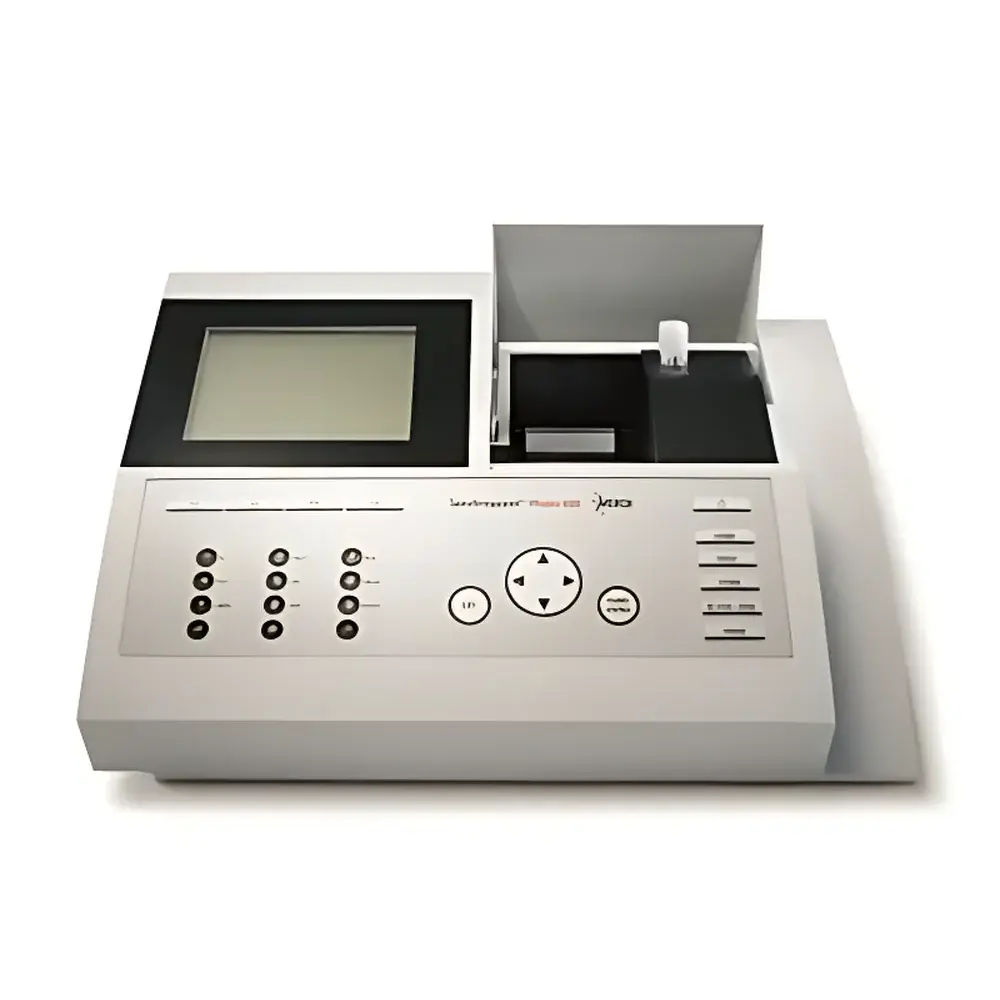
Merck Spectroquant® Pharo 300 UV-Vis Spectrophotometer
| Brand | Merck |
|---|---|
| Origin | Germany |
| Manufacturer Type | Original Equipment Manufacturer (OEM) |
| Product Category | Imported Instrument |
| Model | Pharo 300 |
| Optical Design | Single-beam |
| Detector | Photodiode Array (PDA) |
| Wavelength Range | 190–1100 nm |
| Light Source | Xenon Flash Lamp |
| Spectral Bandwidth | 4 nm |
| Wavelength Resolution | 1 nm |
| Wavelength Accuracy | ±1 nm |
| Absorbance Range | ±3.3 A |
| Absorbance Resolution | 0.001 A |
| Absorbance Accuracy | ±0.003 A (for A < 0.600 A) |
| Cuvette Types | 16 mm round, 10/20/50 mm square (auto-recognized) |
| Scan Increment | 1 nm |
| Data Storage | 1000 measurement results + 4 MB for spectral/dynamic data (e.g., 100 scans or 400 kinetics curves) |
| Compliance | DIN, US EPA certified methods |
Overview
The Merck Spectroquant® Pharo 300 UV-Vis Spectrophotometer is a high-precision, single-beam spectrophotometric platform engineered for routine and regulatory-compliant water and wastewater analysis in environmental, municipal, and industrial laboratories. Based on stable xenon flash lamp illumination and photodiode array detection, the instrument delivers rapid, reproducible absorbance measurements across the ultraviolet and visible spectrum (190–1100 nm). Its optical architecture employs a fixed-path, stabilized single-beam design—optimized for robustness, minimal drift, and low maintenance—while maintaining rigorous wavelength fidelity (±1 nm accuracy) and high photometric resolution (0.001 A). Unlike scanning monochromator-based systems, the Pharo 300 utilizes discrete wavelength selection via software-controlled PDA readout, enabling instantaneous multi-point acquisition without mechanical movement, thereby enhancing long-term stability and reducing calibration frequency.
Key Features
- Integrated AQA (Analytical Quality Assurance) framework with three hierarchical verification levels: AQA 1 (wavelength validation using PhotoCheck or CertiPUR® UV/VIS standards), AQA 2 (system performance verification with CombiCheck or CertiPUR® reference solutions), and AQA 3 (matrix interference assessment via MatrixCheck functionality).
- Auto-recognizing cuvette detection for 16 mm round and 10/20/50 mm square cells—ensuring automatic range optimization and eliminating manual pathlength input errors.
- Barcode-driven workflow: Full compatibility with Spectroquant® pre-filled test kits and economical reagent packs; all methods—including blank subtraction—are pre-programmed and executed automatically upon barcode scan.
- GLP-compliant data handling: Built-in audit trail, user access control, electronic signature support (via optional PC software), and 21 CFR Part 11–ready export capabilities for regulated environments.
- Onboard method library: Preloaded with over 170 validated analytical procedures covering >50 parameters (e.g., COD, nitrate, phosphate, heavy metals) compliant with DIN 38404, DIN EN ISO 15306, and U.S. EPA Methods 4500 series.
- Expandable application scope: Supports custom method development (up to 100 user-defined concentration programs and 20 kinetic or spectral scan protocols), full-wavelength scanning (1 nm increment), multi-wavelength quantification, and time-resolved kinetics—functioning equivalently to a general-purpose laboratory UV-Vis spectrophotometer.
Sample Compatibility & Compliance
The Pharo 300 accommodates standard aqueous environmental samples—including raw water, drinking water, wastewater effluents, and digested sludge extracts—without modification. Its optical path design minimizes stray light and scattering artifacts common in turbid matrices, while the AQA 3 MatrixCheck protocol provides objective, algorithmic evaluation of spectral interferences (e.g., color quenching, particulate scatter, or overlapping analyte peaks). All factory-loaded methods are traceably validated against national and international reference materials and have undergone third-party certification per DIN and U.S. EPA guidelines. The instrument meets IP31 ingress protection requirements and includes spill containment channels and cuvette breakage safeguards—critical for unattended operation in field-deployable or shared lab settings. Regulatory documentation—including IQ/OQ templates, calibration certificates, and AQA validation reports—is provided with each unit to support GxP audits.
Software & Data Management
Data acquisition, processing, and reporting are managed through the embedded graphical interface (available in English, German, Spanish, French, Italian, and Simplified Chinese) and optionally extended via Merck’s PC-based Spectroquant® Method Manager software. The instrument stores up to 1000 individual measurement records locally, plus 4 MB of non-volatile memory dedicated to spectral datasets (e.g., 100 full-scan spectra from 300–900 nm) and kinetic traces (400 curves × 150 data points each). All data—including timestamps, operator IDs, cuvette IDs, and AQA verification logs—are exportable in CSV or PDF format via USB-A port or RS-232 serial connection. Firmware and method updates are delivered free-of-charge via USB drive or network-connected PC, ensuring sustained compliance with evolving regulatory requirements without hardware replacement.
Applications
- Regulatory environmental monitoring: Routine compliance testing for drinking water (DIN EN ISO 5667-3), wastewater discharge (EU Urban Wastewater Directive), and industrial process streams.
- Method development and validation: Custom curve generation for emerging contaminants, enzyme kinetics, or ligand-binding assays requiring precise absorbance tracking at multiple wavelengths.
- Quality control in water treatment plants: Rapid verification of coagulant dosing, disinfectant residual (e.g., chlorine, ozone), and nutrient removal efficiency (N, P).
- Educational and research labs: Teaching spectroscopic principles, Beer-Lambert law validation, and comparative method studies under controlled GLP conditions.
- Field-deployable analysis: Optional battery pack and automotive power adapter enable off-grid operation during emergency response or remote site surveys—maintaining full metrological integrity.
FAQ
Does the Pharo 300 support 21 CFR Part 11 compliance?
Yes—when used with Spectroquant® Method Manager software and configured with user authentication, electronic signatures, and audit-trail logging, the system satisfies core 21 CFR Part 11 requirements for electronic records and signatures in regulated laboratories.
Can I use non-Merck reagents or custom cuvettes?
The instrument accepts any standard 10/20/50 mm square or 16 mm round cuvette. While barcode recognition and auto-blank subtraction are optimized for Spectroquant® kits, manual method creation allows full flexibility for third-party reagents and non-standard protocols.
What is the typical warm-up time and recalibration interval?
No warm-up is required—the xenon flash lamp operates instantaneously. Wavelength calibration is verified daily via AQA 1; photometric calibration is recommended before each analytical batch using CertiPUR® standards per ISO/IEC 17025 guidance.
Is the 190–2600 nm range specified in marketing materials technically accurate for this model?
No—the Pharo 300 is physically equipped with a UV-Vis PDA detector covering 190–1100 nm. The 2600 nm figure refers to legacy NIR-capable variants (e.g., Pharo 300 NIR); this configuration is strictly UV-Vis.
How does the instrument handle highly colored or turbid samples?
MatrixCheck (AQA 3) performs automated spectral deviation analysis against reference spectra; users receive actionable flags indicating potential interference, prompting dilution, filtration, or alternative wavelength selection—documented within the audit trail.




