
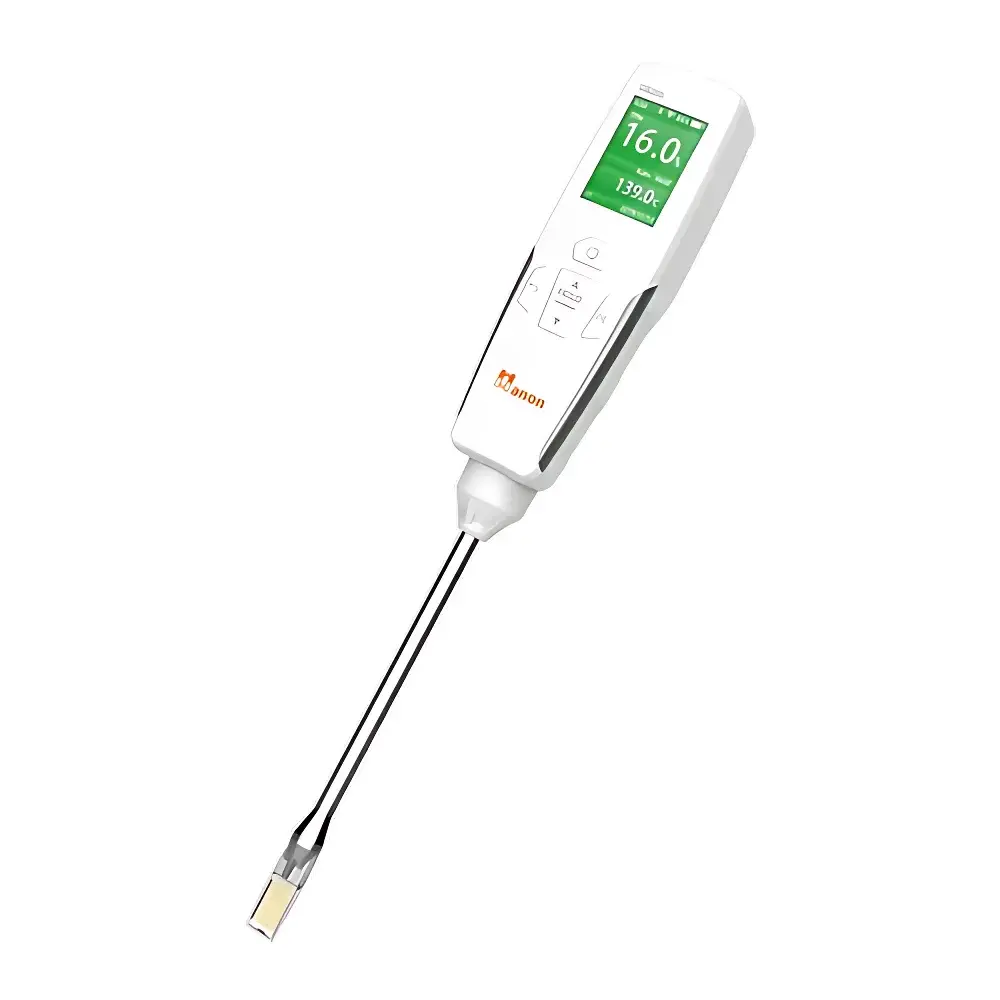
Hanon OS280 Edible Oil Quality Analyzer
| Brand | Hanon |
|---|---|
| Origin | Shandong, China |
| Manufacturer Type | Authorized Distributor |
| Origin Category | Domestic (China) |
| Model | OS280 |
| Pricing | Upon Request |
| Measurement Principle | Capacitive Sensing of Total Polar Materials (TPM) |
| Temperature Range | 0–200 °C |
| Temperature Resolution | 0.1 °C |
| Temperature Accuracy | ±1 °C |
| TPM Range | 0–50% |
| TPM Accuracy | ±2% TPM |
| TPM Resolution | 0.1% |
| TPM Response Time | <10 s |
| Temperature Sensor | PTC |
| TPM Sensor | Patented Capacitive Sensor (Patent No.: ZL201310243911.2) |
| Display | Color LCD with Chinese UI |
| Operating Temp. | 0–50 °C |
| Storage Temp. | −40–70 °C |
| Enclosure Material | ABS Engineering Plastic |
| Probe Material | Food-Grade Stainless Steel (316) |
| IP Rating | IP65 |
| Power | Two AA Alkaline Batteries (1.5 V each) |
| Data Storage Capacity | 10,000 Records |
| Weight (with protective probe cap) | 218 g |
| Wireless Connectivity | Wi-Fi & Bluetooth |
| Probe Design | Quick-Release Modular Probe |
Overview
The Hanon OS280 Edible Oil Quality Analyzer is a field-deployable, non-destructive instrument engineered for rapid, on-site quantification of Total Polar Materials (TPM) in frying oils and edible fats. It operates on a validated capacitive sensing principle, where changes in dielectric permittivity—directly correlated with the accumulation of polar degradation compounds (e.g., free fatty acids, oxidized triglycerides, polymerized species)—are measured in real time. Unlike classical laboratory-based methods such as AOCS Cd 18-90 or ISO 8534, which require solvent extraction, column chromatography, and gravimetric analysis, the OS280 eliminates reagent use, sample preparation, and analytical delays. Its design conforms to the regulatory threshold defined in GB 2716–2018 Food Safety National Standard – Vegetable Oils, which mandates that TPM content in frying oils must not exceed 27% (w/w) to ensure consumer safety and compliance with food hygiene requirements.
Key Features
- Real-time TPM quantification: Delivers results in under 10 seconds at operating temperatures up to 200 °C—enabling in-situ monitoring during active frying without oil cooling or sampling interruption.
- Patented dual-sensor architecture: Integrates a precision PTC temperature sensor and a proprietary capacitive TPM transducer (ZL201310243911.2), calibrated against reference oils traceable to NIST-traceable standards.
- Robust field-grade construction: IP65-rated enclosure and food-grade 316 stainless steel probe withstand thermal shock, grease adhesion, and repeated cleaning cycles in commercial kitchens and inspection environments.
- Intuitive color interface: High-contrast TFT display with localized Chinese menu navigation, real-time trend graphs, timestamped measurement logging, and visual status indicators (green/orange/red LED feedback aligned with GB 2716 thresholds).
- Wireless data integrity: Supports encrypted Bluetooth 5.0 and IEEE 802.11n Wi-Fi for secure transfer of measurement records—including TPM value, temperature, date/time stamp, and operator ID—to LIMS or cloud-based audit platforms.
- Extended operational autonomy: Dual AA alkaline battery configuration enables >8 hours of continuous use; quick-release probe facilitates rapid replacement, calibration verification, and cross-contamination mitigation.
Sample Compatibility & Compliance
The OS280 is validated for use across common frying media including soybean oil, palm olein, sunflower oil, canola oil, peanut oil, and blended frying fats. It maintains accuracy across viscosity ranges typical of fresh to heavily degraded oils (10–120 mPa·s at 50 °C). The device meets functional requirements outlined in ISO/IEC 17025:2017 for field instruments used in food safety screening and supports GLP-aligned documentation workflows. While not a certified reference method per se, its performance has been verified against interlaboratory round-robin studies conducted by provincial CDCs and grain quality supervision centers in accordance with CNAS-CL01:2018. Data export logs include digital signatures and immutable timestamps compliant with basic 21 CFR Part 11 readiness for internal QA audits.
Software & Data Management
Measurements are stored locally in non-volatile memory (10,000-record capacity) with automatic overwrite protection for critical batches. The embedded firmware supports CSV export via USB-C or wireless sync to the Hanon SmartOil Manager desktop application (Windows/macOS). This software enables batch-level statistical analysis (mean TPM, standard deviation, drift trending), PDF report generation with QR-coded traceability, and configurable alert thresholds aligned with jurisdiction-specific limits (e.g., 24% for EU pre-screening, 27% for GB 2716 enforcement). All data files contain embedded metadata: probe serial number, firmware revision, calibration due date, and environmental ambient temperature—ensuring full chain-of-custody transparency.
Applications
- Routine quality control in fast-food chains, school cafeterias, and catering services performing daily TPM checks prior to oil discard decisions.
- Regulatory field inspections by municipal food safety bureaus conducting unannounced audits of frying oil turnover practices.
- Process optimization in snack food manufacturing facilities, where TPM trends correlate with product shelf-life stability and acrylamide formation potential.
- Preliminary screening in QC laboratories to triage samples for confirmatory GC-MS or FTIR analysis—reducing lab workload by >60%.
- Training and education in food science programs, providing students hands-on experience with rapid fat degradation metrics aligned with national curriculum standards.
FAQ
Does the OS280 require calibration before each use?
No. Factory calibration is stable for 12 months under normal operating conditions. A two-point verification (fresh oil / aged oil reference) is recommended weekly using supplied check standards.
Can the probe be immersed in hot oil continuously?
Yes. The probe is rated for continuous immersion at ≤200 °C; however, prolonged exposure above 180 °C may accelerate sensor drift—limit dwell time to <30 seconds per measurement for optimal longevity.
Is the device suitable for testing animal-derived frying fats (e.g., lard, tallow)?
Yes. Validation data confirms consistent TPM response across saturated and unsaturated lipid matrices, though users should establish matrix-specific correlation curves when switching between plant and animal fats.
How is data security handled during wireless transmission?
All Wi-Fi and Bluetooth sessions employ TLS 1.2 encryption; device pairing requires manual approval, and no credentials are stored on the instrument—complying with ISO/IEC 27001-aligned data handling policies.
What maintenance is required for long-term reliability?
Wipe probe with lint-free cloth after each use; avoid abrasive cleaners. Annual return-to-factory verification is advised for metrological traceability—no user-serviceable internal components exist.




